 Ferndale
 Cordata's Exterior Challenge: A Wet, Mossy, Salt-Tinged Climate
Cordata sits in the north Whatcom County corridor near Ferndale and Bellingham, close enough to Bellingham Bay and the Strait of Georgia that salt-laden air is a real factor for anything mounted on the outside of a house. Add in the driving, wind-pushed rain that rolls off the Pacific through the fall and winter, and a moss season that can stretch from October well into spring under the region's tree cover and cloud ceiling, and you have three separate stressors working on a home's exterior at the same time. None of them is dramatic on its own. Together, over ten or fifteen years, they are exactly what wears out siding, roofing, and trim that wasn't built or installed for this specific climate.
Homes in and around Cordata tend to sit under a mix of open sky and mature tree canopy, with plenty of shaded north- and west-facing walls that stay damp far longer after a storm than a south-facing wall in full sun. That uneven drying is the root cause of most of the exterior problems we get called out for in this area.
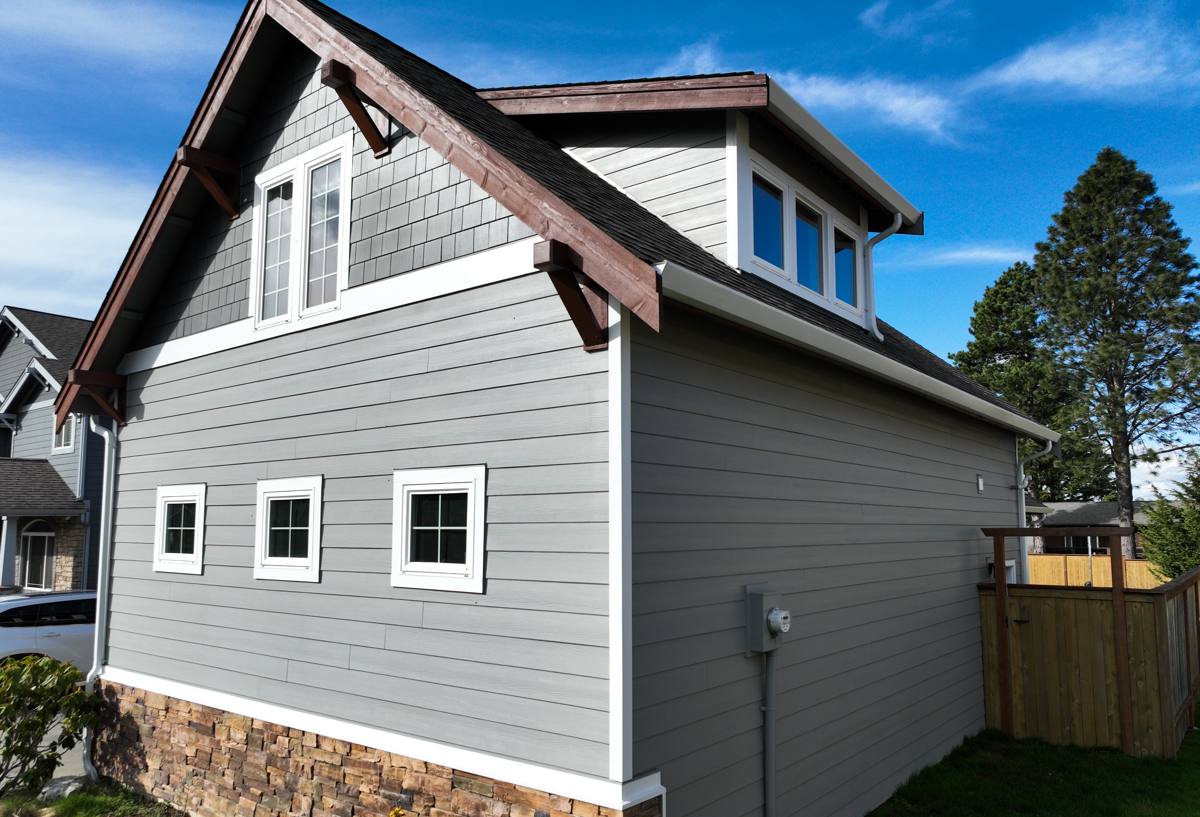
What Driving Rain and Salt Air Actually Do to a House
Wind-Driven Rain
Whatcom County storms rarely fall straight down. Wind pushes rain sideways into wall assemblies, siding laps, and window and door trim. Any material that isn't dimensionally stable, or any installation that skimps on flashing and proper lap coverage, gives that water a path inward. Once moisture gets behind siding, it doesn't leave quickly in a climate this humid and overcast — it sits, and it works on whatever it's touching.
Salt Air
Proximity to Bellingham Bay and the Strait means airborne salt is a low-grade but constant presence. Salt accelerates corrosion of exposed fasteners and metal flashing, and it can contribute to the breakdown of finishes that aren't engineered to hold up in a marine-influenced environment. It's a slower process than storm damage, but it's cumulative and it doesn't take a break in the summer.
Moss and Prolonged Dampness
Long moss seasons mean organic growth gets a real foothold on shaded siding, roof surfaces, and anywhere water sits or drains slowly. Moss holds moisture against the surface it's growing on, which is a problem for wood-based products in particular, and it's a maintenance headache on any siding that isn't easy to clean without damaging the finish.
Why We Only Install James Hardie Siding in This Climate
We install James Hardie fiber cement siding exclusively — we don't offer vinyl, LP SmartSide, Cemplank, Allura, primed spruce, or cedar. That's not a marketing position; it's a decision we made after weighing how each of those products actually performs against Whatcom County's combination of driving rain, salt air, and moss.
Wood-based siding, including primed spruce and cedar, looks good on day one, but wood is organic material in a climate that stays damp for months at a time. It needs consistent maintenance — recoating, caulking, moisture checks — to avoid rot, and shaded walls in areas like Cordata are exactly where that maintenance burden shows up worst. Engineered wood products like LP SmartSide improve on raw wood's moisture resistance but are still wood-fiber based, meaning edge sealing and joint maintenance stay important over the life of the product. Vinyl is low-maintenance and inexpensive, but it's a thin material that can warp, fade, and crack with age, and its seams and profile depend heavily on installation quality to shed wind-driven rain. Other fiber cement brands like Cemplank and Allura are chemically similar to Hardie, but we've standardized on Hardie specifically for its ColorPlus factory-baked finish, its HZ5 product engineering for wet Pacific Northwest climates, and the depth of its transferable warranty when installed to spec.
James Hardie fiber cement is non-combustible, dimensionally stable in wet-dry cycling, and holds a factory finish that's built to resist fading and moisture intrusion far longer than a field-applied paint job. For a climate that punishes anything less than that, it's the product we're willing to put our name behind.
James Hardie Product Lines We Work With
- HardiePlank lap siding — the most common choice for full re-sides, available in several textures and exposures
- HardiePanel — vertical panel siding, often used for accents or modern-style facades
- HardieShingle — shingle-profile siding for homes wanting a traditional Pacific Northwest look without the maintenance of real wood shingles
- HardieTrim — matched trim boards for a consistent, factory-finished look around windows, doors, and corners
Common Problems We Find on Cordata-Area Homes
| What We Find | Likely Cause | Why It Matters |
|---|---|---|
| Soft or delaminating siding on shaded walls | Wood-based siding holding moisture in low-sun areas | Left alone, leads to rot and sheathing damage |
| Moss buildup at siding laps and roof valleys | Long wet season, shade from tree canopy | Traps moisture against surfaces, accelerates wear |
| Corroded or streaking fasteners and flashing | Salt-air exposure on lower-grade metal | Weakens the water-shedding system over time |
| Cracked or warped vinyl panels | Age and wind-driven rain working at seams | Compromised seams let water behind the wall |
| Peeling paint on trim and fascia | Field-applied finish breaking down in constant humidity | Exposes underlying wood to the same moisture problem |
Beyond Siding: Roofing, Windows, and Decks in the Same Climate
The same conditions that wear out siding — driving rain, salt air, moss — work on the rest of a home's exterior too, which is why we handle roofing, windows, and decks alongside siding rather than treating them as separate problems.
Roofing
Roof valleys and north-facing slopes in Cordata's tree-shaded lots are prone to the same moss growth that affects siding, and moss on a roof holds water against shingles and can work its way under flashing over time. Proper ventilation and moss-resistant materials matter more here than in a drier climate.
Windows
Window flashing and sealant are a common failure point during wind-driven rain events. Old or poorly flashed windows are one of the more frequent sources of hidden water intrusion we find when we open up a wall during a siding project.
Decks
Decks take the moss-and-moisture combination worst of all, since horizontal surfaces hold standing water directly. Material choice and proper drainage/spacing matter as much as the framing underneath.
Why a Local Crew Matters for a Neighborhood Like This
A crew that works this specific stretch of Whatcom County day in and day out has already seen how a given wall orientation, tree cover pattern, and exposure to weather off the Bay plays out over years, not just how a spec sheet describes it. That translates into practical decisions on site — where to pay extra attention to flashing, which walls need the most careful moisture management, how to sequence work around a wet forecast. It also means someone is local if a warranty question or a maintenance question comes up years down the road, rather than a crew that did one job in the area and moved on.
What Correct Installation Looks Like
James Hardie siding performs the way it's rated to perform only when it's installed to the manufacturer's specifications. In a climate like this one, a few details matter more than most:
- Proper weather-resistive barrier and flashing integration behind every seam, window, and door
- Correct lap exposure and fastening pattern for the specific Hardie product being used
- Caulking and sealing at joints using products rated for the assembly, not general-purpose sealant
- Attention to clearance at grade and any horizontal surfaces (decks, porches) where splash-back and standing moisture are a risk
- Ventilation behind the siding to let any incidental moisture dry out rather than sit
Skipping any of these doesn't show up as a problem in year one. It shows up in year five or eight, usually on the shaded, weather-exposed side of the house — which is exactly where Cordata's tree cover and orientation make it most likely.
Maintenance Once It's Installed
One of the practical advantages of factory-finished fiber cement in this climate is how little upkeep it needs compared to wood or a field-painted surface. A periodic rinse to keep moss and organic buildup from taking hold, an occasional check of caulking at joints and trim, and attention to anything growing directly against the siding (vegetation held tight to a wall stays damp longer) covers most of what's needed. That's a meaningfully lighter maintenance load than a product that needs recoating or edge-sealing on a schedule.
Choosing a Contractor for This Kind of Work
- Ask specifically how they detail flashing around windows, doors, and butt joints — this is where most water intrusion problems start
- Confirm they're a certified or experienced Hardie installer, since factory warranty coverage depends on installation meeting manufacturer standards
- Ask how they sequence work around this area's wet season, not just whether they "can work in the rain"
- Get a clear explanation of what's covered under the material warranty versus the workmanship warranty
- Look for a crew that can speak to roofing, windows, and decks together, since problems in one area often trace back to another
If you're weighing a siding project on a Cordata-area home, we're glad to take a look and talk through what your specific walls and exposure are dealing with. Reach out for a free, no-pressure estimate using the form below.