 Ferndale
 Exterior Work Built for Lynden's Climate
Lynden sits in the northern part of Whatcom County, close enough to the Nooksack River valley and the open farmland around it that homes here take on a specific kind of weather punishment. It's not dramatic, storm-of-the-century stuff — it's the slow, steady kind. Marine air off the Salish Sea keeps things damp for most of the year, rain falls in long soaking stretches rather than short downpours, and there's enough humidity lingering in the yard and against north-facing walls to keep moss and algae in business nearly year-round. Add in the occasional cold snap that blows in from the Fraser Valley to the north during winter, and you've got a climate that's hard on paint, hard on caulk, and eventually hard on whatever material is standing between your framing and the outside world.
None of this is unique to any one street or subdivision in Lynden — it's the reality for exteriors across this part of Whatcom County. What matters is choosing materials and installation practices that are actually built for it, rather than materials that happen to look fine in a showroom and start showing their age within a few wet seasons.
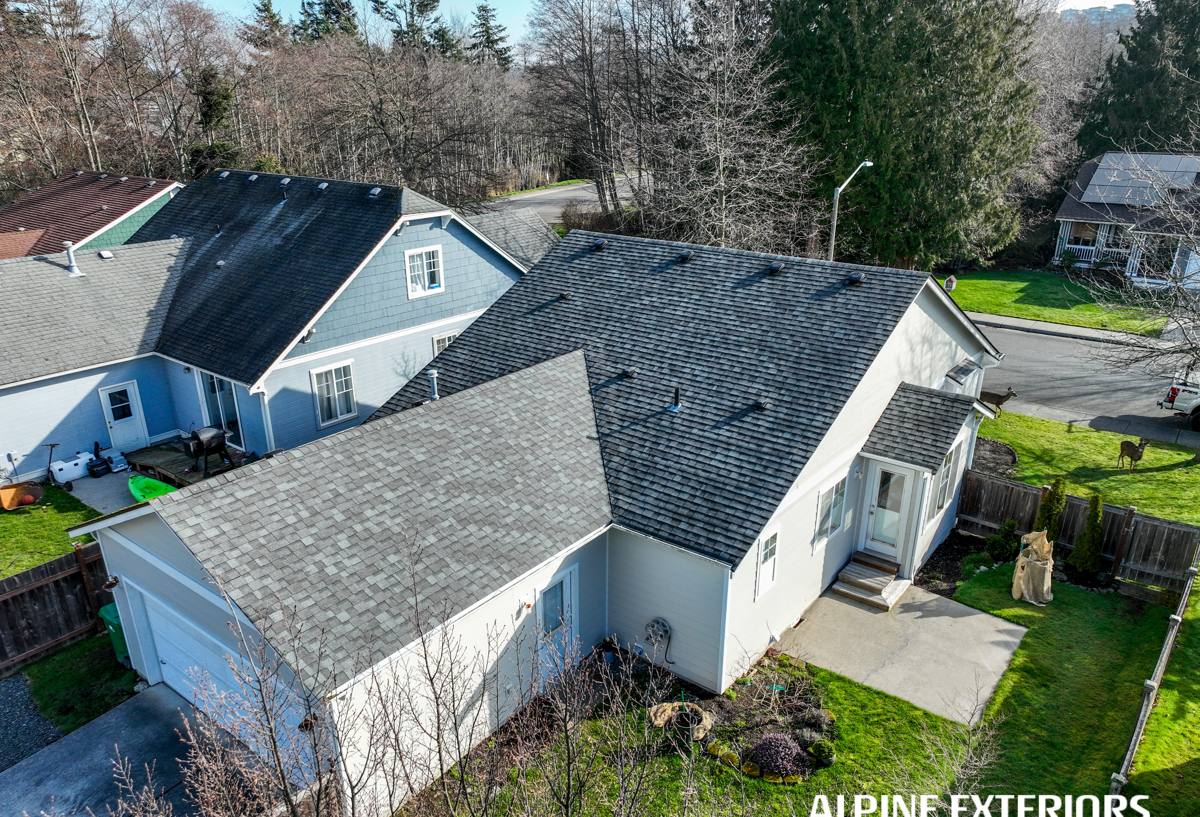
What Whatcom County Weather Does to a House
Moisture That Doesn't Let Up
Western Washington doesn't get the heaviest annual rainfall in the state, but it gets some of the most persistent — long gray stretches where siding, trim, and fascia stay damp for days at a time. Materials that absorb water or that rely on a perfect, unbroken paint film to stay sealed are working overtime here. Any gap, any hairline crack in the finish, any spot where caulk has started to pull away, becomes an entry point.
Moss, Algae, and Shaded Walls
Lynden's mix of open agricultural land and mature trees around older properties means plenty of shaded, slow-drying wall sections — the kind where moss and green algae take hold fastest. On some materials that's mostly a cosmetic problem that a soft wash handles. On others, it's a sign that moisture is being held against the substrate longer than it should be, which shortens the material's working life.
Wind and Temperature Swings
Most of the year is mild, but Whatcom County is exposed to occasional outflow wind events and cold snaps that push in from the north. Materials and fasteners that flex, expand, and contract with those swings need to be installed with the right clearances and the right fastener pattern — done wrong, that's where cracking and popped nails show up first.
Why We Standardized on One Siding Product
We install James Hardie fiber cement siding exclusively. We don't install vinyl, LP SmartSide, primed spruce, cedar, or other fiber cement brands like Allura or Cemplank. That's a deliberate call, not a sales pitch, and it's worth explaining honestly.
Every one of those alternatives has legitimate strengths — cost, appearance, or ease of installation. But in a climate like Whatcom County's, the trade-offs that come with them (moisture sensitivity at cut edges, paint film that fails faster under UV and damp cycles, or maintenance schedules that most homeowners underestimate when they buy) are the kind of thing that shows up as a callback five or ten years down the road. We got tired of watching good products fail for climate reasons rather than workmanship reasons, so we picked one system, learned it thoroughly, and stand behind it.
What James Hardie Gets Right for This Region
- Non-combustible core — fiber cement doesn't feed a fire the way wood-based products can, which matters for insurance conversations as much as safety.
- Engineered for moisture, not just painted against it — the HZ5 product line is formulated for the freeze-thaw and wet-dry cycling typical of the Pacific Northwest.
- ColorPlus factory finish — baked-on color that resists fading and chipping far longer than field-applied paint, which matters when your siding spends most of the year damp.
- Doesn't rot, and won't feed moss the way wood substrates can — surface growth can still occur and needs occasional washing, but it isn't degrading the board underneath.
- Strong transferable warranty — useful if you plan to sell within the ownership window, and a sign of how the manufacturer expects the product to perform long-term.
We're not going to tell you every other product is junk — that's not honest and it's not our call to make about a competitor's material. What we will tell you is that after years of exterior work in this specific climate, this is the system we trust enough to put our name behind, and it's the only one we install.
Siding, Roofing, Windows, and Decks — One Crew, One Standard
Most homes eventually need more than one exterior system addressed, and it's rarely efficient to bring in four separate contractors on four separate timelines. We handle siding, roofing, windows, and decks, which means the flashing details where a roofline meets a wall, or where a window opening meets new siding, are handled by one crew working to one standard — not handed off between companies who've never seen each other's work.
Roofing
A roof in poor condition undermines even the best siding job — water finds its way down behind fascia and into wall assemblies from the top first. We evaluate roof condition as part of any siding estimate, because ignoring it just moves the problem.
Windows
Old or poorly flashed windows are one of the most common sources of hidden water intrusion behind siding. Replacing siding around windows that leak is a short-term fix; we address both together when it makes sense.
Decks
Outdoor living space takes the same weather beating as your walls, just horizontally, which means standing water is a bigger risk than on a vertical wall. We build and repair decks with drainage and material choices suited to the same wet climate driving our siding standards.
Cost Factors for Whatcom County Homeowners
Every property is different, and we don't quote sight-unseen — but these are the factors that most commonly move the number up or down on a siding project in this area.
| Factor | Why It Matters Here |
|---|---|
| Existing siding removal | Older wood or vinyl siding with hidden moisture damage adds sheathing repair costs before new siding goes on |
| Home size and wall complexity | Gables, dormers, and multiple stories increase labor and material cutting |
| Trim and finish level | Smooth vs. cedar-textured panels, trim board profiles, and corner details all affect material cost |
| Moisture damage found during tear-off | Common on older Whatcom County homes with wood siding — sheathing or framing repair is priced once it's exposed |
| Access and site conditions | Rural lots, fencing, or landscaping close to the house can add setup time |
What Correct Installation Actually Involves
Fiber cement siding performs the way it's rated to perform only when it's installed to the manufacturer's specifications — and this is where a lot of the horror stories about "bad siding" actually originate, regardless of brand.
- Proper weather-resistive barrier and flashing sequencing behind every board
- Correct fastener type, spacing, and penetration depth — Hardie is unforgiving of shortcuts here
- Butt joints and corners sealed and caulked per spec, not just for looks
- Clearances maintained at grade, roofline, and decking to avoid trapping moisture
- Factory-cut edges sealed where field cuts expose the substrate
A crew that's installed hundreds of squares of Hardie in this exact climate catches the details that a generalist crew, installing it for the first or second time, is more likely to miss.
Why a Local Crew Matters
A contractor based in and around Ferndale who regularly works Whatcom County jobs has already seen how a given wall orientation, a given amount of tree cover, or a given exposure to wind off the water behaves over a few winters. That's not something you get from a national franchise rotating crews through the region for a season. It also means warranty and service calls are handled by people who are still local next year, not a call center.
Ready for a Straight Answer on Your Home
If your Lynden-area home has siding that's showing its age — fading paint, soft spots, moss that keeps coming back no matter how often it's washed — we're glad to take a look and give you an honest read on what's driving it and what your options are. Reach out for a free, no-pressure estimate; we'll walk the exterior with you and tell you plainly what we see.