 Ferndale
 Every so often a Ferndale homeowner comes to us with a bid in hand that specs Allura fiber cement siding instead of James Hardie, usually because it landed a little cheaper. It's a fair question to ask why we won't just match that bid and install it. The short answer is that we only install one fiber cement system, and we built that standard around what actually holds up on Whatcom County homes over 20 or 30 years — not around whatever board happens to be on sale that month. Here's the honest version of why Allura doesn't make the cut.
Allura Is Real Fiber Cement, Not a Downgrade
Let's be clear about what Allura is: a legitimate fiber cement product made from portland cement, sand, and cellulose fiber, cured into a rigid board. That puts it in the same material category as James Hardie, not in the category of vinyl or engineered wood. It's non-combustible, it resists the rot and swelling that plague wood siding, and it holds a paint or factory finish far better than most alternatives. Some Allura lap and panel profiles look nearly identical to Hardie's on a spec sheet, and plenty of contractors around the country install it without complaint. This isn't a page about a bad product — it's a page about why a fiber-cement-only contractor still turned down this particular fiber cement brand.
Where the Two Products Actually Diverge
Fiber cement siding is never really "just a board." It's a system: the lap siding, the trim, the soffit, the caulk, and the touch-up paint all have to expand, contract, and weather together for decades without drifting apart in color or fit. James Hardie designs its lap siding, trim, and ColorPlus finish as one coordinated system with a matched caulk and touch-up program sold specifically to keep repairs invisible. Allura sells siding and trim, but the depth of a fully matched system — plus the network of distributors and installers built around it in this specific corner of Washington — is thinner. In practice, that gap shows up as a crew pairing an Allura board with trim from whatever the supply house has in stock, or a touch-up kit that's a close-but-not-exact match after a repair five years down the road. That's not a flaw in the board itself; it's a consequence of a newer, less established regional supply chain compared to the market leader.
Batch and Color Consistency
A related issue that homeowners rarely think about until it bites them: fiber cement color runs and product formulations change over a manufacturer's history. If you ever need a replacement plank after storm damage or a remodel touches one section of wall, you need a supplier who still stocks a genuine match, or a finish system with a well-documented color-matching process. James Hardie's ColorPlus program has enough regional depth and longevity in the Pacific Northwest that matching an older run is a solvable problem more often than not. With a thinner regional footprint, that same problem is more likely to end in a visibly mismatched patch.
Installation Sensitivity Nobody Puts on the Brochure
Fiber cement in general is less forgiving to install correctly than vinyl or wood — it has to be nailed to spec, gapped and caulked correctly at every joint, and flashed properly above every window and door to keep water out of the wall assembly. James Hardie publishes detailed, climate-zone-specific installation requirements (its HardieZone system) that spell out fastener patterns, clearances, and moisture management for a region like ours, and a large share of local crews have built their entire process around that exact spec. That depth of documented, climate-matched installation guidance and the number of installers who've run thousands of linear feet of it here is part of what actually protects a house — a well-designed board installed loosely still leaks. We haven't seen the same weight of climate-specific installation infrastructure built up around Allura in this market, which means more of the outcome rests on a given crew's general fiber cement experience rather than a manufacturer-backed, region-specific spec.
Allura vs. James Hardie, Side by Side
| Factor | Allura Fiber Cement | James Hardie Fiber Cement |
|---|---|---|
| Core material | Cement, sand, cellulose fiber | Cement, sand, cellulose fiber |
| Combustibility | Non-combustible | Non-combustible |
| Climate-specific install spec | General fiber cement guidance | HardieZone HZ5 spec engineered for wet, coastal Pacific Northwest conditions |
| Factory finish | Factory-finish options available; thinner regional touch-up network | ColorPlus baked-on finish with a widely stocked, color-matched caulk and repair kit |
| Trim and accessory match | Not always sourced as one coordinated system in this region | Siding, trim, and soffit engineered and sold as a matched system |
| Local installer base | Fewer Whatcom County crews with deep, repeated experience | Well-established regional installer base |
| Warranty recognition | Manufacturer-backed, less commonly referenced by local lenders and appraisers | Strong transferable warranty, widely recognized in real estate documentation |
| Upfront material cost | Generally lower | Generally higher |
What a Warranty Is Actually Worth
Every fiber cement manufacturer, including Allura, backs its product with a written warranty. We don't dispute that those warranties exist or that they're honored when a claim is filed correctly. What we weigh is what that warranty is actually worth in practice: how many certified local installers can perform a warranty-compliant repair a decade from now, how easily a matching plank or finish can be sourced when something needs replacing, and how familiar local home inspectors and appraisers are with the brand when the house eventually sells. A warranty that's hard to act on locally, or unfamiliar to the professionals who show up at closing, is worth less than one with a long, documented track record in this exact region — and that track record is where Hardie has the deeper bench.
Why Ferndale's Climate Raises the Stakes
Ferndale sits close enough to the water and low enough in the Nooksack valley that siding here takes a real beating over time. Salt air moving in off Bellingham Bay accelerates corrosion on fasteners and speeds up the breakdown of caulk and finish coatings compared to an inland home. Storms rolling through Whatcom County frequently drive rain sideways rather than letting it run straight down a wall, which puts sustained pressure on every seam, joint, and piece of flashing a siding system has. And the mix of tree cover, farmland humidity, and long gray stretches typical of this area feeds a moss season that can run most of the year on shaded, north-facing walls — moss that thrives on any surface holding moisture and organic debris. None of that argues against fiber cement; it argues for fiber cement done exactly right, with a matched system and a documented, climate-specific install spec standing behind it. In an environment that gives a house very little dry season to recover in, we don't want any part of that resting on a thinner regional track record.
What We Install Instead
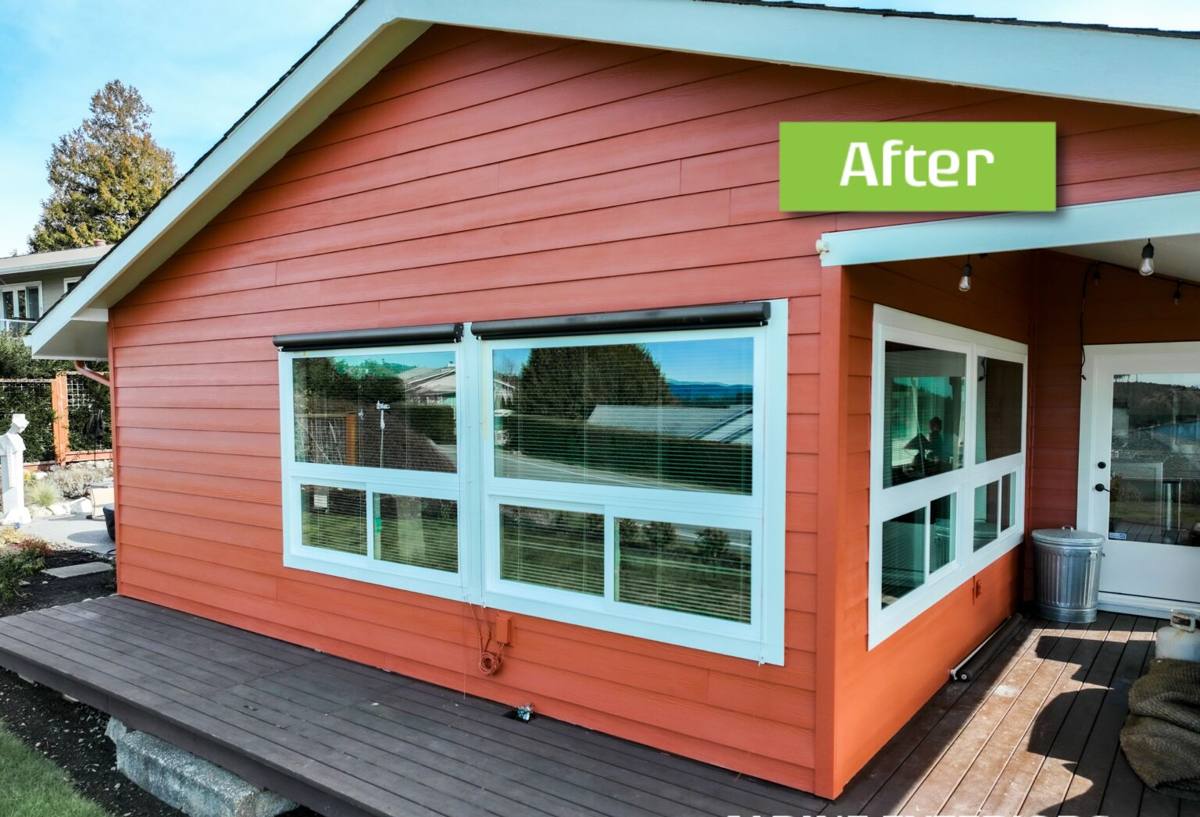
We standardized on James Hardie's HZ5 product line, engineered specifically for regions that deal with sustained moisture and coastal exposure rather than a single generic formulation sold everywhere in the country. Paired with the ColorPlus factory finish, a matched trim and caulk system, and a genuinely deep bench of local installers who run this exact spec week after week, it's the fiber cement system we're comfortable standing behind on a Ferndale home dealing with salt air, driving rain, and a long moss season — not because Allura is defective, but because Hardie's full system has the deepest, most locally proven track record we've found in Whatcom County.
Questions Worth Asking Before You Sign a Fiber Cement Bid
If a bid you're comparing is built around a brand other than Hardie, these questions will tell you more than the price alone:
- Is the trim, soffit, and touch-up paint coming from the same manufacturer as the siding, or is the crew mixing brands based on what's in stock?
- How many jobs has this specific crew completed with this brand, and can they describe how it's held up through a full Whatcom County wet season?
- Is there a documented, climate-specific installation spec for this product, or general fiber cement guidance applied to a coastal Washington home?
- What does the manufacturer's warranty actually require to stay valid, and is that written down anywhere?
- If a plank gets damaged in five years, how easily can an exact color and profile match be sourced locally?
- How familiar are local home inspectors and appraisers with this brand if you sell the house down the road?
Our Standard, Not a Verdict on Allura
We're not telling you that Allura siding is destined to fail on a Ferndale home — it's a genuine fiber cement product, and a crew that knows it well can install it competently. What we're telling you is that after weighing the depth of the matched system, the climate-specific installation documentation, the local installer base, and the warranty track record in this exact climate, we decided one fully coordinated system gives homeowners the most predictable result over decades of salt air, driving rain, and moss pressure. That's a professional standard built around what we've seen actually hold up here, not a claim about what any single Allura job will or won't do.
If you're weighing siding options for a home in Ferndale or anywhere else in Whatcom County, we're glad to take a look at your property, walk through your exposure and current siding condition, and give you a straight answer about what we'd recommend. Reach out for a free, no-pressure estimate.