 Ferndale
 Bellingham's Climate and What It Does to Home Exteriors
Bellingham sits on the shore of Bellingham Bay in Whatcom County, which means homes here deal with a combination of coastal exposure and heavy annual rainfall that few other parts of the country experience together. Salt-laden air moves inland off the bay and settles on siding, trim, and fasteners. Add in a wet season that stretches from fall through spring, and you get exterior materials that are almost never given a real chance to dry out completely before the next system rolls through.
Layer on the tree canopy that shades so many Bellingham streets and yards, and you get a third factor: moss and algae growth. Shaded, damp siding is exactly the environment moss spores need to take hold, and once moss establishes itself on a wall surface, it holds moisture against that surface even longer, compounding the problem it started.
None of this is unusual for the Pacific Northwest, but it does mean that siding decisions made for a drier or less coastal region often don't hold up the same way here. What performs well in Spokane or Boise is not necessarily what should go on a home a few blocks from Bellingham Bay.
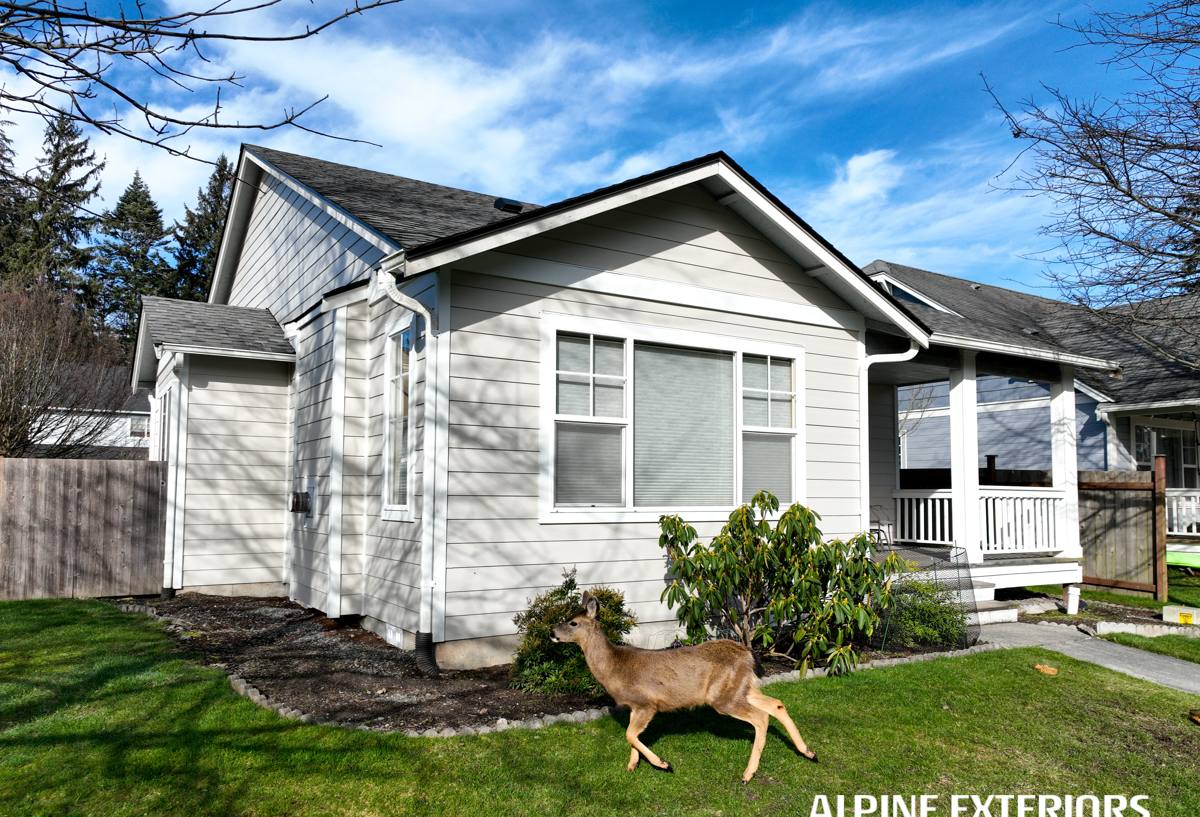
Why Siding Choice Matters More Here Than Most Places
Siding is your home's primary defense against bulk water, wind-driven rain, and constant moisture cycling. In a climate like Bellingham's, that job never really lets up. A siding product that swells, delaminates, or absorbs water when it shouldn't will show problems faster here than it would in a milder or drier market.
We see this play out most with wood-based and wood-composite products. Materials like primed spruce, cedar, and engineered wood siding (LP SmartSide and similar products) rely on factory or field-applied coatings to keep moisture out. Those coatings work as designed for a while, but any breach — a nail hole, a cut edge, a caulk joint that fails — gives water a path into the wood fiber. Once that happens in a climate that rarely gives materials a long dry stretch, swelling, soft spots, and paint failure tend to follow faster than manufacturers' literature suggests.
Vinyl siding avoids the moisture-absorption problem but brings its own trade-offs in a coastal, rain-heavy environment: it can warp or distort with temperature swings, its seams and panels give wind-driven rain more opportunities to get behind the cladding, and its appearance is difficult to upgrade or touch up once it fades. We don't install vinyl for the same reason we don't install engineered wood — we'd rather put one product on a home that we're confident will perform for decades than offer a menu of options with very different long-term outcomes.
James Hardie Fiber Cement: What We Install and Why
We install James Hardie fiber cement siding exclusively. It's a cement, sand, and cellulose fiber composite that doesn't absorb water the way wood-based products do, and it doesn't expand and contract with temperature the way vinyl does. That combination matters directly in a climate defined by salt air and sustained wet weather.
Built for This Region
James Hardie engineers specific product lines (HZ5 and similar climate-zone formulations) for the moisture and temperature patterns of different U.S. regions. The Pacific Northwest's wet, moderate climate is one of the conditions these formulations account for, which is part of why we standardized on this manufacturer rather than a generic fiber cement product.
ColorPlus Factory Finish
Most of what we install uses Hardie's ColorPlus finish — a color baked onto the board at the factory under controlled conditions, rather than painted on site. It resists fading, chipping, and the kind of moisture-related paint failure that shows up on field-painted wood siding after a few wet winters. It also means touch-up, when it's ever needed, uses matched factory-formulated paint rather than a guess at the original color.
Fire Resistance
Fiber cement is non-combustible. That's not the primary reason most Bellingham homeowners choose it, but it's a real difference from wood-based and vinyl siding, and it factors into some insurance conversations.
Warranty
James Hardie backs its siding with a substantial, transferable limited warranty. Because it's transferable, it's also a selling point if you list your home down the road — the coverage doesn't reset to zero the moment ownership changes hands.
The Installation Process for Bellingham Homes
Fiber cement performs the way it's designed to only when it's installed to spec, and installation quality matters even more in a climate that gives water so many chances to find a way in. Our process on Bellingham projects generally includes:
- Inspecting and repairing the existing wall assembly — sheathing, framing, and any hidden moisture damage — before new siding goes up
- Installing a weather-resistant barrier and properly lapped flashing at every window, door, and penetration
- Maintaining correct clearances at grade, roof lines, and decks so siding isn't sitting in standing water or trapped moisture
- Following James Hardie's fastening, gapping, and caulking specifications exactly, since deviating from spec is one of the more common ways fiber cement installations underperform
- Finishing with factory-matched trim and accessories so the whole system — not just the field panels — is built for the same climate
That attention to the wall assembly underneath the siding is often what separates a job that lasts thirty-plus years from one that develops problems in five, especially in a market where the siding rarely gets a long break from moisture.
One Crew for the Whole Exterior Envelope
Siding doesn't work in isolation — it's one part of a home's exterior envelope, working alongside the roof, windows, and any attached structures like decks. We handle all four (siding, roofing, windows, and decks), which matters in a climate like Bellingham's because these systems are constantly interacting at the details that fail first: where siding meets roof flashing, where trim meets a window frame, where a deck ledger attaches to the house.
When one contractor is responsible for how those transitions are built, there's no gap in accountability between "that's the roofer's flashing" and "that's the siding contractor's trim." In a region where wind-driven rain tests every seam and joint, that coordination is a practical advantage, not just a convenience.
Cost Factors for a Bellingham Siding Project
Every home is different, but the variables that move a siding project's cost up or down are fairly consistent. This isn't a quote — it's a guide to what actually drives the number.
| Factor | Why It Matters |
|---|---|
| Home size and wall complexity | More square footage and more corners, gables, and dormers mean more material and labor |
| Existing siding removal | Tear-off and disposal of old siding adds time, especially with wood or vinyl that's failing |
| Underlying wall condition | Rot or moisture damage found once old siding comes off has to be repaired before new siding goes on |
| Trim and detail work | Window and door trim, corner boards, and fascia detailing add labor beyond flat wall panels |
| Color and finish selection | ColorPlus factory finishes vs. field-painted options carry different material costs |
| Site access | Steep lots, tight setbacks, or limited staging area (common on hillside and in-town Bellingham lots) can affect labor time |
Signs Your Bellingham Home Needs New Siding
Because this climate doesn't give exteriors much of a break, siding problems here tend to progress faster than in drier regions once they start. Some signs worth acting on rather than waiting out:
- Soft, spongy, or crumbling spots when you press on the siding surface
- Persistent moss or algae staining that returns quickly after cleaning
- Paint that's peeling, bubbling, or failing in patches rather than evenly with age
- Visible gaps, warping, or buckling in panels, especially after wind events off the bay
- Rising interior heating costs that suggest the wall assembly is no longer insulating or sealing the way it should
- Siding that was installed more than 20-25 years ago and has never been fully inspected
Any one of these on its own might just need a repair. Several together, or a home that's overdue for an inspection, is worth a closer look before another wet season sets in.
Maintenance in a Wet, Mossy Climate
Fiber cement is low-maintenance compared to wood, but "low-maintenance" isn't "no-maintenance" in a climate like this one. A periodic rinse to keep moss and algae from establishing on shaded walls, keeping gutters clear so water isn't sheeting down the siding face, and trimming back vegetation that keeps a wall surface shaded and damp all go a long way toward getting the full lifespan out of the material. None of this is unique to Hardie siding — it's just what any exterior needs in a region with this much sustained moisture.
Why a Local Crew Matters
A crew that works in Whatcom County day in and day out knows what Bellingham's combination of salt air, rainfall, and shade actually does to a wall assembly over time, because we see it on real homes, not just in a manufacturer's spec sheet. That local knowledge shapes decisions on flashing details, product selection, and where extra attention is worth the time — the kind of judgment calls that don't show up in a generic installation manual but make a real difference to how a home holds up here.
If you're weighing a siding replacement, dealing with an aging wood or vinyl exterior, or just want an honest read on where your home stands, we're happy to take a look. Reach out for a free, no-pressure estimate using the form below.