 Ferndale
 Marietta's Exterior Challenge: Water, Salt, and Shade
Marietta sits low and close to the water on the edge of Bellingham Bay, just south of Ferndale in Whatcom County. That location is part of what makes it a beautiful place to live, and it's also exactly why the exteriors on homes here take a beating that inland neighborhoods never see. Salt-laden air drifts in off the bay, driving rain comes in sideways during winter storms, and the tree cover and marine humidity that make the area feel lush also keep siding and trim damp for days at a time. Add in a moss season that can stretch from October well into spring, and you've got a climate that is genuinely hard on exterior building materials.
We've worked on homes throughout this stretch of Whatcom County long enough to know that a siding system that performs fine in a drier, inland part of the state can struggle here. Homeowners in Marietta don't need generic advice about siding — they need a plan that accounts for salt exposure, sustained moisture, and shade patterns specific to this part of the county.
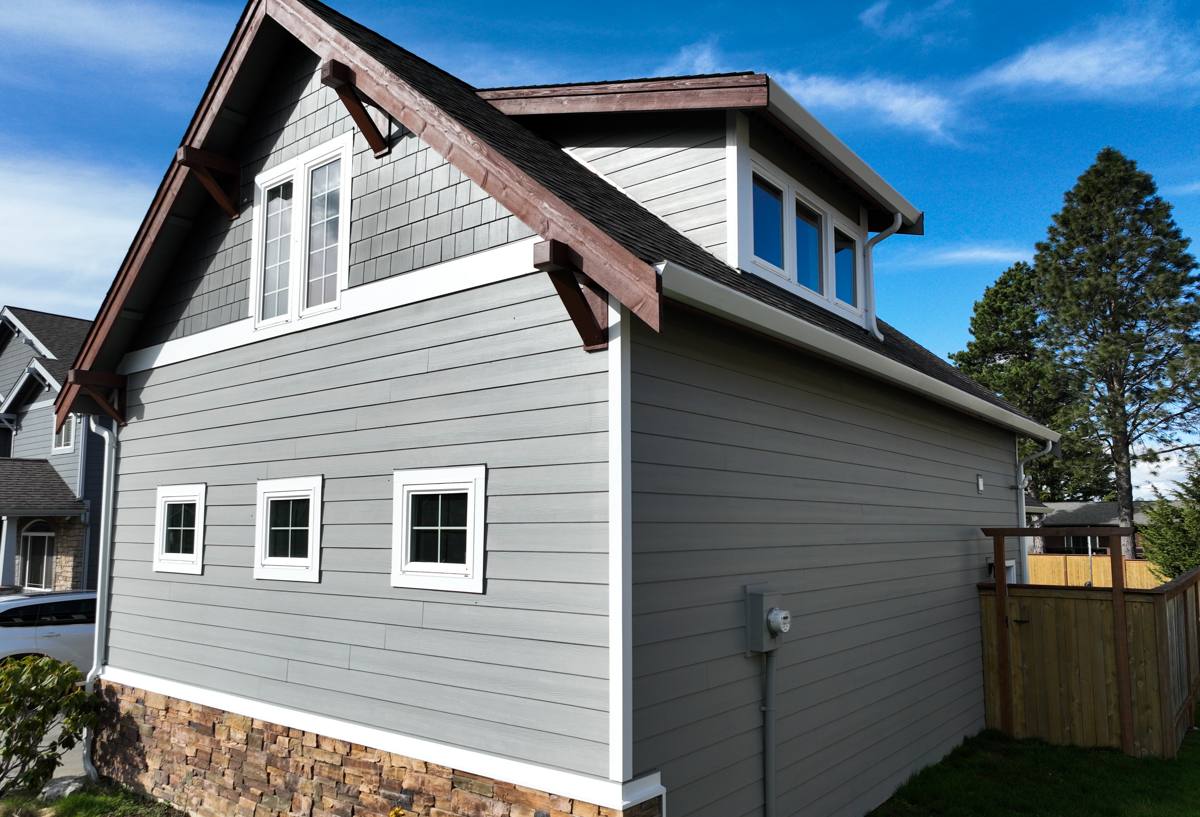
Why Salt Air Matters More Than People Expect
Salt air doesn't just affect boats and metal railings. Airborne salt settles on exterior surfaces and accelerates the breakdown of paint films, corrodes fasteners and metal flashing over time, and can work its way into seams and joints where two materials meet. On wood-based siding products, that salt exposure combines with moisture to speed up rot at the very points — butt joints, corners, bottom edges — where water already wants to collect.
This is one of the reasons we pay close attention to fastener selection and flashing details on every Marietta project, not just the siding panel itself. A siding job is only as good as the metal and hardware behind it, and in a salt-air environment, that hardware needs to be specified correctly the first time.
What Driving Rain Does to a Wall System
Driving rain — rain pushed sideways by wind rather than falling straight down — hits vertical wall surfaces with real force during Whatcom County storms. That means water isn't just landing on top of trim and running off; it's being pushed into laps, seams, and any gap in the water-resistive barrier behind the siding. A wall assembly built for this climate needs correct lap sequencing, properly integrated flashing at windows and doors, and a siding material that doesn't swell or degrade when it takes on repeated moisture exposure.
Moss, Shade, and the Long Wet Season
Marietta's tree cover and proximity to the water mean many homes sit in partial shade for a good part of the day, and shaded, damp surfaces are exactly where moss and algae take hold. On some siding materials, that growth isn't just cosmetic — it holds moisture against the surface and can accelerate deterioration underneath. On others, it's mostly a maintenance nuisance: something you can wash off without it compromising the material underneath.
That distinction matters when you're choosing a product for a Marietta home. A siding material that handles moss and mildew as a surface-level cleaning issue, rather than a structural risk, is going to save you money and stress over a 20- or 30-year ownership period.
Why We Install Only James Hardie Fiber Cement
We made a decision as a company to install James Hardie fiber cement siding exclusively — not vinyl, not LP SmartSide, not cedar, not other fiber cement brands like Cemplank or Allura. That's a deliberate standard, not a default, and it's rooted in exactly the conditions we just described.
- Non-combustible material: Hardie's fiber cement composition doesn't burn, which matters for long-term risk regardless of climate.
- Engineered for the Pacific Northwest: Hardie's HZ5 product line is specifically formulated for climates with sustained moisture and freeze-thaw cycling, which describes Whatcom County well.
- Factory-applied ColorPlus finish: baked-on color resists fading and chipping far better than field-applied paint, which matters when salt air is already working against paint film integrity.
- Moisture behavior: fiber cement doesn't swell, rot, or delaminate the way wood-based products can when they stay damp for extended periods.
- Warranty structure: Hardie backs its products with a strong, transferable warranty, which adds real value if you sell the home down the road.
We want to be fair about this: other siding products aren't scams, and each has situations where it performs reasonably well. Vinyl is inexpensive and low-maintenance in mild climates. Wood-based composite siding can look great when it's new. But in a location like Marietta — salt air, driving rain, heavy shade, long wet seasons — the trade-offs on those products (moisture sensitivity, seam performance, finish longevity) are exactly the trade-offs we're not willing to build a house around. That's why we standardized on Hardie and don't install alternatives.
Comparing Siding Options for a Marietta Home
| Factor | Vinyl Siding | Wood-Based Composite | James Hardie Fiber Cement |
|---|---|---|---|
| Moisture tolerance in high-rain climate | Moderate — can warp under heat/cold cycling | Lower — susceptible to swelling if seals fail | High — engineered for wet climates |
| Salt air / coastal exposure | Fair — can chalk and fade faster | Fair to poor if moisture gets behind panels | Good — factory finish resists fading |
| Fire resistance | Melts/deforms under heat | Combustible | Non-combustible |
| Moss/algae impact | Surface only, washes off | Can trap moisture against substrate | Surface only, washes off |
| Typical finish longevity | Color fades over time, no repaint option | Field-applied paint needs recoating | Factory ColorPlus finish, long repaint interval |
| Relative upfront cost | Lower | Moderate | Moderate to higher |
What a Siding Project Looks Like for Marietta Homes
Assessment and Planning
Every project starts with a walk-around of the home, looking specifically at moisture entry points, existing rot or damage at corners and trim, gutter and drainage performance, and how much direct sun versus shade each wall gets. That last point matters more here than in a lot of areas — a north-facing wall shaded by trees needs different attention than a south-facing wall that dries out quickly.
Water Management First
Before any new siding goes up, we confirm the water-resistive barrier, flashing at windows and doors, and kick-out flashing where rooflines meet walls are correct. This is the step that gets skipped on rushed jobs, and it's the step that determines whether a wall system holds up through 20 years of Whatcom County winters.
Installation to Manufacturer Spec
James Hardie siding performs the way it's designed to only when it's installed to spec — correct fastener type and spacing, proper clearances from grade and roof lines, and correct joint treatment. We install to those specifications on every job, because a Hardie product installed incorrectly can lose the performance advantages that make it worth choosing in the first place.
Trim, Roofing, Windows, and Decks
Siding doesn't work in isolation. We also handle roofing, windows, and decks, because a home's exterior envelope is one connected system — a roof leak or a failed window seal can undermine even well-installed siding. When we're on-site for a siding project, we look at the whole envelope, not just the panels.
Why a Local Crew Makes a Real Difference
A crew that works throughout Whatcom County and understands Ferndale-area conditions specifically brings something a traveling or out-of-area contractor can't: familiarity with how this climate actually behaves on a house, month to month. That includes knowing which wall orientations in the Marietta area tend to hold moisture longest, how local storm patterns drive rain into specific elevations, and what moss and algae growth patterns look like on homes near the water versus further inland. It also means being available for a warranty callback or a follow-up question without a long drive.
Maintenance: What Marietta Homeowners Should Actually Do
- Rinse siding surfaces annually, especially shaded walls, to keep moss and algae from building up
- Keep gutters clear so water isn't overflowing onto wall surfaces below
- Trim back vegetation that keeps siding in constant shade and moisture
- Inspect caulking around windows and trim yearly and have gaps resealed promptly
- Have flashing and trim checked periodically, especially after major storms
- Address any soft spots, staining, or discoloration quickly rather than waiting
Cost Factors to Expect
Siding project costs vary based on home size, the condition of the existing wall assembly, how much trim and detail work is involved, and whether roofing, window, or deck work is bundled in at the same time. Homes with existing moisture damage will need repair work factored in before new siding goes on — that's not an upsell, it's a necessary step to avoid covering up a problem. We provide a clear, itemized estimate before any work begins so there are no surprises.
Ready to Talk About Your Marietta Home?
If you're noticing moss buildup, fading, soft spots, or drafts around your siding, roofing, windows, or decks, it's worth having a local crew take a look before small issues turn into bigger repairs. We're happy to walk the exterior with you, answer honest questions about material choices, and put together a free, no-pressure estimate — just fill out the form below to get started.