 Ferndale
 Fairhaven sits close enough to the water that its homes live with a different set of exterior stresses than houses a few miles inland. Salt-laden air off Bellingham Bay, wind-driven rain that comes in sideways off the water, and the long gray stretch of fall through spring when moss and algae get a real foothold all add up over time. We serve Fairhaven and the surrounding Whatcom County communities out of Ferndale, and the exterior work we do here reflects what this specific stretch of coastline does to a house.
What Fairhaven's Location Does to a House
Being close to saltwater changes the maintenance math on a home's exterior. Salt air accelerates corrosion on fasteners, flashing, and any metal trim that isn't properly rated for coastal exposure. It also settles into porous or absorbent siding materials over years, contributing to surface breakdown that shows up as chalking, discoloration, or premature paint failure.
Add to that the Pacific Northwest's driving rain pattern — rain that doesn't just fall straight down but gets pushed horizontally into walls during winter storms — and you have a climate that punishes any siding system with weak seams, poor water-shedding detail, or a finish that wasn't built to handle sustained moisture contact. Then there's the moss and algae season, which in this part of Whatcom County can stretch from October well into April. Shaded north-facing walls, areas under tree cover, and anything close to the ground stay damp long enough for organic growth to take hold if the surface and coating don't resist it.
None of this means a house near Fairhaven is doomed to constant repairs. It means the exterior materials and installation details matter more here than they would in a drier, inland climate.
Why We Install Only James Hardie Fiber Cement
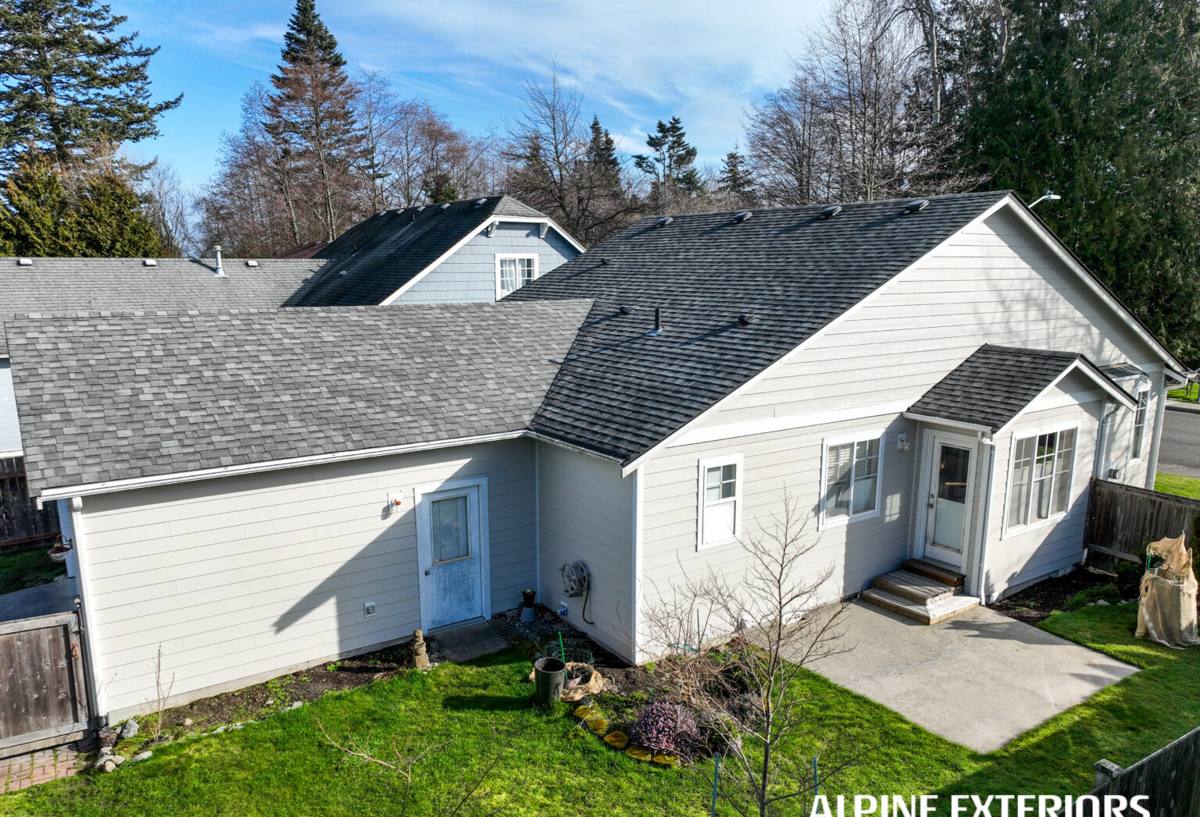
We made a decision as a company to install one siding product: James Hardie fiber cement, factory-finished with ColorPlus coating. We don't install vinyl, LP SmartSide, primed wood, cedar, or other fiber cement brands like Cemplank or Allura. That's not a marketing angle — it's a standard we hold because of what we've seen exterior materials do (and fail to do) in coastal Whatcom County conditions specifically.
Fiber cement is non-combustible, dimensionally stable in wet-dry cycling, and doesn't feed mold or rot the way wood-based products can. James Hardie's HZ5 product line is engineered for climates with heavy moisture exposure, which fits this region better than a general-purpose product line built for a drier market. The ColorPlus finish is baked on at the factory under controlled conditions, which gives it better adhesion and UV resistance than field-applied paint — a real advantage when a wall is going to see near-constant damp exposure for months at a time.
We're not going to tell you every other product on the market is junk. Vinyl is inexpensive and low-maintenance in the sense that it doesn't need painting, but it can warp, fade, and become brittle over decades, and its seams and expansion joints are exactly the kind of detail that struggles under driving rain. Cedar has real appeal and performs well when maintained aggressively, but that maintenance burden — refinishing, moisture monitoring, protecting it from pests — is a lot to ask of a homeowner in a climate that stays damp for half the year. We'd rather put a product on your house that's engineered for this exposure than sell you something that looks good on day one and becomes a maintenance project by year five.
How We Handle Siding Installation for Coastal Exposure
Water Management Comes First
Correct installation matters as much as the product choice. Before siding goes up, we look at flashing details around windows, doors, and roof-to-wall transitions — the places where wind-driven rain finds its way in if the details are wrong. We use rain screen or drainage plane strategies where the wall assembly calls for it, giving bulk water a way out instead of trapping it behind the siding.
Fastening and Trim for Salt Air
We use fasteners and trim components rated for the corrosion exposure this area sees, rather than defaulting to standard hardware that looks fine on installation day but starts rusting within a couple of winters near the water.
Following the Manufacturer's Installation Spec
James Hardie's warranty is only as strong as the installation behind it. That means correct nailing patterns, proper clearances from grade and roof lines, factory-cut edges sealed where required, and joints treated the way the manufacturer specifies — not shortcuts that save an afternoon but cost the homeowner the warranty's protection later.
Roofing, Windows, and Decks in the Same Climate
Siding is only part of what keeps a Fairhaven-area home dry and sound. We also handle roofing, window replacement, and deck construction, and the same climate logic applies across all of it. A roof in this area needs underlayment and flashing details that account for wind-driven rain and moss growth on shaded slopes. Windows need to be properly flashed into the wall assembly so they don't become the weak point in an otherwise well-built exterior. Decks near the water face their own version of the salt-and-moisture problem, particularly in fastener choice and any wood components exposed to standing moisture. We look at a home's exterior as one connected system rather than a set of separate trades, because a leak or moisture problem rarely respects the boundary between the siding and the roof.
Comparing Exterior Siding Options for This Climate
| Material | Moisture Behavior in Coastal WA | Maintenance Over Time | Our Take |
|---|---|---|---|
| James Hardie Fiber Cement (HZ5, ColorPlus) | Engineered for wet climates; stable in wet-dry cycling | Low; factory finish resists chalking and fading | What we install |
| Vinyl | Doesn't absorb moisture but seams/joints are a weak point in driving rain | Low but can warp, fade, crack over decades | Not installed by our crew |
| Cedar / Wood | Absorbs moisture; vulnerable to rot and moss without diligent upkeep | High; regular refinishing and inspection required | Not installed by our crew |
| LP SmartSide / Other Composite | Engineered wood strand product; performance depends heavily on sealed edges and correct install | Moderate; edge sealing failures are a common issue | Not installed by our crew |
Cost Factors Homeowners Ask About
Every home near Fairhaven is a little different, so we don't quote pricing without seeing the house, but the factors that move a siding project's cost up or down are consistent:
- Square footage and the complexity of the roofline and wall planes (more corners and transitions mean more labor and trim)
- Whether existing siding needs to be fully removed or if there's underlying sheathing or moisture damage to address first
- Number and size of window and door openings, since each one needs proper flashing integration
- Siding profile and color selection (lap width, board-and-batten, or shingle-style Hardie products vary in material cost)
- Site access — proximity to the water, tree cover, and lot slope can affect staging and scaffolding needs
A Local Crew Matters More Than It Sounds
A crew that works Whatcom County's coastal communities regularly knows which details actually matter here — where moss tends to establish first on a north wall, how far wind-driven rain can push water up under trim, which fastener grades hold up near the bay instead of streaking within a couple of seasons. That's knowledge you build by working the same climate over and over, not something you get from a national installation manual alone. We're based in Ferndale and work this stretch of Whatcom County regularly, so we're not guessing at how this environment behaves — we're accounting for it in the plan from the start.
What to Expect When You Call Us
- An in-person walkaround of your home's exterior, checking current siding condition, trim, flashing, and any visible moisture or moss issues
- A straightforward explanation of what we find — no pressure to replace something that still has useful life left
- A written estimate that breaks out material and labor so you understand what you're paying for
- A realistic timeline that accounts for weather windows, since we don't rush installation in conditions that compromise the work
- Direct answers about why we recommend James Hardie for your specific situation, including trade-offs if you're considering alternatives
Get a Straight Answer About Your Home's Exterior
If you're noticing moss buildup, paint that's failing faster than it should, or you're just planning ahead for a home near Fairhaven's coastal exposure, we're happy to take a look and give you an honest read on your options. Reach out for a free, no-pressure estimate — there's a form below to get started.