 Ferndale
 Two Products, One Decision
Homeowners in Ferndale and around Whatcom County usually narrow their siding search down to two finalists: James Hardie fiber cement and LP SmartSide engineered wood. Both are a step up from vinyl in appearance and durability, both take paint well, and both are marketed as low-maintenance. We get asked to bid both products regularly. We only install one of them, and we think homeowners deserve a straight answer about why.
This page isn't a takedown of LP SmartSide. It's a real look at what the product is made of, how it behaves over years of Pacific Northwest weather, and why we made a professional call to stop installing it and build our business around fiber cement instead.
What Each Product Actually Is
LP SmartSide
LP SmartSide is an engineered wood product. Strand board or wood fiber is bonded with resin, pressed under heat, and coated with a zinc-borate treatment and resin-saturated overlay to resist moisture and insects. It's cut and installed much like traditional wood siding, and it comes in lap boards, panels, and trim.
James Hardie Fiber Cement
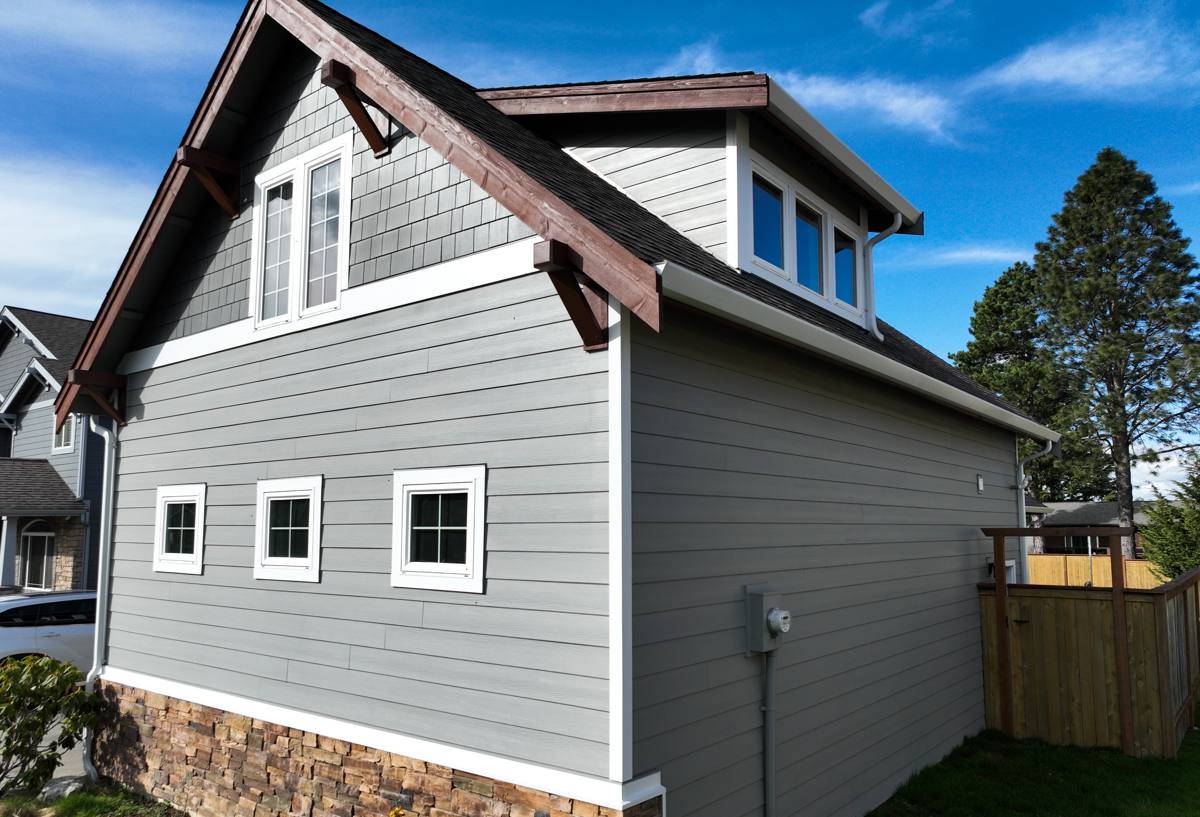
James Hardie siding is made from cement, sand, and cellulose fibers, cured into a rigid board. There's no wood core and nothing for moisture to feed on. Hardie's HZ5 product line is specifically engineered for regions with sustained damp weather, which is why it's the version we spec for jobs here rather than the HZ10 line built for hot, dry climates.
Why Whatcom County's Climate Makes This a Real Question
This isn't an academic debate for homes here. Ferndale sits close enough to the Salish Sea that salt-laden air is a factor on exterior materials, and Whatcom County's weather pattern adds driving rain off the water and a moss season that can stretch from fall through spring. Siding on a Ferndale home isn't dealing with the occasional storm — it's dealing with near-constant low-grade moisture exposure for months at a time, plus organic growth that holds that moisture against the wall.
Any wood-based product, no matter how well it's treated at the factory, is more exposed in this environment than a product with no organic material to protect in the first place. That single difference drives most of the decision below.
Where LP SmartSide Gets It Right
To be fair to the product: LP SmartSide is a legitimate step up from raw wood siding, and it's a reasonable, lighter-weight, easier-to-cut option that a lot of contractors like working with. Modern SmartSide holds up better than the OSB siding products of the 1990s that gave engineered wood a bad name — LP redesigned the treatment process specifically to address those older failures. It takes paint well, it's less brittle than fiber cement to handle on site, and the upfront material cost is often lower.
The Trade-Offs That Made Us Stop Installing It
Moisture Is Still the Enemy of Wood
Even with resin treatment, SmartSide is still a wood-fiber product at its core. Its long-term performance depends heavily on every cut edge, seam, and fastener penetration being properly sealed at installation and re-sealed as caulking ages. In a climate with our moss season and driving rain, that maintenance schedule isn't optional — it's the thing standing between the siding and moisture intrusion at the panel edges, which is where wood-based products are most vulnerable.
Installation Sensitivity Has Higher Stakes
Both products require correct installation — clearances, fastener placement, flashing, and caulking all matter for fiber cement too. But when a wood-based product is installed wrong or maintenance lapses, the failure mode is swelling, delamination, or rot at the compromised area. That's a repair, not just a cosmetic issue.
Ongoing Maintenance Commitment
SmartSide needs its factory finish maintained — caulked joints inspected, touch-up paint kept current, and any damaged panels addressed promptly before moisture gets past the treated surface. For homeowners who want to paint or maintain their siding on a schedule, that's a fair trade. For homeowners who want to install it once and think about it again in twenty years, it's a mismatch with a wet coastal climate.
Warranty Structure
LP's warranty is solid on paper, but like most engineered wood warranties, it carries exclusions tied to installation practices and ongoing maintenance — miss a caulking cycle or leave an edge unsealed and a claim can get complicated. We'd rather stand behind a product where the warranty isn't contingent on a homeowner's maintenance calendar.
What Fiber Cement Does Differently
Fiber cement sidesteps the core issue by removing wood from the equation entirely. It won't swell, delaminate, or rot, because there's no organic material for moisture to act on. It's also non-combustible, which matters increasingly for insurance conversations. James Hardie's ColorPlus finish is baked on at the factory in a controlled environment, rather than field-applied, which gives it more consistent coverage and a longer repaint interval than a product finished on site or touched up after installation.
None of that makes fiber cement maintenance-free — it still needs correct caulking, proper clearance from grade and hard surfaces, and normal exterior upkeep. But the consequences of a small maintenance gap are far less severe than they are on a wood-fiber product in a climate like ours.
Side-by-Side: The Honest Comparison
| Factor | LP SmartSide | James Hardie Fiber Cement |
|---|---|---|
| Core material | Engineered wood strand/fiber | Cement, sand, cellulose fiber |
| Combustibility | Combustible (treated) | Non-combustible |
| Moisture vulnerability | Higher at unsealed cuts/edges | No organic material to feed decay |
| Finish | Field or shop-primed, painted after install | ColorPlus factory-baked finish available |
| Maintenance cycle | Regular caulk/paint inspection required | Lower-frequency upkeep |
| Typical repaint interval | Shorter, product-dependent | Longer with ColorPlus finish |
| Weight/handling on site | Lighter, easier to cut | Heavier, requires fiber-cement blades/tools |
| Warranty structure | Maintenance-contingent exclusions common | Strong transferable warranty |
Installation Matters Either Way — But the Margin for Error Is Different
We want to be fair here: sloppy installation can hurt any siding product. Fiber cement installed with wrong fastener depth, no gap at butt joints, or poor flashing detail will fail early too. The difference is what happens when a small installation flaw goes unnoticed for a few years. On fiber cement, a caulking gap that goes unaddressed for a season is a cosmetic fix. On a wood-based product, the same gap is an opening for moisture into material that can swell and break down. In a region with our rain and humidity pattern, that gap in risk tolerance is the whole reason for our position.
What to Check Before You Choose Either Product
- Ask what core material is actually inside the board, not just the brand name on the invoice
- Ask what the manufacturer's warranty requires of you to stay valid — maintenance schedule, caulking, repainting
- Ask whether the installer is factory-certified for that specific product
- Ask what clearance from grade, decks, and roof lines the manufacturer requires, and confirm the bid meets it
- Ask what happens to a damaged panel in 10 years — can it be spot-repaired or does it require a full section replacement
- Ask for the specific product line (Hardie HZ5 vs. HZ10, for example) — climate zone matters more than brand name
Cost and Long-Term Value
Engineered wood typically carries a lower material cost upfront than fiber cement. That gap narrows when you factor in ColorPlus finishes that reduce or eliminate early repainting, and it can reverse over a couple of decades once ongoing maintenance and any moisture-related repairs are counted. We don't quote invented numbers here because costs vary by project size, trim complexity, and access — but we're glad to walk through real cost-per-year thinking, not just install-day pricing, when we bid a job.
Why We Standardized on James Hardie
We made a decision as a company to install one product system and install it correctly, rather than carry every option on the market and let price alone decide. James Hardie's fiber cement, in the HZ5 formulation built for damp climates, with a factory ColorPlus finish and a strong transferable warranty, matches what Ferndale and Whatcom County homes actually face year-round: salt air, driving rain, and a moss season that doesn't give siding much of a break. That's not a knock on every wood-based product on the market — it's a standard we hold our own work to, and it's what we're willing to warranty and stand behind.
If you're weighing siding materials for a home in the Ferndale area, we're happy to walk your specific house, talk through what we see in your exposure and trim details, and give you a free, no-pressure estimate for a James Hardie installation.