 Ferndale
 Marietta Sits Right Where the Weather Tests a Deck the Hardest
Marietta is a waterfront community, and that proximity to the water is exactly what makes composite decking a smart choice here — and exactly what makes a sloppy installation fail faster than it would a few miles inland. Salt-laden air, wind-driven rain off the water, and the long stretch of gray, damp months that Whatcom County gets every fall through spring all work on a deck at once. Wood decking in this setting checks, cups, and grays out quickly unless it's babied with stain every year or two. Composite is built to shrug off moisture and UV, but only if the installation underneath it respects what this specific location throws at it.
We're not talking about generic "coastal Pacific Northwest" conditions in the abstract. Homes in Marietta deal with salt air corrosion on hardware, near-constant humidity that feeds moss and algae growth on any horizontal surface, and rain that comes in sideways often enough that flashing details matter more than they would on a sheltered inland lot. A composite deck built for this spot needs the right board, the right substructure, and fasteners that won't corrode out from under it in ten years.
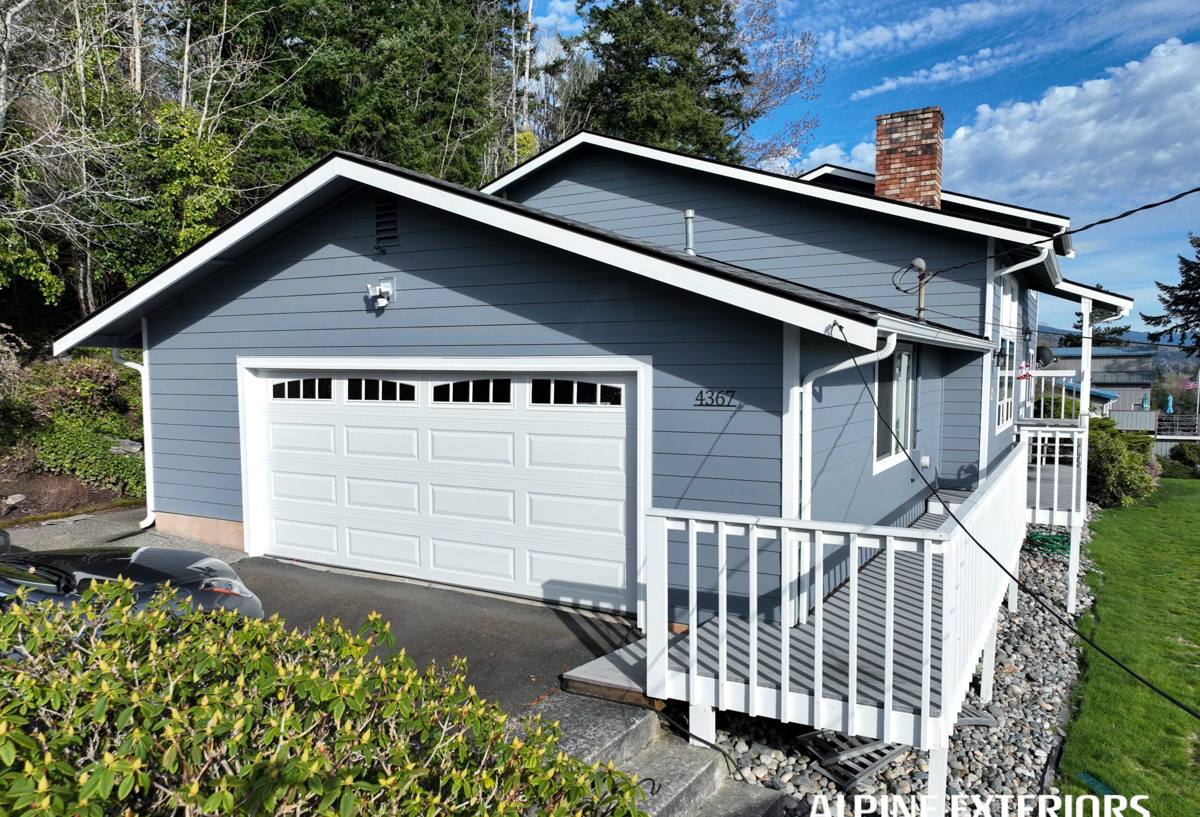
What Salt Air, Driving Rain, and Moss Season Actually Do to a Deck
Salt Air and Hardware
Salt in the air accelerates corrosion on anything ferrous. Standard coated deck screws and joist hangers can start showing rust streaks within a few seasons this close to the water. That corrosion doesn't stay cosmetic — a corroded fastener loses grip strength, and a corroded joist hanger is a structural problem, not a cosmetic one.
Driving Rain and Water Management
Wind-driven rain doesn't fall straight down — it gets pushed sideways and up under overhangs, ledger boards, and deck edges. If flashing and gapping aren't done correctly, water finds its way into places it's not supposed to be: behind ledger boards, into end grain, and down into joists that were never meant to sit wet.
Moss and Algae ("Moss Season")
Whatcom County's long damp season is exactly the environment moss and algae need to establish themselves on any surface that stays wet and shaded. Composite decking resists rot, but the surface can still grow a slick, greenish film if drainage and airflow underneath aren't handled right — and a slick deck surface is a real slip hazard, not just an eyesore.
What a Correctly Installed Composite Deck Looks Like Here
A composite deck built right for Marietta's conditions isn't a different product than a composite deck built anywhere else — it's the same board installed with more discipline in a few specific places:
- Joist tape (a self-adhering waterproof membrane) over every joist top, not just the ones near the house
- Proper end-gapping and board spacing so water actually drains instead of pooling between boards
- Ledger board flashing that directs water away from the house rim joist, sealed and lapped correctly
- Stainless steel or coated corrosion-resistant fasteners and hardware throughout, not just at visible connections
- Adequate ventilation and clearance underneath the deck so the substructure can dry out between rains
- Blocking and framing spaced to the composite manufacturer's spec — composite spans differently than wood, and undersized framing shows up as bounce and long-term sagging
None of this is visible once the deck is finished, which is exactly why it's the part most likely to get skipped by a crew in a hurry.
Substructure: The Part Nobody Sees But Everyone Regrets
The composite boards on top get all the attention, but the framing underneath is what determines whether the deck is still solid in fifteen years. In a location like Marietta, we treat the substructure as the part of the job that actually needs the coastal-grade attention — pressure-treated framing rated for ground contact where it's close to grade, joist tape on every top edge, and hardware that's rated for the exposure, not just whatever came in the standard box. A deck can look flawless on the surface and still be quietly rotting or rusting from below if this step was rushed.
We also pay attention to footing depth and drainage around posts. Whatcom County's frost depth and soil drainage requirements aren't exotic, but skipping them because "it's just a deck" is how decks end up with heaving posts or standing water pooling at the base a few years in.
Choosing the Right Composite Board for a Marietta Home
Not all composite decking is built the same, and the differences matter more in a salt-air, high-moisture setting than they would somewhere drier.
| Board Type | Moisture Behavior | Best Fit For |
|---|---|---|
| Fully capped composite | Cap layer sheds water and resists staining/mold on all sides | Waterfront and high-exposure lots like Marietta |
| Capped on top only | Bottom and edges more exposed to moisture wicking | Covered or partially sheltered decks |
| Uncapped composite | Absorbs moisture more readily, more prone to surface mold in damp climates | Drier inland settings, less ideal here |
| PVC/mineral-based decking | Doesn't absorb moisture at all, very stable in wet climates | Homes prioritizing lowest long-term maintenance |
For a home this close to salt water, we generally steer clients toward fully capped composite or PVC-based boards. It's not that other options are bad products — it's that in this specific exposure, the extra moisture resistance pays for itself in fewer years than it would somewhere sheltered and dry.
Color Considerations
Darker composite boards run hotter in direct sun and can show algae growth less than lighter boards, but lighter and mid-tone colors tend to hide pollen, salt residue, and everyday grime better between cleanings. There's no universally "right" answer — it's a tradeoff worth talking through based on how much sun the deck gets and how the homeowner wants to maintain it.
Fasteners, Flashing, and Hardware: Where Corners Get Cut
This is the section that separates a deck that lasts from one that doesn't, and it's almost entirely invisible once the job is done. In a salt-air environment:
- Hidden fastener clips and screws should be stainless steel or specifically rated for coastal/marine exposure
- Joist hangers and structural hardware need the same corrosion rating, not standard galvanized
- Ledger flashing should be a continuous, properly lapped material — not caulk doing a flashing's job
- Post bases and any exposed metal at grade need a rating suited to wet, salty soil contact
We spec hardware for this job the way we'd spec it for our own homes on the same stretch of coastline — it costs more up front than the generic hardware aisle option, and it's the reason the deck doesn't need hardware replaced in year six.
Our Process for a Marietta Composite Decking Project
- On-site assessment — we look at drainage, sun/shade exposure, grade, and how close the deck sits to prevailing wind and rain direction
- Board and hardware selection — matched to the exposure level of that specific deck, not a one-size answer
- Permit and setback check — Whatcom County and local requirements reviewed before framing starts
- Substructure build — treated framing, joist tape, corrosion-rated hardware, correct spans
- Decking installation — proper gapping, hidden fastening, and clean edge/border detailing
- Final walkthrough — drainage check, railing and stair inspection, and a plain-language rundown of what maintenance actually looks like going forward
Living With a Composite Deck Through Moss Season
Composite decking is lower-maintenance than wood, not zero-maintenance. In this climate, that mostly comes down to keeping water moving and surfaces clean:
- Sweep debris off the deck regularly through fall so wet leaves don't sit and shade the surface
- Rinse or lightly scrub the surface periodically during the wettest months to stay ahead of algae film buildup
- Keep gutters and downspouts near the deck clear so runoff isn't dumping extra water onto the surface
- Check that furniture and planters aren't blocking drainage gaps between boards
None of this is heavy work, but skipping it in a place with this much rain and shade is how a deck that should stay clean for years starts looking neglected after one bad winter.
Why Hiring a Crew That Already Works in Marietta Matters
A lot of what makes a composite deck last here isn't in the manufacturer's install manual — it's knowledge that comes from having built and repaired decks in this exact microclimate. Knowing which hardware actually holds up against the salt air after a few winters, how much slope this specific type of lot needs for real drainage, and what corners tend to get cut by crews unfamiliar with waterfront exposure — that's the difference between a deck that needs attention in five years and one that doesn't. We work in Ferndale and the surrounding Whatcom County waterfront neighborhoods regularly, and Marietta's conditions are ones we plan for from the first site visit, not something we figure out after a callback.
If you're planning a composite deck in Marietta, we're happy to walk the site, talk through board and hardware options honestly, and put together a free, no-pressure estimate. There's a form below — reach out and we'll take it from there.