 Ferndale
 Why Lynden Roofs Wear Differently Than Roofs Inland
Lynden sits in the part of Whatcom County that catches a specific combination of weather most roofing crews from outside the area don't plan for: marine air moving in off the Salish Sea, long stretches of driving rain through fall and winter, and shade-heavy, damp conditions that keep roof surfaces wet for days at a time. None of that is dramatic weather. There's no hurricane season here. But it's steady, and steady is what actually wears out a roof. A roof that's technically "fine" in a dry climate can fail years early here if it wasn't built with this specific climate in mind.
The three things we design every Lynden roof around are salt-carrying air, sustained rainfall rather than short bursts, and a moss season that can run eight months or longer depending on tree cover and sun exposure. Get those three things right in the installation and a roof will do its job quietly for decades. Get them wrong and you're looking at premature granule loss, soft decking, and moss that lifts shingles from underneath before anyone notices a leak.
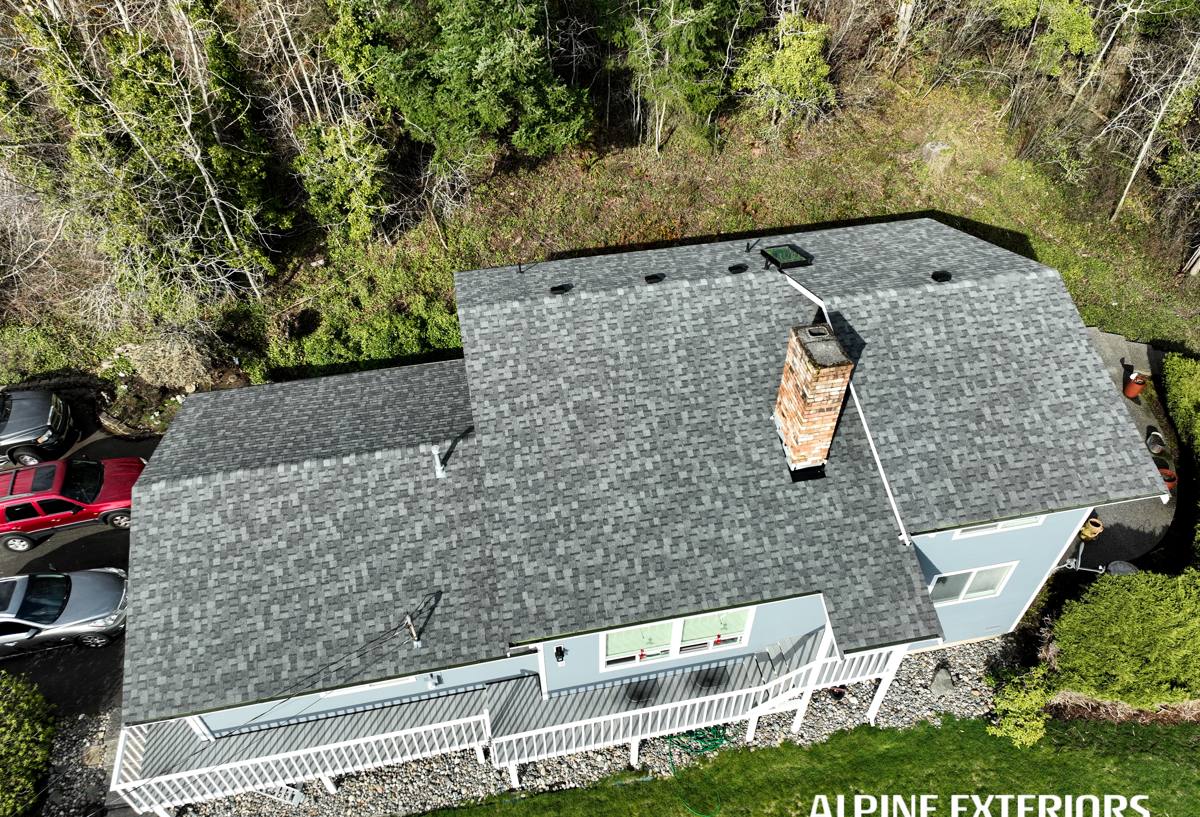
Signs a Lynden Home Needs a New Roof, Not Another Repair
Homeowners often call us for a repair and it turns into a new roof conversation once we're actually up there. That's not an upsell — it's what the roof tells us. Here's the honest checklist we walk through before recommending full replacement over a patch:
- Granules collecting in gutters or at downspout outlets — a sign the shingle surface is breaking down, not just dirty
- Moss growing in mats rather than thin surface film, especially on north-facing slopes with tree cover
- Shingles that are curling, cupping, or losing their tab lines when viewed from the ground
- Soft spots or slight sagging in the roof deck felt when walking the surface
- Daylight visible through the attic roof boards, or damp insulation below the deck
- A roof that's 20+ years old with 3-tab shingles, regardless of how it looks from the street
- Repeated flashing leaks around chimneys, skylights, or vent pipes after prior patch jobs
If you're only seeing one or two of these, a repair may still be the right call. If you're seeing three or more, or the roof is past 20 years, a new installation is usually the more honest recommendation, because patching an aging roof in this climate tends to buy months, not years.
What a Correct New Roof Installation Actually Involves
Tear-Off and Deck Inspection
We don't install over existing layers. A full tear-off is the only way to actually see the deck, and in a climate that pushes moisture into a roof system from every direction, that inspection matters more here than it would somewhere dry. Any soft, delaminated, or water-stained sheathing gets replaced before anything new goes down — no exceptions, because covering bad decking with new shingles just hides the problem for a season or two.
Underlayment and Ice-and-Water Barrier
This is where a lot of the climate-specific decision-making happens. We use synthetic underlayment across the full roof for its water resistance and tear strength, plus self-adhering ice-and-water barrier at the eaves, valleys, and any roof-to-wall transitions — the spots where wind-driven rain actually finds its way in during a real Whatcom County storm. This layer is the difference between a roof that sheds water and one that just slows it down.
Flashing Details
Flashing failure is the single most common cause of "mystery leaks" we get called out for on roofs that are otherwise in decent shape. Step flashing at walls, counter-flashing at chimneys, and proper valley metal all get installed fresh, never reused from the old roof, and never just caulked over. Caulk is a maintenance item, not a flashing strategy.
Ventilation
A roof that can't breathe traps moisture in the attic, and trapped moisture is what accelerates rot and, indirectly, moss growth on the deck side. We check intake at the soffits and exhaust at the ridge or roof vents as part of every installation, not as an afterthought — it's one of the most overlooked parts of a new roof and one of the cheapest to get right while the roof is already open.
Choosing the Right Material for Lynden's Weather
There isn't one "best" roofing material for every home — it depends on budget, roof pitch, tree cover, and how long you plan to own the home. Here's how the common options actually perform under the salt air, sustained rain, and moss pressure typical of this area.
| Material | Moss/Moisture Resistance | Salt Air Durability | Typical Lifespan Here |
|---|---|---|---|
| Architectural asphalt shingle | Good with proper ventilation; algae-resistant granules help | Solid; the standard choice regionally | 25-30 years |
| 3-tab asphalt shingle | Fair; thinner profile holds moisture longer | Adequate but wears faster | 15-20 years |
| Standing seam metal | Excellent; sheds water and resists moss growth | Very good with proper coating/fastener choice | 40-50+ years |
| Cedar shake | Requires diligent maintenance; moss-prone without upkeep | Moderate; needs regular treatment | 20-30 years with upkeep |
| Synthetic composite shake/slate | Very good; doesn't absorb moisture like wood | Good | 40-50 years |
For most Lynden homes we install architectural asphalt shingle as the balance of cost and performance, with metal as the upgrade path for homeowners planning to stay long-term or dealing with heavy tree cover and persistent moss. We frame cedar shake honestly with clients: it's a beautiful, traditional look, but it demands a maintenance schedule most homeowners underestimate in a climate this damp — that's a trade-off worth knowing before you commit, not a knock on the material itself.
Our Installation Process, Start to Finish
- On-site assessment — we walk the roof and attic, not just look from the driveway, and check deck condition, ventilation, and flashing points before quoting
- Written estimate — materials, scope, and timeline spelled out, no vague allowances
- Material selection — we walk through the options above based on your roof, budget, and how long you plan to stay in the home
- Scheduling around weather — in this region that means watching the forecast closely rather than committing to a rigid date; an open roof deck and an unexpected rain system don't mix
- Tear-off and deck repair — old material removed, deck inspected and repaired as needed
- Underlayment, flashing, and ventilation installed — the layers that actually determine how the roof performs over the next 20-30 years
- New roofing material installed — per manufacturer specification, not shortcuts
- Final walkthrough — we review the finished roof with you, including gutters and any debris cleanup, before calling the job done
Moss, Algae, and Salt Air: What Happens After Installation
A new roof isn't maintenance-free, and we'd rather tell you that upfront than have you find out the hard way. In this climate, moss and algae will eventually try to re-establish themselves on any roof surface, especially on shaded, north-facing slopes. Algae-resistant shingle granules and, where appropriate, zinc or copper strips near the ridge help slow regrowth, but they don't eliminate the need for periodic light maintenance — keeping gutters clear, trimming back overhanging branches, and gently clearing debris before it mats down and holds moisture against the surface.
Salt-laden air moving inland off the water is a slower, quieter factor, but it's part of why we specify corrosion-resistant fasteners and flashing metals on every installation rather than treating that as an upgrade option. It's a small cost difference at install time and a real difference in how the roof looks and performs at year 15.
What Affects the Cost of a New Roof
Every roof is priced on its own specifics, but the factors that actually move the number are consistent. We'd rather walk you through these than quote a flat number with no context behind it.
| Cost Factor | Why It Matters |
|---|---|
| Roof size and pitch | Steeper roofs take longer and require more safety setup |
| Number of layers being removed | Tear-off labor scales with how much old material comes off |
| Deck condition | Rotten or soft sheathing found during tear-off adds material and labor |
| Material choice | Asphalt, metal, and composite materials carry different price points, as shown above |
| Roof complexity | Valleys, dormers, chimneys, and skylights all add flashing work |
| Ventilation upgrades | Adding intake or exhaust vents where the existing system is inadequate |
We don't publish a flat per-square price because it genuinely varies with these factors, but we'll give you a clear, itemized number after the on-site assessment — not a range that balloons once we're on the roof.
Why a Local Ferndale Crew Matters for a Lynden Roof
Lynden and Ferndale sit close enough that the climate reality is the same house to house — the same moss pressure, the same driving rain patterns, the same salt-air exposure carried in off the water. A crew that works this stretch of Whatcom County regularly isn't guessing at underlayment specs or ventilation requirements; we're building to conditions we deal with on every job, not adapting a generic install method to local weather after the fact. That familiarity shows up in the details — where we place ice-and-water barrier, how we handle valley flashing, which ventilation setup actually performs on a shaded Lynden lot — rather than in anything we'd need to advertise.
Being local also means we're reachable after the job is done. If something comes up during that first winter — the season that actually tests a new roof here — we're not a call center or a crew that's moved three counties away.
Permits and Warranty Basics
New roof installations typically require a building permit, and we handle that as part of the project rather than leaving it for the homeowner to sort out. On the warranty side, expect two separate pieces: a manufacturer's warranty covering the material itself, and our workmanship warranty covering the installation. Ask any contractor you're considering to spell out both in writing before work starts — a verbal promise on workmanship coverage isn't worth much if there's ever a question later.
If your Lynden home is due for a new roof, or you're not sure whether what you're seeing is a repair situation or a replacement one, we're happy to take a look and give you a straight answer. Fill out the form below for a free, no-pressure estimate.