 Ferndale
 Why Lynden-Area Homes Are Hard on Siding
Homes in and around Lynden sit inside the same weather pattern that shapes all of Whatcom County: damp air moving in off Puget Sound, long stretches of driving rain from fall through spring, and short, mild summers that never fully dry out the ground or the north side of a house. Add the salt-laden air that reaches inland on prevailing westerly winds, and you get a combination that's rough on almost every exterior building material. Paint chalks and fades faster than it would in a drier climate. Caulk joints open up. And anything with real wood content — cedar lap, primed spruce, even some engineered wood products — stays damp long enough, long enough of the year, to start feeding rot and mold from the inside out.
The other constant here is moss and algae. Whatcom County's moss season isn't a few weeks in spring — it's most of the year. Shaded walls, north-facing elevations, and anything near overhanging trees or gutters that don't clear water fast enough will show green and black staining faster than homeowners expect, sometimes within a couple of seasons on the wrong product. Siding that can't shed water quickly or resist that kind of biological growth ends up looking tired long before it's structurally failed.
What James Hardie Actually Solves Here
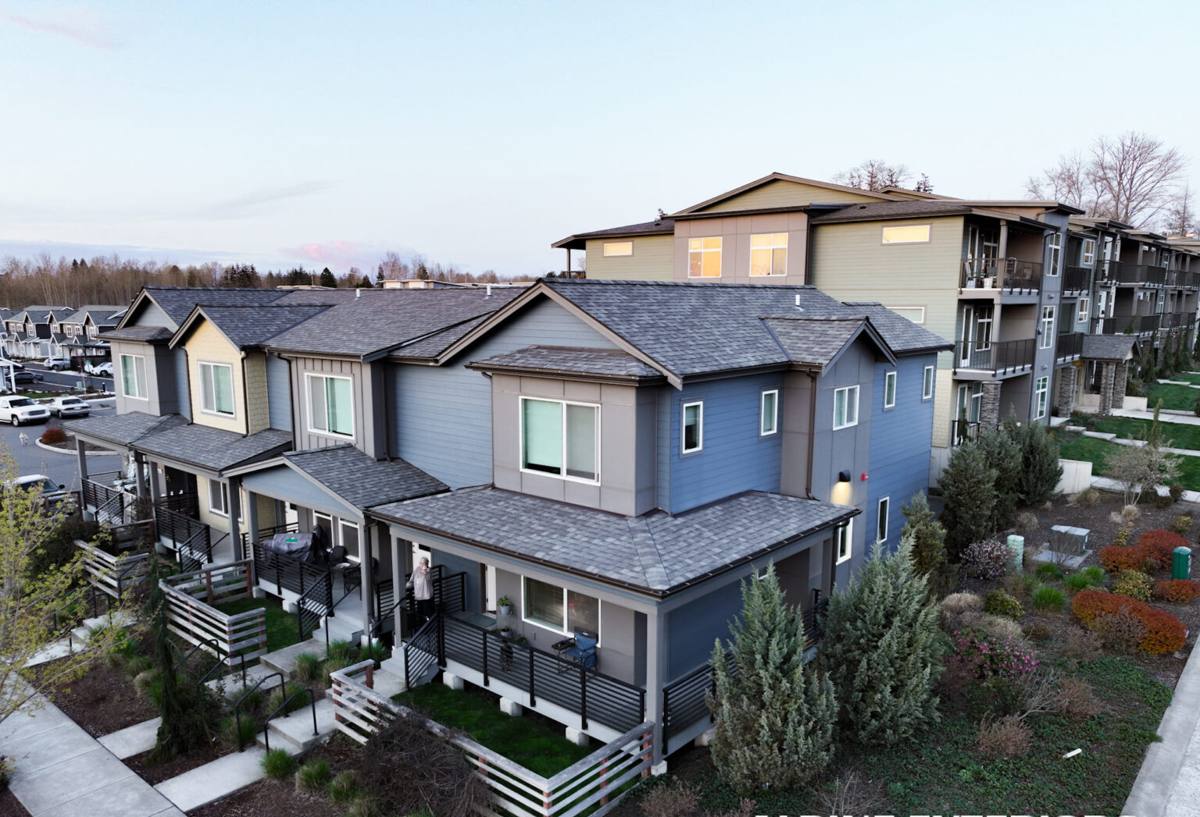
James Hardie fiber cement siding is engineered specifically for regional climate zones, and the HZ5 product line is built for exactly this kind of Pacific Northwest exposure — cold, wet winters and moisture that lingers. Fiber cement itself is not organic material, so it doesn't feed mold or rot the way wood-based products can. It holds up to repeated wet-dry cycling without swelling, cupping, or delaminating, which is the failure mode we see most often on older wood and engineered-wood siding in this area.
The factory-applied ColorPlus finish matters just as much as the substrate. It's baked on under controlled conditions, which gives it better fade resistance and adhesion than field-applied paint — a real advantage when the maintenance cycle on painted wood siding out here can be every 3-5 years just to keep ahead of the weather. That doesn't mean Hardie siding is maintenance-free; it still needs the same attention every exterior surface needs — clean gutters, trimmed vegetation, and an occasional rinse to keep moss from establishing — but the material itself isn't the weak point.
Product Lines We Work With
- HardiePlank lap siding — the standard horizontal siding for most single-family homes, available in several exposure widths and textures
- HardiePanel vertical siding — often used for accent walls, gables, or a board-and-batten look
- HardieTrim — matching trim boards for corners, window and door casings, and fascia
- HardieShingle — a shingle-profile option for homes wanting that look without the maintenance of real cedar shingle
Why We Only Install James Hardie
We get asked from time to time why we don't offer vinyl or LP SmartSide as a lower-cost alternative. Both are legitimate products with their own place in the market — vinyl is inexpensive and low-maintenance in mild climates, and LP SmartSide has improved a lot over the years. Our reason for standardizing on James Hardie isn't that those products are junk; it's that we've made a professional call about what holds up best, longest, with the least callback risk, in this specific climate. Vinyl can warp and become brittle with UV and temperature swings, and its seams and butt joints give water more places to get behind the wall over a wet Whatcom County winter. LP SmartSide is an engineered wood product — better moisture resistance than old-style hardboard, but it's still wood-based at its core, which means edge sealing and caulk maintenance stay critical for the life of the siding in a climate that rarely lets a wall fully dry out. Fiber cement removes that variable. That's the trade-off we made, and it's why every job we take on uses the same system.
What a Correct Installation Requires in This Climate
James Hardie siding performs the way it's rated to perform only when it's installed to spec — and in a wet climate, the installation details matter more than the material choice. A rushed or shortcut job on Hardie siding can still trap moisture behind the wall, which defeats the whole point of switching to it.
What we check on every job
- Correct weather-resistive barrier installed and lapped properly behind the siding, not just stapled up as an afterthought
- Rigid flashing at every window, door, and roof-to-wall intersection — not just caulk, which fails long before the siding does
- Proper minimum clearance between the bottom of the siding and grade, decks, patios, and roof lines, so splash-back and standing water don't sit against the material
- Manufacturer-specified fastener pattern and nailing, sized correctly for the plank profile and exposure
- Factory-cut edges used wherever possible, with any field cuts back-primed and caulked per Hardie's written instructions
- Adequate gap and sealant at butt joints and trim intersections to allow for expansion without opening a water path
None of this is exotic — it's simply following James Hardie's published installation guidelines, which exist precisely because a fiber cement wall system depends on the drainage plane behind it working correctly, not just the visible siding on the surface.
Our Process for Lynden-Area Homes
The steps are the same whether we're working closer to Ferndale proper or out toward Lynden, but the site conditions — tree cover, wind exposure, proximity to open fields or water — shape a few of the decisions along the way.
- On-site assessment. We look at the existing siding, sheathing condition where accessible, moisture entry points, and roofline drainage before we ever talk product selection.
- Scope and estimate. A written estimate covering material, labor, trim, flashing detail, and any sheathing repair contingency — no vague allowances.
- Prep and tear-off. Removing existing siding down to the sheathing, addressing any rot or moisture damage found underneath before it gets covered up again.
- Weather barrier and flashing. This is the step that determines how the wall performs for the next 30-plus years — we don't compress this timeline to save a day.
- Hardie installation. Plank, panel, or shingle installed to manufacturer spec, with attention to fastener pattern and joint treatment.
- Trim, caulking, and final inspection. Walk-through with the homeowner before we call the job complete.
Cost Factors to Understand Before You Compare Quotes
Siding quotes can look wildly different for reasons that have nothing to do with contractor markup. Here's what actually drives the number.
| Factor | Why It Matters |
|---|---|
| Sheathing/framing condition underneath | Hidden rot or water damage found at tear-off adds repair scope that a surface-only quote won't reflect |
| Home shape and trim detail | More corners, gables, and window/door openings mean more cutting, flashing, and labor hours |
| Siding profile chosen | Lap width, panel vs. shingle, and smooth vs. textured finish all carry different material costs |
| Access and site conditions | Steep grades, limited staging area, or multi-story walls affect labor time and equipment needs |
| Full-house vs. partial replacement | Matching new siding to old product on a partial job can limit color and profile options |
Signs Your Current Siding Needs Attention
- Soft or spongy spots when you press on the siding near the bottom edge or below windows
- Persistent green or black staining that returns quickly after cleaning
- Paint that's bubbling, peeling, or chalking heavily between repaint cycles
- Visible gaps opening up at butt joints, corners, or trim boards
- Warping, cupping, or boards that no longer sit flat against the wall
- Interior signs — musty smell, staining, or soft drywall near exterior walls, which often trace back to siding that's no longer shedding water correctly
Why a Local Crew Matters Here
Siding installation isn't one-size-fits-all across regions, and it isn't one-size-fits-all within Whatcom County either. A crew that's used to working Ferndale and the surrounding Lynden-area properties already understands how this climate behaves on a real wall — how fast moss establishes on a shaded elevation, how far wind-driven rain travels under an inadequate roof overhang, how salt air off the Sound accelerates fastener corrosion if the wrong hardware gets used. Those are the details that separate a siding job that looks good at handoff from one that still looks and performs well ten winters later. We work this area regularly, which means fewer surprises during tear-off and a crew that isn't learning the local weather on your house.
If you're planning a siding project in Lynden or anywhere around Ferndale, we're happy to come take a look and give you a straightforward, no-pressure estimate — what your home actually needs, what it would cost, and why. Use the form below to get started.