 Ferndale
 Bellingham's Climate Is Harder on Siding Than It Looks
Bellingham sits close enough to the water that salt-laden air is a real factor on exterior materials, and the marine layer that rolls off Bellingham Bay keeps humidity high for much of the year. Add Whatcom County's long wet season, driving rain that comes in sideways off Puget Sound during winter storms, and the deep shade many Bellingham lots get from mature evergreens, and you get a climate that's tough on siding in three specific ways: moisture intrusion, sustained dampness that feeds moss and algae, and slow material fatigue from repeated wet-dry cycles.
None of this is dramatic. It's slow. A siding product that's marginal for this climate doesn't fail in year one — it fails in year eight or ten, after the homeowner has already stopped thinking about it. That's the gap we're trying to close with this page: what Bellingham homes actually need from their siding, and why we install James Hardie fiber cement exclusively to meet that need.
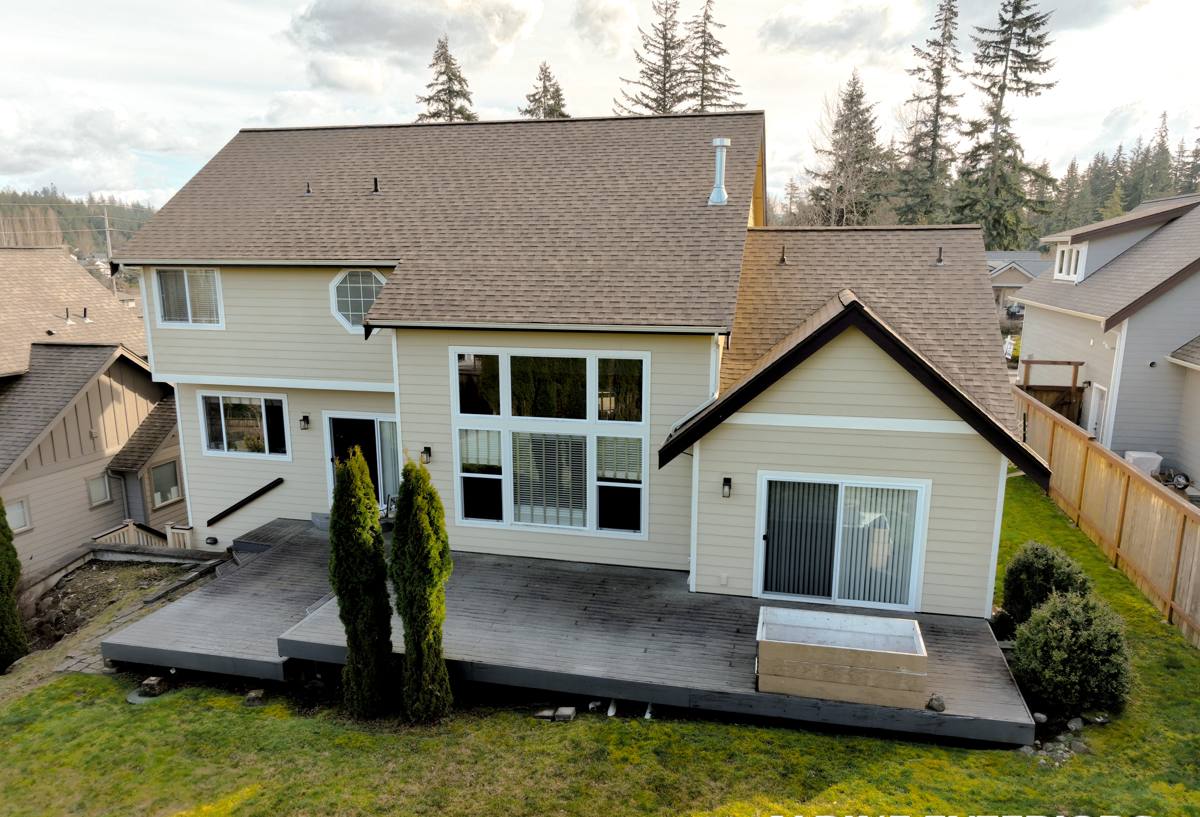
What Bellingham Homes Need From Their Siding
Moisture Resistance That Doesn't Depend on Perfect Maintenance
Every siding material can handle water if it's maintained perfectly and never gets a nick, a gap, or a missed caulk line. Real houses don't get that. What matters is how a material behaves when maintenance slips for a season or two, which happens to everyone. Fiber cement doesn't swell, rot, or delaminate the way wood-based products can when moisture sits against them.
Resistance to Moss, Algae, and Surface Staining
With shaded, damp exteriors common in this area, siding needs a factory finish that resists moss and algae growth on the surface itself, not just a coat of paint that will need to be scrubbed and recoated every few years to keep organic growth from taking hold.
Dimensional Stability in a Wet-Dry Climate
Bellingham sees real seasonal swings between soggy winters and drier summer stretches. Siding that expands and contracts too much with moisture and temperature will eventually open up joints, crack paint films, and loosen fasteners — problems that then let more water in, accelerating everything else.
A Product Line Actually Engineered for This Region
Not all fiber cement is built the same for every climate. James Hardie makes region-specific HZ5 products engineered for climates like ours, with formulations aimed at resisting moisture damage in wetter, more humid regions rather than a one-size-fits-all approach.
Why We Only Install James Hardie in This Area
We've made a deliberate decision not to install LP SmartSide, vinyl siding, Cemplank, Allura, primed spruce, or cedar on Bellingham homes. That's not a marketing position — it's a standard we hold ourselves to because of what we see happen to these materials in exactly this climate over time.
- Wood-based composites and cedar rely on maintained paint or stain films and can absorb and hold moisture at cut edges and fastener points — a real liability with our rain volume and shaded, slow-drying lots.
- Vinyl siding is lightweight and low-cost but it expands and contracts significantly with temperature, can warp or become brittle over decades, and offers no meaningful protection against wind-driven rain getting behind the panel.
- Other fiber cement brands like Cemplank and Allura are legitimate products, but we've standardized on one manufacturer so our crews are deeply fluent with one set of installation specs, one warranty structure, and one finish system — rather than splitting expertise across several.
James Hardie backs its ColorPlus factory finish with a strong, transferable limited warranty, and its non-combustible fiber cement composition holds up to the specific stresses — sustained moisture, salt air, biological growth — that define this part of Washington. That combination is why it's the only product we put on homes.
The James Hardie Product Lines That Fit Bellingham
| Product Line | Best Use on Bellingham Homes | Why It Fits |
|---|---|---|
| HardiePlank Lap Siding (HZ5) | Whole-home primary siding | Region-specific formulation engineered for wetter, humid climates like ours |
| HardiePanel Vertical Siding | Accent walls, gables, modern facades | Clean lines for contemporary Bellingham builds and additions |
| HardieShingle Siding | Craftsman and cottage-style homes | Matches the traditional shingle look common in older Whatcom County neighborhoods without wood's moisture sensitivity |
| HardieTrim Boards | Fascia, corner boards, window trim | Resists the moisture and moss issues that plague painted wood trim in shaded, damp conditions |
ColorPlus factory-applied finishes are worth calling out specifically for this area: because the color and coating are baked on at the factory under controlled conditions, you get more consistent moss and algae resistance and a longer stretch before repainting than field-applied paint typically delivers here.
What a Correct Installation Actually Involves
Fiber cement performs to its rating only when it's installed to spec. Most siding failures we're called to look at — on any brand — trace back to installation shortcuts, not the material itself. In a climate like Bellingham's, these details matter more than they would somewhere drier.
Water Management Behind the Siding
Correct installation starts with a properly lapped weather-resistive barrier, flashing at every window, door, and horizontal transition, and a rainscreen or drainage gap where conditions call for it, so any water that does get past the siding has somewhere to go besides your sheathing.
Clearances and Fastening
James Hardie specifies minimum clearances from grade, roof lines, and decks, along with specific fastener types, spacing, and penetration depth. Skipping these is the single most common cause of early moisture problems and warranty disputes we see industry-wide.
Caulking and Joint Treatment
Every joint, seam, and penetration needs the right sealant applied correctly — not just for appearance, but because these are the exact points where wind-driven rain finds its way in during Bellingham's winter storm season.
Cut-Edge Sealing
Factory edges of Hardie products come primed, but field cuts expose raw fiber cement. Sealing every cut edge before installation is a small step that's easy to skip and directly affects long-term moisture resistance.
Our Process for Bellingham Homes
- On-site assessment — we look at your home's exposure to prevailing wind and rain, shade patterns, existing moisture or moss issues, and current siding condition.
- Product and color selection — we walk through which Hardie line and ColorPlus finish fits your home's style and this climate.
- Tear-off and sheathing check — we remove existing siding and inspect the sheathing underneath for any hidden moisture damage before it's covered up again.
- Water barrier and flashing installation — the unglamorous work that determines whether the siding actually performs for the next few decades.
- Hardie installation to manufacturer spec — correct clearances, fastening, and joint treatment throughout.
- Final inspection and walkthrough — we go over the finished work with you before we consider the job done.
Why Hiring a Crew That Already Works in Bellingham Matters
Siding installation isn't uniform across climates, and a crew that mostly works drier inland regions can develop habits that don't hold up here. A crew with real Bellingham and Whatcom County experience already knows to over-build water management details rather than treat them as optional, already understands which exposures on local lots need extra attention for moss and algae, and already knows how James Hardie's HZ5 products are meant to be detailed for this specific climate. That local pattern-recognition is difficult to replace with a generic install crew, however skilled they are elsewhere.
Cost Factors Worth Understanding Upfront
| Factor | Why It Affects Your Project |
|---|---|
| Tear-off scope | Removing old siding down to sheathing versus siding over existing material affects labor and disposal costs |
| Sheathing condition | Hidden moisture damage found during tear-off may need repair before new siding goes on |
| Product line selected | Lap, panel, shingle, and trim products carry different material costs |
| Home complexity | Gables, dormers, and multiple wall planes add labor time versus simple rectangular walls |
| Water management upgrades | Adding or improving flashing and drainage details is a smart investment given our rainfall, but adds scope |
We give straightforward, honest ranges once we've actually seen your home — we don't believe in quoting blind, and we don't believe in lowballing to win a job and finding "surprises" later.
Signs Your Bellingham Home May Need New Siding Soon
- Persistent moss or algae staining that returns quickly after cleaning
- Soft spots, bubbling, or visible warping in existing siding
- Paint that's peeling or failing faster than it should
- Visible gaps at seams, corners, or trim where water could be getting behind the siding
- Musty smells or interior wall staining near exterior walls, which can indicate moisture already getting through
If your home's exterior is showing any of these, it's worth having someone look at it before the next wet season rather than after. We offer free, no-pressure estimates for Bellingham homeowners — use the form below to get one scheduled.