 Ferndale
 Metal Roofing Built for Kendall's Climate
Kendall sits inland from Ferndale in the foothills stretch of Whatcom County, and that location comes with its own weather personality. You get the same relentless Pacific rain season as the rest of the county, but with more tree cover, more shade, and often more standing moisture on the roof deck than homes closer to the water. Add in the seasonal moss and lichen growth that thrives in shaded, damp conditions, and you have a roofing environment that punishes anything less than a correctly installed, correctly ventilated system.
Metal roofing has become one of the most requested upgrades we install in this area, and for good reason. Done right, it sheds water fast, resists moss colonization far better than composition shingle, and holds up to decades of freeze-thaw cycling and wind-driven rain without the granule loss and mat degradation that eventually catches up to asphalt. Done wrong — wrong fastener pattern, wrong underlayment, poor flashing details — a metal roof can trap moisture and cause problems faster than the shingle roof it replaced. The install matters as much as the material.
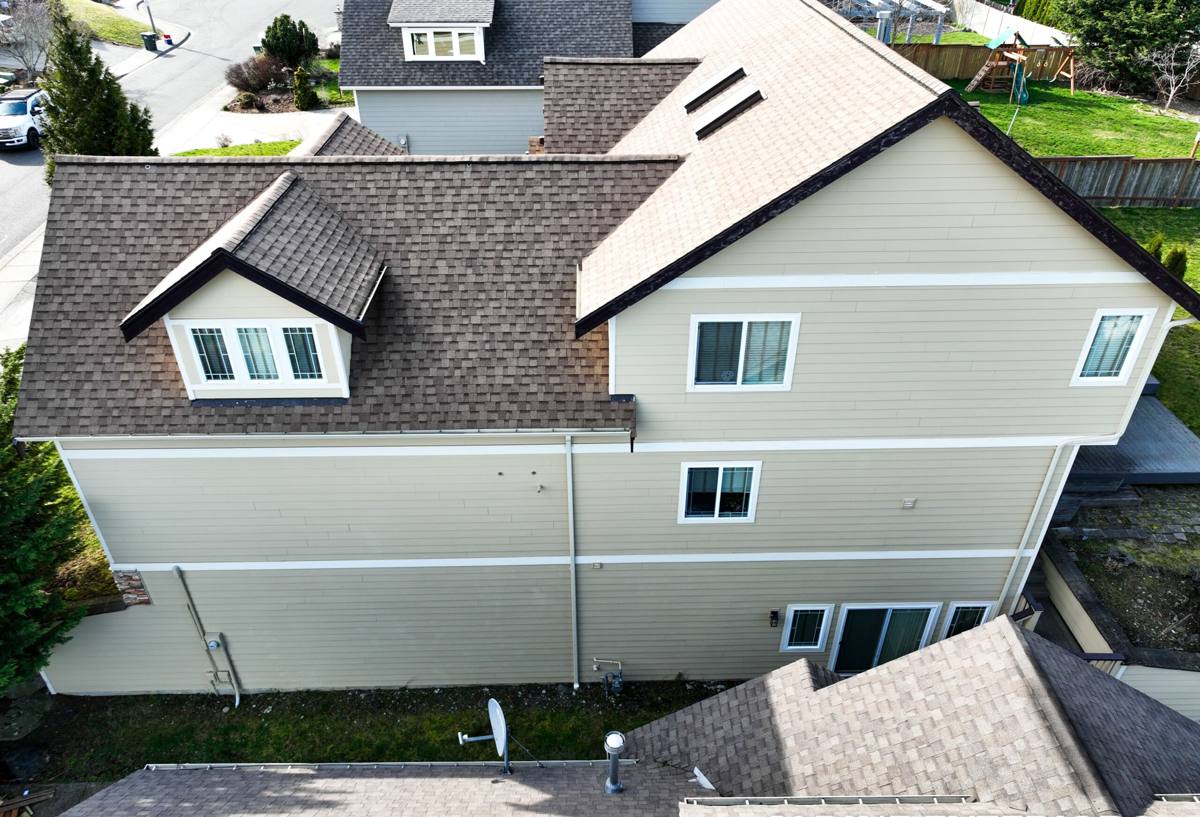
What Kendall Homes Actually Need From a Roof
Before talking panel styles or price, it helps to understand what's actually working against a roof out here.
Moss and Organic Growth
Shaded rooflines, north-facing slopes, and homes tucked near trees hold moisture longer after a rain event. That moisture is what moss needs to establish. On composition shingle, moss roots into the granule layer and lifts it, shortening the roof's life. On a properly installed metal roof, there's no granule layer to root into, and the smooth, sloped panel surface sheds water and debris quickly enough that moss has a much harder time getting a foothold.
Sustained Wet Season
Whatcom County's rainy season isn't just frequent rain — it's weeks of sustained dampness where roofs rarely get a full dry-out period. That's tough on any roofing material's fasteners, flashing, and underlayment. Metal systems handle sustained moisture well, but only when flashing at valleys, penetrations, and roof-to-wall transitions is detailed correctly the first time, since repeat access for repairs is harder on a metal roof than shingle.
Wind-Driven Rain
Storms coming through the county often bring rain sideways, not just down. That pushes water into laps, seams, and fastener penetrations that would stay dry in a calmer rain. Panel overlap, fastener spacing, and sealant choice all need to account for that lateral pressure, not just gravity drainage.
Temperature Swings and Snow Load
Kendall's slightly more inland, higher-elevation position than Ferndale proper means it can see colder snaps and occasional snow accumulation that coastal parts of the county miss. Metal roofing sheds snow well once it's in place, but the roof deck and structure underneath still need to be sound, and ice-damming risk at eaves needs to be addressed with proper underlayment, not assumed away because "metal doesn't ice dam."
Panel Types We Install
Not every metal roofing product is a fit for every home, and we don't push one option across the board. Here's how the common choices compare for a residential job in this area.
| Panel Type | Best For | Trade-Offs |
|---|---|---|
| Standing seam (concealed fastener) | Most homes; long-term low-maintenance goal | Higher upfront cost; requires skilled installation for clean seams |
| Exposed-fastener panel (e.g. ribbed/corrugated) | Outbuildings, shops, budget-conscious re-roofs | Fasteners penetrate the panel face; gaskets age and need eventual re-torque or replacement |
| Stone-coated steel | Homeowners wanting a traditional shingle or shake look | More installation steps; more seams and fastener points than standing seam |
For most Kendall homes, we lean toward standing seam because the concealed fastener system removes the long-term maintenance item of exposed screws working loose or gaskets drying out — a real concern given how many wet-dry cycles this climate puts a roof through in a year. That said, exposed-fastener panels are a legitimate, more affordable option for shops, garages, and secondary structures where the maintenance trade-off makes sense.
What a Correct Metal Roof Installation Involves
A metal roof is only as good as what's underneath and around it. Here's what we consider non-negotiable on every install:
- Deck inspection and repair — any soft, delaminated, or water-damaged sheathing gets replaced before a single panel goes on
- Ice-and-water shield at eaves and valleys — critical protection against wind-driven rain and any ice-damming risk
- Synthetic underlayment across the full deck — a secondary water barrier in case anything ever gets past the panels
- Proper ventilation at ridge and soffit — trapped attic moisture is a bigger threat to a metal roof's substrate than most homeowners expect
- Correct panel-to-fastener matching — fastener type, spacing, and torque specific to the panel manufacturer's requirements, not a generic install
- Custom-formed flashing at every penetration, valley, and wall transition — stock flashing rarely fits a real roofline correctly
- Proper panel overlap and sealant at laps — sized for wind-driven rain, not just standard gravity drainage
Skipping any one of these doesn't usually cause an immediate failure — it causes a problem that shows up in year three or year eight, after the crew that installed it is long gone. That's the gap we're most often called in to fix on other contractors' work.
Our Process for a Kendall Metal Roof Project
1. On-Site Assessment
We walk the roof, check the deck condition where accessible, look at existing ventilation, and note anything specific to the property — tree cover, roof pitch, shaded areas prone to moss, existing moisture damage. This is also where we talk through panel options honestly, including what we would and wouldn't recommend for that specific roof.
2. Written Estimate
You get a clear scope of work and pricing before any commitment — what's being removed, what underlayment and flashing package is included, and the panel type and finish being quoted.
3. Tear-Off and Deck Prep
Old roofing comes off, the deck gets inspected, and any damaged sheathing is replaced. This step is where hidden problems from years of moss and moisture retention often surface, and we'll show you what we find before proceeding.
4. Underlayment and Flashing
Ice-and-water shield goes down at vulnerable areas, synthetic underlayment covers the rest of the deck, and all flashing is custom-formed and installed before panels go up.
5. Panel Installation
Panels are installed to manufacturer spec for fastener pattern, spacing, and overlap, with attention to how the roof will handle both standing water and wind-driven rain given its specific slope and exposure.
6. Final Walkthrough
We walk the finished roof with you, cover care and maintenance basics, and make sure you know what documentation and warranty coverage applies to your job.
Maintenance: What Metal Roofing Does and Doesn't Need
One of the appeals of metal roofing in a moss-prone climate like this is how little routine maintenance it needs compared to shingle. That doesn't mean zero maintenance.
- Keep gutters and valleys clear of needles and debris so water has a clear path off the roof
- Trim back tree limbs that overhang the roofline to reduce shade and debris buildup, which limits moss and lichen establishment
- Have penetrations (vents, flashing, chimney flashing) visually checked periodically, especially after major wind events
- Avoid pressure washing panel finishes — it can damage coatings and force water under laps
Compare that to a shingle roof in this climate, which typically needs periodic moss treatment, granule loss monitoring, and a shorter overall service life due to the constant damp exposure Whatcom County delivers.
Cost Factors for a Kendall Metal Roof
Every roof is different, but the main variables that move the price on a metal roofing project are consistent:
| Factor | Why It Matters |
|---|---|
| Panel type | Standing seam costs more than exposed-fastener panel due to material and labor complexity |
| Roof complexity | Valleys, dormers, and multiple roof planes require more custom flashing and labor time |
| Deck condition | Rot or delamination found during tear-off adds repair cost not visible during a surface estimate |
| Existing layers | Full tear-off of old roofing adds cost but is usually the right call for a metal roof, since manufacturers generally require a clean substrate |
| Ventilation upgrades | Adding or correcting ridge/soffit ventilation during the project is cheaper than doing it later |
We'd rather walk you through these variables on your specific roof than quote a number that doesn't hold up once we're actually up there.
Why Hire a Crew That Already Works in This Area
Kendall's mix of tree cover, elevation, and sustained wet-season exposure isn't identical to a roof five miles away in downtown Ferndale or out toward the water. A crew that regularly works Whatcom County properties knows to check for the moss-prone shaded slopes, understands how local wind patterns drive rain into laps and flashing, and isn't guessing at what underlayment package actually holds up here versus what a manufacturer's minimum spec sheet says for a drier climate. That local familiarity shows up in the details — flashing choices, ventilation decisions, fastener selection — that don't show up on a glossy brochure but absolutely show up in how the roof performs ten years out.
If you're weighing a metal roof for your Kendall property, we're happy to come take a look, walk you through honest options for your specific roof, and put together a straightforward estimate — no pressure, no sales script. The form below gets you started.