 Ferndale
 Composite Decking Built for Sudden Valley's Climate
Sudden Valley sits in a part of Whatcom County where the weather does not let up on outdoor structures. Salt-laden air moves in off the water, driving rain soaks anything with exposed grain, and a long moss season blankets shaded, low-airflow surfaces for months at a time. A deck built without those conditions in mind will show it within a few seasons — soft spots, green film on the boards, fasteners that back out, and a substructure that stays damp long after the sun comes back out.
Composite decking, installed correctly, holds up far better against that combination than dimensional lumber. But "composite" is not one product, and a composite deck is only as good as the framing, flashing, and fastening underneath it. This page covers what a Sudden Valley home actually needs from a composite deck, what we check before we ever set a board, and how our process is built around the realities of this specific area rather than a generic install.
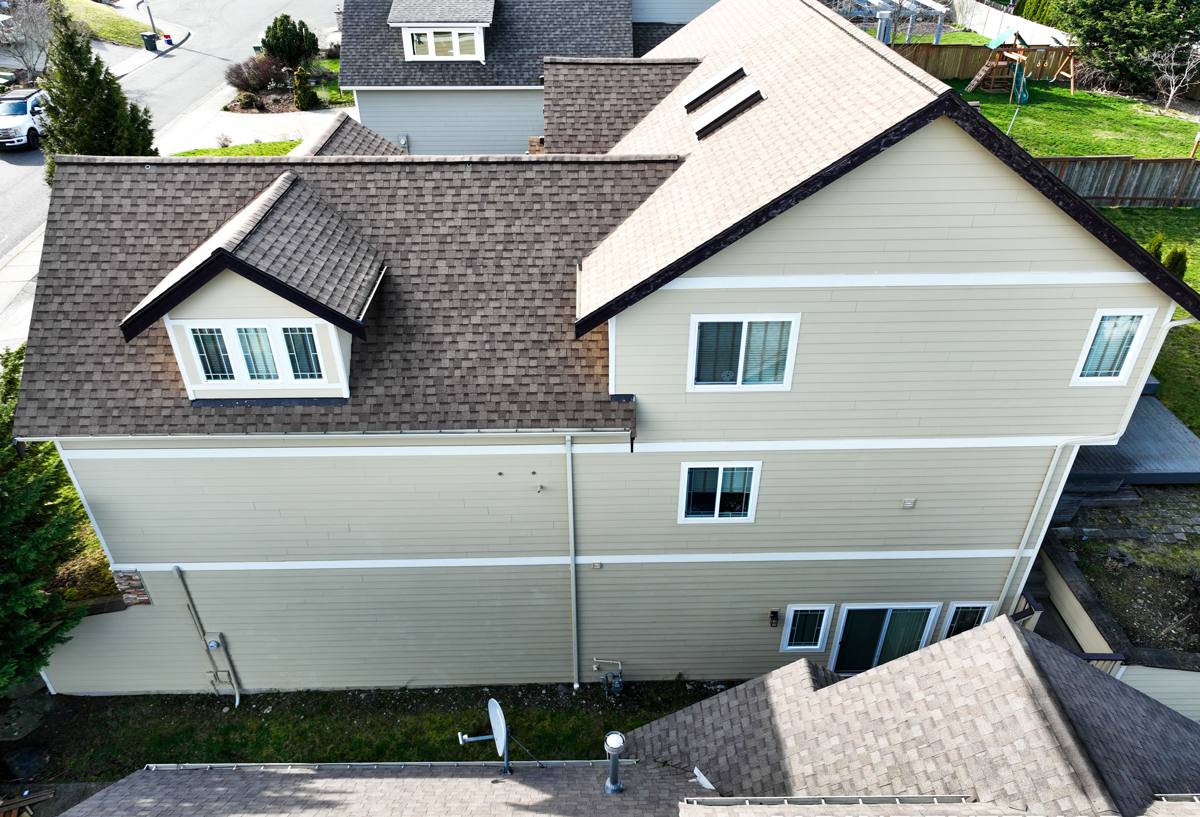
What Whatcom County Weather Does to an Outdoor Deck Over Time
Moss and Algae Growth
Shaded decks near trees or on the north side of a home stay damp for extended stretches, especially through fall and winter. That moisture, combined with limited direct sun, is exactly what moss and surface algae need to take hold. On wood decking this often means yearly power-washing and re-staining just to keep the surface from getting slick. On composite decking, the surface matters — some boards resist organic growth far better than others because of how their outer layer is capped and how textured the surface is.
Driving Rain and Standing Moisture
Rain here does not always fall straight down. Wind-driven rain gets under railings, into board gaps, and against ledger connections at the house. If those areas are not flashed and gapped correctly, water gets trapped rather than draining, and that trapped moisture is what eventually rots framing or causes fastener corrosion even under a composite surface that looks fine from above.
Salt Air and Metal Fasteners
Proximity to salt air accelerates corrosion on lower-grade screws, brackets, and joist hangers. A deck can look structurally sound on the surface while its hardware is quietly degrading underneath. This is one of the most common failure points we find on older decks in this area, and it is entirely preventable with the right hardware from the start.
What a Correct Composite Deck Installation Actually Involves
A composite deck is not just "wood framing with plastic boards on top." The framing and details underneath the surface determine whether the deck lasts fifteen years or thirty. Here is what we treat as non-negotiable on every Sudden Valley project:
- Ledger board flashing that directs water away from the house wall, not into it
- Joist tape or an equivalent protective barrier on top of every joist, so the composite decking's fasteners don't sit on exposed, moisture-absorbing wood
- Corrosion-resistant fasteners and hardware rated for coastal or high-moisture exposure, not standard interior-grade hardware
- Proper board spacing for drainage and seasonal expansion, since composite boards move with temperature more than most homeowners expect
- Adequate airflow underneath the deck so the substructure can actually dry out between rain events instead of staying saturated
- Hidden fastener systems installed to the manufacturer's spec, since incorrect spacing or torque is a common cause of surface warping later
Skipping any one of these does not usually show up right away. It shows up in year three or four, when the surface boards still look new but the frame underneath has been quietly absorbing moisture the whole time.
Composite Decking Compared to the Alternatives
Homeowners in Sudden Valley usually weigh composite decking against pressure-treated wood or PVC decking. Each has real trade-offs, and there is no single "best" answer for every home — it depends on budget, how much upkeep you want to do, and how the deck will be used.
| Decking Type | Moisture & Moss Resistance | Maintenance | Typical Lifespan |
|---|---|---|---|
| Pressure-treated wood | Lowest — absorbs water, grows moss in shade, needs regular sealing | Annual cleaning, staining, and inspection for soft spots | 10–15 years with upkeep |
| Capped composite | Strong — capped outer layer resists moisture absorption and staining | Occasional washing; no staining or sealing | 25–30+ years |
| PVC decking | Very strong — fully synthetic, essentially non-absorbent | Minimal; can run hotter in direct sun | 25–30+ years |
We generally steer homeowners toward capped composite for most Sudden Valley applications because it strikes a good balance: it handles the moss and moisture concerns well, it does not require the ongoing sealing that wood does, and it is more forgiving of installation tolerances than some PVC products. Non-capped or budget composite boards, by contrast, can still absorb moisture at cut edges and are more prone to surface staining over time — we will walk you through the specific product lines we install and why, based on your budget and how the deck will be used.
Our Process for Sudden Valley Deck Projects
1. On-Site Assessment
We look at sun exposure, drainage patterns around the home, existing framing condition if this is a replacement, and how the deck ties into the house. This is where we catch ledger or moisture issues before they become part of a new deck's problems.
2. Permitting
Most deck projects of meaningful size require a permit through the local jurisdiction. We handle that process as part of the job so you are not left tracking down inspections on your own.
3. Tear-Off and Framing Inspection or Build
On a replacement, we remove the old decking down to the frame and evaluate every joist, beam, and post connection. Anything compromised by rot or corrosion gets replaced before new decking goes down — not patched around.
4. Moisture Protection and Framing Prep
Joist tape, ledger flashing, and corrosion-resistant hardware go in at this stage. This is the part of the job that is invisible once the deck is finished, and it is the part that determines how well the deck holds up to the driving rain and salt air this area sees.
5. Composite Installation
Boards go down to manufacturer spec for spacing, fastening, and expansion gaps, with attention to drainage so water moves off the deck rather than pooling.
6. Final Walkthrough
We go over the finished deck with you, including what routine care looks like and what to watch for as the seasons change.
What Drives the Cost of a Composite Deck
Every project is different, but these are the factors that most affect price on a Sudden Valley composite deck:
| Factor | Why It Matters |
|---|---|
| Deck size and shape | More square footage and more cuts around angles or curves increase material and labor |
| Framing condition | A full tear-off with rotted or corroded framing costs more than an install over sound, existing structure |
| Composite product tier | Capped composite and PVC cost more upfront than basic composite but require less long-term upkeep |
| Railing and stair systems | Composite or metal railing systems, multiple stair runs, and lighting add to the total |
| Site access and grade | Sloped lots or limited equipment access around a home can add labor time |
We give straightforward, itemized estimates so you can see exactly where the money is going and where you have room to adjust the scope if needed.
Keeping a Composite Deck Looking Good Through Moss Season
Composite decking cuts down maintenance significantly compared to wood, but it is not zero-maintenance in a climate like this one. A little seasonal attention goes a long way:
- Sweep off leaves, needles, and debris regularly, especially in fall — trapped organic material is what feeds moss and mildew growth
- Rinse the deck with plain water periodically through the wet months, particularly in shaded sections
- Use a soft-bristle brush and a mild composite-safe cleaner for any surface film, rather than a pressure washer on high setting, which can damage the board's cap layer
- Check that gaps between boards stay clear so water continues to drain instead of pooling
- Confirm underneath the deck stays ventilated — trimming back vegetation that blocks airflow underneath helps the substructure dry between storms
Why Hiring a Crew That Already Works in Sudden Valley Matters
Deck framing details that work fine in a drier climate are not enough here. A crew that has built and repaired decks throughout Ferndale and the surrounding Whatcom County area already knows where moisture tends to collect on homes near the water, how much airflow a substructure actually needs in this climate, and which hardware holds up against salt air rather than corroding early. That local pattern recognition is the difference between a deck that gets re-flashed and re-decked in eight years and one that is still solid decades later.
It also means fewer surprises during the project itself — permitting quirks, typical soil and drainage conditions on local lots, and realistic timelines around the wetter months are all things a local crew has already worked through many times over.
If you are considering a new composite deck or need to replace an aging one in Sudden Valley, we are happy to take a look and give you a straightforward, no-pressure estimate. Use the form below to get started.