 Ferndale
 Why This Stretch of Whatcom County Wears Out Siding Faster
Homes in and around Lummi Nation sit close to open water, and that changes what siding has to deal with day to day compared to a house further inland. Between the salt air coming off the bay, wind-driven rain that hits walls sideways instead of falling straight down, and a wet season that stretches long into spring, exterior siding here is working harder than it would almost anywhere else in Whatcom County. When we talk to homeowners about a siding replacement in this area, we start with the climate, because the climate is what determines whether the job holds up for twenty years or starts failing in five.
Salt Air and Constant Moisture
Airborne salt doesn't just affect metal fasteners and hardware — it also holds moisture against exterior surfaces longer than dry inland air does. Wood-based products absorb that moisture, swell, and eventually start to separate at seams and edges. Paint and factory finishes break down faster under that kind of chronic dampness. Siding near the water needs a substrate that doesn't take on moisture the way wood or wood-composite products do, and it needs fasteners and flashing details that are built for a corrosive environment, not just a rainy one.
Wind-Driven Rain from the Water
Rain that comes straight down is one problem. Rain that gets pushed sideways by wind off the water is a different and harder problem, because it finds its way into laps, seams, and penetrations that would stay dry in a calmer setting. This is why the water-resistive barrier, the flashing around windows and doors, and the way courses of siding overlap matter more here than they would on a sheltered inland lot. A siding job that looks fine on a dry day can still be letting water behind it during a wind-driven storm off the bay — and you usually don't find out until there's already damage to the sheathing.
Shade, Moss, and the Long Wet Season
Whatcom County's wet season runs long, and shaded north- and west-facing walls near tree cover stay damp for weeks at a stretch. That's exactly the environment moss and algae need to take hold. Once moss establishes on a wall, it holds moisture against the surface, which accelerates whatever damage the salt air and driving rain are already causing. Siding replacement here isn't just about picking a color and a plank profile — it's about choosing a product and an installation approach that resists that combination of salt, rain, and shade instead of feeding it.
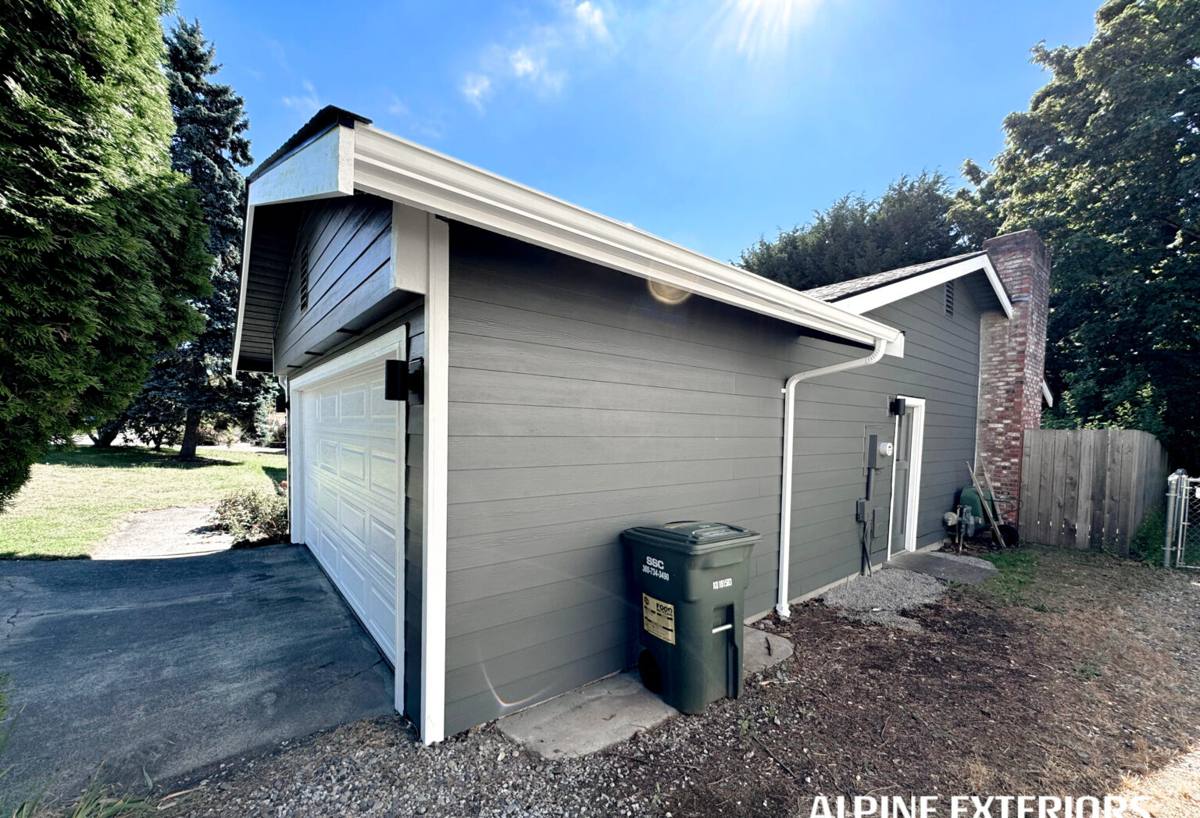
What a Correct Siding Replacement Actually Involves
A siding replacement is more than swapping old panels for new ones. Done right, it's a chance to fix whatever caused the old siding to fail in the first place — and in a marine climate, that's almost always a moisture problem, not just an appearance problem.
Full Tear-Off, Not a Cover-Up
Installing new siding directly over old, failing siding traps whatever moisture and damage is already there. On a home exposed to this much wind-driven rain and salt air, that's a mistake that shows up again within a few years. A correct replacement means removing the old siding down to the sheathing so the crew can actually see what's underneath.
Checking the Sheathing Before Anything Goes Back On
Once the old siding is off, the sheathing gets inspected for soft spots, rot, and prior water damage — problems that are common on homes that have taken on years of coastal moisture behind failing siding or gaps in old flashing. Any damaged sheathing gets repaired or replaced before new siding goes up. Skipping this step is one of the most common reasons a "new" siding job fails early.
Flashing and Water Management Details
Every penetration — windows, doors, hose bibs, light fixtures, vents — needs proper flashing so water is directed out and away from the wall assembly rather than into it. On a home this exposed to wind-driven rain, we pay particular attention to head flashing above windows and doors, kick-out flashing where a roofline meets a wall, and the overlap at horizontal laps. These are small details, but they're the difference between siding that sheds water and siding that eventually lets it in.
Why We Only Install James Hardie Fiber Cement
We install James Hardie fiber cement siding exclusively. We don't install vinyl, LP SmartSide, or cedar, and that's a deliberate standard, not a limitation in what we're able to do. Each of those products has real strengths, but in a salt-air, high-moisture environment like this one, they come with trade-offs we're not willing to put our name behind.
| Material | How It Handles Salt Air & Moisture | Ongoing Maintenance |
|---|---|---|
| Vinyl | Doesn't absorb moisture itself, but can warp, fade, or become brittle under sun and temperature swings; seams and fasteners are the weak point in wind-driven rain | Low, but repairs are visible and matching old panels gets harder over time |
| Cedar / wood | Absorbs moisture readily; salt air and constant dampness accelerate rot, cupping, and finish failure | High — regular refinishing and vigilant caulking required |
| LP SmartSide | Engineered wood strand product; performs well when detailing is precise, but any breach in the factory coating exposes wood fiber to the same moisture risks as other wood products | Moderate — depends heavily on installation quality and prompt repair of any damage |
| James Hardie fiber cement | Non-combustible, dimensionally stable, engineered specifically for wet climates in its HZ5 product line; doesn't swell, rot, or feed moss the way wood-based sidings can | Low — factory ColorPlus finish holds color and resists moisture without regular refinishing |
Hardie's ColorPlus factory finish is baked on rather than field-applied, which matters in a climate where a field-applied paint job has to fight constant humidity to cure and adhere properly. The HZ5 product line is engineered for exactly this kind of climate — wet, coastal, and prone to moss and mildew. Combined with a strong transferable warranty, that's why fiber cement is the only product we put on homes in this part of Whatcom County.
Our Process for a Siding Replacement Near Lummi Nation
- Inspection and assessment. We look at the current siding, the sheathing where accessible, existing flashing details, and any moss, staining, or soft spots that point to trapped moisture.
- Written estimate. You get a clear scope of work and pricing before anything starts — no vague allowances that turn into surprise change orders.
- Full tear-off. Old siding comes off completely so the crew can see and address the substrate underneath.
- Sheathing repair. Any damaged or compromised sheathing is replaced before the weather-resistive barrier goes back on.
- Weather barrier and flashing. A new water-resistive barrier is installed with correct overlaps, and flashing is detailed around every window, door, and penetration.
- James Hardie installation. Siding is installed to Hardie's published specifications — correct fastener type and spacing, proper clearances, and factory-finished cuts sealed where required.
- Final walkthrough. We go over the finished work with you before calling the job done.
What Drives Cost on a Job Like This
Every home is different, so we don't quote firm numbers without seeing the house, but a few factors consistently move the price up or down on jobs in this area.
| Factor | Why It Matters |
|---|---|
| Condition of the existing sheathing | Hidden rot or water damage found during tear-off adds repair work before new siding can go on |
| Home size and wall complexity | More corners, dormers, and cutouts around windows and doors mean more labor and material waste |
| Siding profile chosen | Lap siding, board and batten, and shingle-style Hardie products differ in material and installation time |
| Trim and accessory work | Replacing trim, fascia, or soffits alongside the siding is more efficient than doing it as a separate project later |
| Access and site conditions | Tree cover, slope, and how close the home sits to the water can affect staging and scheduling around weather |
Keeping New Siding Looking Right in a Marine Climate
Even the right product installed correctly benefits from a little routine attention in a climate like this one. None of this is difficult or expensive — it's mostly about not letting small issues sit long enough to become bigger ones.
- Rinse siding once or twice a year to clear salt residue, especially on walls facing open water
- Keep gutters clear so overflow doesn't run down the wall face and feed moss growth
- Trim back vegetation and tree limbs that keep a wall shaded and damp longer than necessary
- Check caulking around windows, doors, and trim annually and touch up before gaps let water behind the siding
- Address any moss or algae promptly with a gentle wash rather than letting it establish and hold moisture against the surface
- Watch for any soft spots, cracks, or areas where paint or finish looks like it's failing, and have them checked before they spread
Why Hiring a Crew That Already Works This Area Matters
Siding installation isn't one-size-fits-all, and a crew that mostly works drier, more sheltered parts of the Pacific Northwest may not think about flashing and drainage details the same way a crew that works this coastline regularly does. Homes near Lummi Nation see a specific combination of stresses — salt air, wind-driven rain, and a long shaded wet season — and correct installation has to account for all three at once, not just one of them. A contractor who already understands how water moves across a wall in this environment is going to make better decisions about flashing, fastener choice, and detailing than one working from a generic playbook.
There's also a practical side to hiring local: scheduling around this area's weather patterns, sourcing materials without long delays, and being available if a question comes up after the job is done. We work this part of Whatcom County regularly, which means we're not guessing at what these homes are up against — we're building for it.
If your siding is showing moss, staining, soft spots, or finish failure, or if it's simply old enough that you're wondering how much longer it will hold up, we're glad to take a look. Reach out for a free, no-pressure estimate — we'll walk the exterior with you, explain what we see, and give you a straight answer about what a correct siding replacement would involve for your home.