 Ferndale
 Why Siding in Blaine Takes a Different Kind of Beating
Blaine sits about as close to the water and the weather as a Whatcom County home can get. That location is part of the appeal, but it's also why siding here fails faster than it does twenty miles inland. Homes in and around Blaine deal with a near-constant mix of salt-laden marine air, wind-driven rain coming straight off the water, and a moss and algae season that, in this part of Washington, barely takes a break. None of those three things individually destroys siding overnight. Together, over years, they find every weak seam, every under-caulked joint, and every product that wasn't built to handle repeated wetting and drying.
When we get called out for a siding repair in Blaine, the damage almost always traces back to one of those three forces, or some combination of them. Understanding which one is at work — and why — is the difference between a repair that lasts and one you're paying for again in two years.
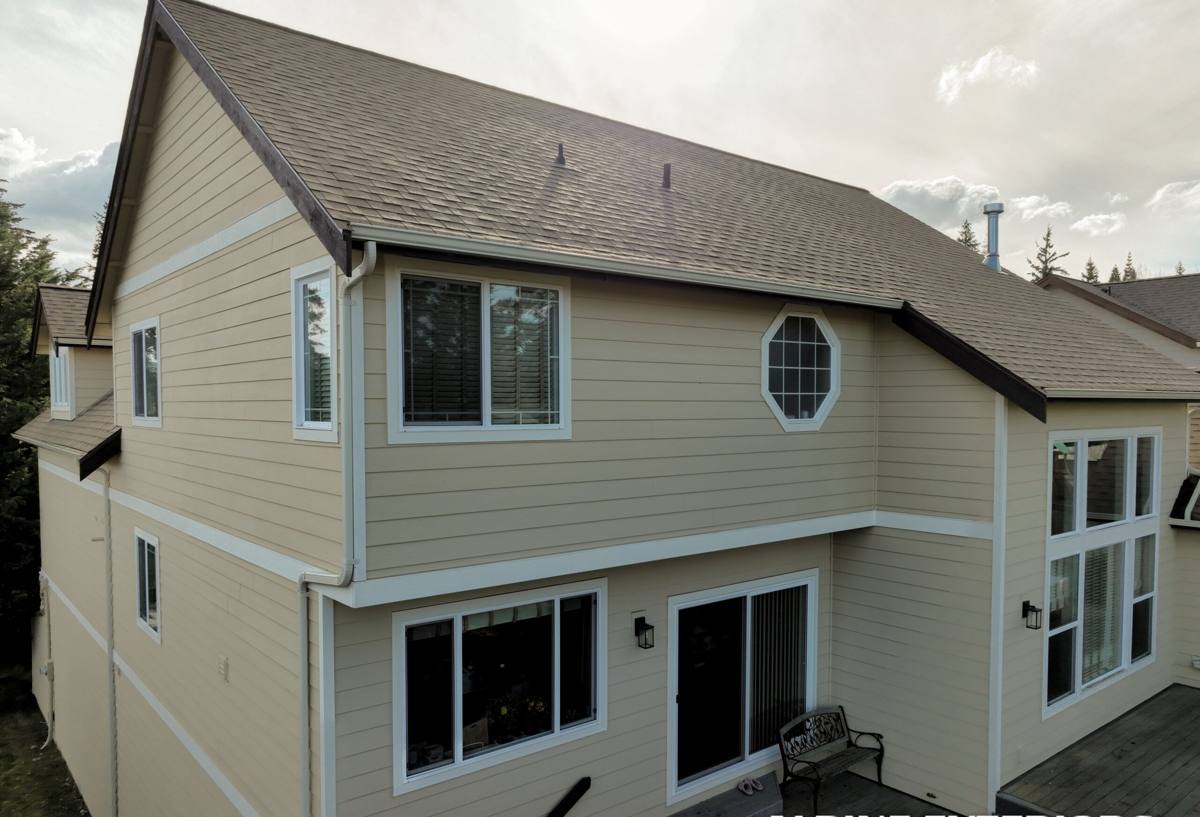
What Salt Air, Rain, and Moss Actually Do to Siding
Salt Air
Airborne salt is corrosive to metal fasteners, flashing, and trim hardware, and it accelerates the breakdown of finishes that aren't rated for coastal exposure. On wood and engineered wood products, salt-carried moisture works its way into any exposed edge or fastener hole and speeds up rot from the inside out. Even paint and factory finishes that hold up fine in drier inland climates can chalk, fade, or lose adhesion faster under sustained salt exposure.
Driving Rain
Rain that falls straight down is rarely the problem. Rain that's pushed sideways by wind off the water is. Wind-driven rain gets forced up under laps, into seams, and behind trim that would otherwise shed water fine in calmer conditions. If the original installation didn't account for that — correct lap spacing, proper flashing at penetrations, sealed and back-primed cut edges — those are exactly the spots that start failing first.
Moss and Algae
Whatcom County's long wet season gives moss and algae plenty of time to establish on siding, especially on north-facing walls and anywhere shaded by trees or neighboring structures. Moss doesn't just look bad — it holds moisture directly against the siding surface far longer than the material would otherwise stay wet, which accelerates rot in wood-based products and can stain or degrade finishes on almost anything it grows on.
Signs Your Blaine Home Needs Siding Repair
Most siding problems are visible well before they become structural. Here's what we tell homeowners to check for, especially after a wet winter:
- Soft or spongy spots when you press on the siding, particularly near the bottom courses and around window trim
- Visible cracking, buckling, or separation at seams and laps
- Paint or finish that's peeling, bubbling, or chalking heavily in one area but not others
- Dark streaking, moss, or algae buildup that keeps coming back after cleaning
- Gaps opening up around windows, doors, or corner trim
- Fastener heads showing rust stains or backing out of the surface
- Any spot where you can see daylight or feel a draft from inside near an exterior wall
Any one of these on its own might be a minor fix. Several showing up in the same area, or damage that's spreading year over year, usually means moisture has been getting behind the siding for a while — and that's worth a real inspection, not a caulk gun.
What a Correct Repair Actually Involves
There's a real difference between patching the visible symptom and fixing the underlying cause. A quick patch covers up the damaged section; a correct repair figures out how water got in, stops that pathway, and then replaces the damaged material with something that matches the performance of what's around it.
| Quick Patch Approach | Correct Repair Approach |
|---|---|
| Caulks over cracks and gaps without checking what's behind them | Removes affected boards to inspect sheathing, house wrap, and flashing underneath |
| Uses whatever siding material is on hand or cheapest | Matches material and profile so the repair doesn't stand out or perform differently |
| Ignores the source of water intrusion | Corrects flashing, trim gaps, or lap spacing that let water in originally |
| Paints over rot or soft wood to hide it temporarily | Cuts back to solid material and replaces anything compromised |
| Treats it as a one-time cosmetic fix | Treats it as part of the wall's long-term moisture management |
In a place like Blaine, where the same conditions that caused the damage are still there every winter, the quick-patch approach almost never holds up. We've replaced a fair number of other contractors' "repairs" that were really just caulk and paint over rot that kept spreading underneath.
Why We Repair With James Hardie Fiber Cement
We install and repair James Hardie fiber cement siding exclusively — we don't install vinyl, LP SmartSide, primed spruce, cedar, or other fiber cement brands like Cemplank or Allura. That's a deliberate standard, not a limitation, and it matters directly to repair work.
Fiber cement is non-combustible and doesn't swell, rot, or delaminate the way wood-based or engineered wood siding can when it stays wet. Hardie's ColorPlus factory finish is baked on rather than field-applied, which means it holds color and resists the chalking and fading that salt air accelerates on site-painted products. When we repair a section of Hardie siding, we're replacing damaged boards with material engineered for the same coastal and marine exposure your home already deals with — including HZ5 products specifically formulated for wetter, harsher climates like ours.
If your home currently has vinyl, wood, or another engineered siding that's failing, we'll give you an honest read on whether a targeted repair makes sense or whether you're better off addressing that section — or eventually the whole elevation — with Hardie instead of continuing to patch a product that's working against the climate rather than with it.
Our Repair Process
- Inspection. We look past the visible damage — checking trim, flashing, seams, and any adjacent siding for signs the same moisture path has spread further than it looks.
- Diagnosis. We identify why the failure happened: a flashing gap, an under-lapped seam, a caulk joint that failed, or straightforward age and weathering.
- Scope and estimate. You get a clear explanation of what's being replaced, why, and what it'll cost — no vague line items.
- Removal. Damaged material comes out cleanly, and we check the sheathing and water-resistive barrier underneath before closing anything back up.
- Correction. Any flashing, trim gap, or lap issue that caused the failure gets fixed as part of the repair, not left in place.
- Replacement. New material goes in matched to the existing siding's profile and finish, installed to manufacturer spec for our coastal exposure.
- Final check. We walk the repair with you before calling it done.
Repair vs. Replace: How We Help You Decide
Not every damaged section needs a full re-side, and we're not going to tell you it does. But there's a point where repeated repairs cost more over time than replacement would have. A few factors we weigh with homeowners:
| Factor | Favors Repair | Favors Replacement |
|---|---|---|
| Extent of damage | Isolated to one or two areas | Spread across multiple elevations |
| Age of existing siding | Relatively recent, otherwise sound | Original siding is decades old or already past its expected service life |
| Underlying cause | A single, fixable source (one flashing detail, one seam) | Systemic issue — original installation lacked proper moisture management throughout |
| Material match | Matching product/profile is available | Existing siding is discontinued, mismatched, or a product we won't install |
| History of repeat repairs | First real issue on this wall | Same section has been patched multiple times already |
We'll tell you straight which category your situation falls into. If a repair genuinely solves the problem, that's what we'll recommend and price — there's no upside for us in overselling a full replacement you don't need.
Why Hire a Crew That Already Works in Blaine
Siding repair in a coastal Whatcom County town isn't quite the same trade as siding repair in a dry inland climate. A crew that regularly works Blaine and the surrounding coastal areas already knows which details tend to fail first under this kind of wind and salt exposure, how much lap and flashing margin actually holds up here versus what a spec sheet says is minimum, and how aggressively moss and algae come back if the underlying moisture issue isn't actually resolved. That local pattern recognition shows up in fewer callbacks and repairs that are sized correctly the first time, instead of a series of small fixes that never quite catch up to the real problem.
Get an Honest Look at Your Siding
If you're seeing soft spots, cracking, persistent moss, or gaps opening up around trim, it's worth getting an inspection before the damage spreads any further into a Blaine winter. We'll give you a straightforward assessment of what's actually going on, what it'll take to fix it correctly, and whether a repair or a longer-term replacement makes more sense for your home. Fill out the form below for a free, no-pressure estimate.