 Ferndale
 Why Windows Fail Faster in Sandy Point
Sandy Point sits close enough to the water that salt-laden air is just part of daily life. That air finds its way into every gap in a window assembly it can reach — corroding hardware, breaking down old sealants, and working into wood sashes that were never built to handle it. Add in driving rain that comes off the Strait of Georgia at an angle rather than straight down, and you've got water pressure testing every seam in a window, not just sitting on the sill waiting to be shed.
Then there's moss season, which in this part of Whatcom County runs long — often from fall through spring. Moss and algae don't just grow on roofs. They colonize window sills, tracks, and the wood trim around older frames, holding moisture against the surface for weeks at a time. On a home a few miles inland, a window might dry out between storms. On a home in Sandy Point, it often doesn't get the chance.
None of this means windows in Sandy Point are doomed to fail early. It means the margin for a sloppy install or the wrong product is much smaller here than it is elsewhere in Ferndale or Bellingham. A window that's "good enough" inland can be a five-year problem on the water.
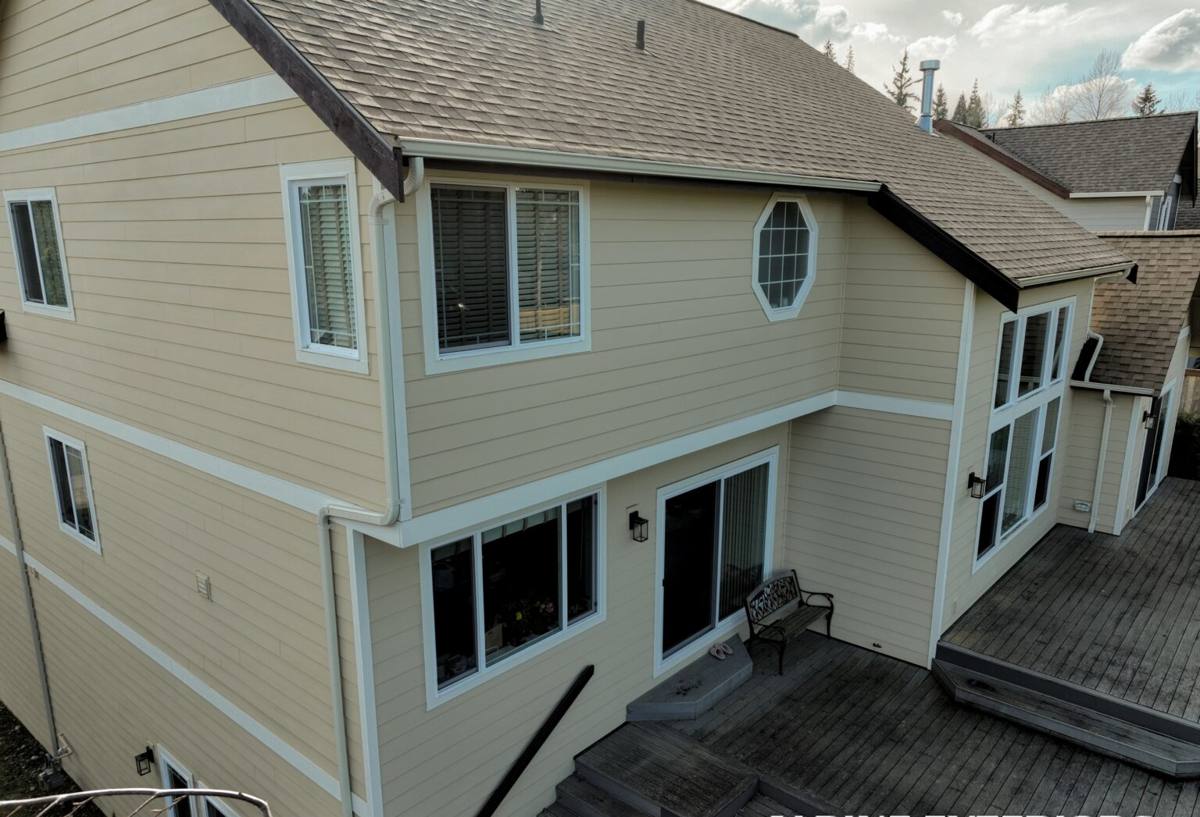
Signs a Sandy Point Home Needs Window Replacement
Salt air and moisture damage don't always show up as an obvious leak. Often it's slower and easier to miss until it's already expensive. Walk your window line and look for these:
- Sashes that feel swollen, stick when opening, or won't latch flush anymore
- Visible pitting, chalky residue, or corrosion on hardware, hinges, or locks
- Persistent condensation between the panes of a double-pane unit (a sign the seal has failed)
- Soft or discolored wood at the sill, corners, or bottom rail
- Moss or dark green growth building up in the tracks or on exterior trim
- A noticeable draft or cold spot near the frame in windy weather
- Paint or finish that's bubbling, peeling, or won't hold no matter how often it's redone
Any one of these on its own might just mean a repair or a re-caulk. Two or three together, especially on a window facing the water, usually means the frame or the seal is past the point where patching makes sense.
What a Correct Window Replacement Actually Involves
Most window failures we see in coastal Whatcom County homes weren't caused by a bad product — they were caused by a rushed or incomplete install. The window itself is only part of the system. Getting it right means paying just as much attention to what you can't see once the trim goes back on.
Flashing and Water Management
Every window opening needs to be flashed so that any water that gets past the exterior cladding is directed back out, not down into the wall cavity. In a home taking regular wind-driven rain off the water, this isn't optional detail work — it's the difference between a window that lasts and one that rots the framing around it from the inside. We integrate the flashing with the house wrap or weather barrier in the correct shingle-lap order, sill first, so water always has a way out.
Sealing Without Trapping Moisture
It's tempting to caulk every gap solid and call it weathertight. That's actually a mistake in a marine climate — a fully sealed opening with no way to drain traps any moisture that does get in, and it will get in eventually. A correct install uses sealant where it belongs and leaves the weep paths and drainage gaps the manufacturer specifies, so the assembly can dry out between storms instead of holding water against the frame.
Fasteners and Hardware
Standard fasteners and hardware corrode faster this close to salt water. We use corrosion-resistant fastening appropriate for coastal exposure, and we spec hardware finishes that are rated to hold up rather than the builder-grade default.
Choosing the Right Frame Material
There's no single "best" window material — there's the right material for a given home, exposure, and budget. In Sandy Point, exposure to salt air and sustained moisture narrows the field more than it would a few miles inland.
| Frame Material | Salt Air / Moisture Performance | Maintenance | Typical Trade-Off |
|---|---|---|---|
| Vinyl | Good — won't corrode or rot, handles moisture well | Low | Limited color/finish options; can flex on very large openings |
| Fiberglass | Excellent — very stable, resists warping and corrosion | Low | Higher upfront cost than vinyl |
| Aluminum | Fair — durable structurally, but prone to corrosion pitting near salt water without a quality coating | Moderate | Higher heat transfer unless thermally broken |
| Wood | Requires real commitment — beautiful, but the most vulnerable to the moss-and-moisture cycle here | High | Needs regular refinishing to avoid rot; we'll always be honest about this before you commit |
| Wood-clad (wood interior, composite/aluminum exterior) | Good — exterior shell protects the wood from direct exposure | Low to moderate | Cost sits between solid wood and vinyl/fiberglass |
We're not going to tell you solid wood windows are a bad product — they're not. But we will tell you plainly that on a home with regular salt air and long stretches of damp shade, wood asks for a maintenance schedule most homeowners don't keep up with, and the consequence is rot at the sill and corners within a few seasons. If you love the look of wood, wood-clad frames get you most of that appearance with a lot less exposure risk.
Glass Packages Worth Considering
Frame material gets most of the attention, but the glass package matters just as much for a waterfront home. Double-pane with a low-E coating and an argon fill is the baseline we'd recommend for anything facing the water — it cuts down on both heat loss and the condensation that shows up first when a home is exposed to constant humidity swings. For homes taking the brunt of the wind directly, we'll also talk through impact-resistant or heavier-gauge glass options, less for storm impact and more because a stiffer glass package handles wind-load flex better over time without stressing the seal.
Our Window Replacement Process
- On-site assessment — we check the current windows, framing condition, and any signs of water intrusion before recommending anything
- Product selection — we walk through frame material, glass package, and finish based on your home's actual exposure, not a generic recommendation
- Removal — old units come out carefully, and we inspect the framing underneath for hidden rot or moisture damage before moving forward
- Repair as needed — any soft or compromised framing gets addressed before a new window ever goes in; installing new windows into damaged rough openings just hides a bigger problem
- Flashing and installation — proper shingle-lap flashing integration, correct shimming and leveling, and fastening specified for coastal exposure
- Sealing and finish work — interior and exterior trim, sealant, and a final check for square operation and a clean, weathertight seal
- Walkthrough — we go over care and any moss/moisture prevention steps specific to your home's location
What Window Replacement Costs in Sandy Point
Every home is different, but the same handful of factors drive cost on most Sandy Point projects. This isn't a quote — it's what to expect to talk through.
| Factor | Why It Matters Here |
|---|---|
| Frame material | Vinyl and fiberglass typically cost less upfront than wood or wood-clad, but hold up better against salt air with less long-term maintenance |
| Number and size of openings | Larger or custom-sized openings (common in older waterfront homes) cost more than standard sizes |
| Extent of framing repair | Homes with long-term moisture exposure sometimes need sill or framing repair discovered during removal — this is the biggest source of surprise cost, and we flag it before proceeding, not after |
| Glass package | Upgraded low-E coatings or heavier glass for wind exposure add cost but reduce condensation and drafts over the life of the window |
| Access and site conditions | Waterfront lots with limited access or steep grades can add labor time |
As a rough range, straightforward vinyl or fiberglass replacements typically run several hundred to over a thousand dollars per window installed, with wood, wood-clad, or larger custom units running higher. We'll give you real numbers for your home after a walkthrough — not a phone estimate.
Why It Matters That We Already Work in Sandy Point
A crew that mostly works dry, inland neighborhoods and shows up in Sandy Point for one job is guessing at things a local crew already knows — how far the salt exposure typically reaches, how long moss season actually lasts on a shaded, water-facing wall, and which flashing details hold up against wind-driven rain and which ones fail within a couple of winters. We've done window and siding work across Ferndale and the surrounding Whatcom County waterfront long enough to know the difference between a install that looks fine on install day and one that's still tight five years later.
We also know Whatcom County's permitting requirements for window replacement, which can vary depending on whether it's a like-for-like swap or a structural change to the opening. Getting that wrong can hold up a project or cause problems at resale — we handle it as part of the job, not as a surprise.
Timing Your Project
Window replacement can technically happen year-round, but the driving rain and long wet stretches that define this stretch of coastline make certain windows of the year easier to work in — shorter exposure time for the open framing, less risk of water getting into the wall before the new unit and flashing are in. If you're planning ahead rather than dealing with an active leak, we'll help you pick a window of time that keeps the job clean rather than rushed.
If your windows are showing wear, letting in drafts, or you're just planning ahead for a home this close to the water, we're happy to come take a look. The estimate is free, there's no pressure, and you'll get a straight answer about what your home actually needs — use the form below to get started.