 Ferndale
 Custer's Coastal Exposure Is Tougher on Siding Than Most Homeowners Realize
Custer sits close enough to the water that homes here take on a different kind of weather than siding a few miles inland. Salt-laden air off the Strait of Georgia and Puget Sound moves through this stretch of Whatcom County constantly, carrying fine salt particles that settle on exterior walls and accelerate corrosion of fasteners, trim, and any siding product that isn't built to handle it. Add in driving rain that comes in sideways during winter storms, and a moss season that can stretch from late fall through spring in the shade of mature evergreens, and you have a climate that is genuinely harder on a home's exterior than the regional average.
Most siding products are engineered for a generic climate zone, not for a specific combination of salt exposure, wind-driven moisture, and prolonged damp shade. That gap between generic engineering and local reality is exactly where siding failures start — usually quietly, behind the wall, long before a homeowner notices a problem on the surface.
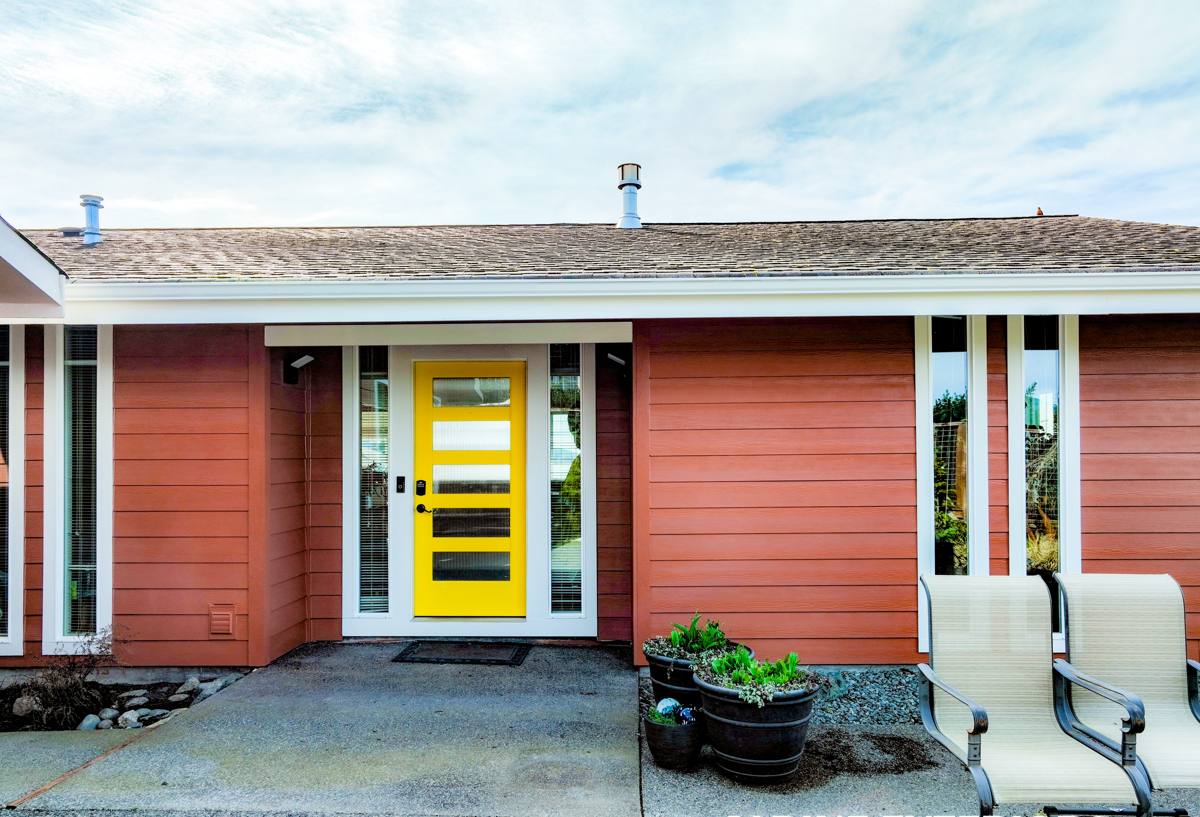
What Salt Air Actually Does to a House
Salt air is corrosive to metal and abrasive to organic materials. On a home near Custer, that shows up in a few predictable ways over time:
- Fasteners and flashing that aren't corrosion-rated begin to rust, staining the siding and eventually losing their grip
- Painted wood and composite trim absorb salt-laden moisture faster than they release it, leading to swelling and paint failure
- Caulk and sealant joints break down faster than their rated lifespan because salt accelerates UV and moisture breakdown of many sealant chemistries
- Any siding product with exposed seams or a porous face collects salt residue that holds moisture against the wall
None of this is dramatic on day one. It's cumulative — a slow erosion of the building envelope that eventually turns into rot, mold, or a premature repaint. The fix isn't a single product feature; it's choosing a siding system engineered for moisture and using installation details that keep water moving away from the wall instead of into it.
Why We Install Only James Hardie Fiber Cement in Custer
James Hardie fiber cement is a cement, sand, and cellulose fiber composite — not wood, not vinyl, not a wood-plastic composite. That composition matters directly for a coastal Whatcom County property:
It doesn't feed moss and mold
Moss needs an organic surface to root into. Fiber cement is inorganic, so it doesn't provide the food source that wood-based sidings do. Moss can still grow on top of dirt and grime if a wall is never cleaned, but it isn't feeding off the siding material itself the way it can with cedar or engineered wood products.
It's dimensionally stable in wet-dry cycling
Custer sees near-constant moisture in winter followed by drying stretches in summer. Wood-based products expand and contract with that cycle, which is what eventually opens up seams, cracks paint films, and loosens fasteners. Fiber cement moves far less, which keeps joints tighter and paint films intact longer.
ColorPlus factory finish resists the salt-and-UV combination
James Hardie's ColorPlus finish is baked on in a factory-controlled process, not brushed on in the field. That finish is formulated to resist fading and hold up to both UV exposure and the kind of airborne salt and moisture Custer homes deal with, which is a meaningfully different bar than a standard field-applied paint job.
Non-combustible
Not a coastal-specific point, but worth noting: fiber cement doesn't burn, which matters anywhere in Whatcom County given regional wildfire risk in dry summer stretches.
Material Comparison for Custer's Conditions
| Material | Salt Air / Moisture Behavior | Moss & Mold Resistance | Typical Maintenance |
|---|---|---|---|
| James Hardie Fiber Cement | Dimensionally stable, factory-sealed finish resists moisture intrusion | Inorganic surface, doesn't feed growth | Periodic wash, no repainting for many years with ColorPlus |
| Cedar / Primed Wood | Absorbs moisture, prone to swelling and warping near water | Organic surface, moss and mold can root directly into it | Regular repainting, caulk touch-ups, rot monitoring |
| Vinyl | Doesn't rot, but can warp and become brittle with temperature swings and UV | Doesn't feed growth, but seams collect grime moss can grow on | Low, but panels can crack or blow off in coastal wind |
| LP SmartSide / Engineered Wood | Wood-strand core is more moisture-sensitive than fiber cement | Engineered wood face is still organic | Edge sealing and seam maintenance is critical near water |
This isn't a claim that every alternative product fails — it's why, as a matter of professional standard, we've chosen to install only the one product line that performs most consistently in this specific climate rather than stock several products and let price alone decide.
What a Correct Fiber Cement Installation Requires Near the Water
The siding material is only half the equation. In a high-moisture, salt-exposed area like Custer, installation detailing is what actually determines whether a home stays dry for the next several decades. A correct install involves:
- Proper water-resistive barrier and rainscreen gap — a drainage plane behind the siding lets any moisture that does get past the surface drain and dry instead of sitting against the sheathing
- Corrosion-rated fasteners — stainless or hot-dip galvanized fasteners rated for coastal exposure, not standard fasteners that will rust and streak the siding within a few seasons
- Correct flashing at every penetration — windows, doors, vents, and hose bibs are where wind-driven rain finds its way in if flashing is skipped or done wrong
- Manufacturer-spec clearances — proper gap between siding and grade, decks, and roof lines so water doesn't wick up into the board
- Sealed and back-primed cut edges — factory finish protects the face of the board, but every field cut needs to be sealed to keep moisture out of the exposed core
Skipping any one of these doesn't usually cause an immediate, visible problem — it causes a five-to-ten-year problem, which is the worst kind because it's invisible until the repair bill is large.
How Our Process Works for Custer Homes
We treat every Custer project as a coastal-exposure job from the first visit, not a standard install with the address changed. That means:
- An on-site assessment that looks specifically at wind exposure, tree cover and shade (moss risk), existing moisture damage, and current flashing condition
- A written scope that specifies the exact James Hardie product line, fastener spec, and flashing details for that home — not a generic bid
- Removal of old siding with an inspection of the sheathing underneath before anything new goes up, so hidden rot or moisture damage gets addressed instead of covered over
- Installation to James Hardie's published fastening and clearance specifications, which is what keeps the manufacturer warranty valid
- A final walkthrough covering what the ColorPlus finish needs going forward and what to watch for given the home's specific sun and shade exposure
Why Hiring a Crew That Already Works Custer Matters
Coastal Whatcom County isn't uniform. A home tucked into tree cover a half-mile from the water deals with a different moss and shade problem than an open, wind-exposed lot closer to the shoreline. A crew that regularly works this specific stretch of coastline has already seen how salt exposure, prevailing wind direction, and shade patterns play out on real homes here — which shows up in better siding-line placement, flashing decisions at problem areas like window heads and deck ledgers, and realistic expectations about how the finish will age in this specific microclimate. That local pattern recognition is difficult to replicate with a crew that mostly works inland or out of the region.
Ongoing Care Checklist for Fiber Cement Siding in a Coastal Climate
- Rinse siding with a garden hose (not a pressure washer aimed directly at seams) once or twice a year to remove salt residue and grime
- Keep gutters clear so overflow doesn't run down the siding face repeatedly in the same spot
- Trim back vegetation and tree limbs that hold shade and moisture against any section of wall, which is the main driver of moss growth
- Inspect caulk joints around windows, doors, and trim annually and re-caulk before a joint fully opens up
- Watch for any streaking below fasteners or trim, which can signal a fastener starting to corrode
- Address any impact damage (chips, cracks) promptly so the underlying core isn't exposed to moisture
Get a Straight Answer for Your Custer Home
Every coastal property carries its own combination of shade, wind exposure, and moisture history, and that's exactly what should drive the siding decision — not a one-size-fits-all quote. If you're weighing a siding replacement or repair in Custer, we're glad to take a look, walk the exterior with you, and give you a straightforward assessment along with a free, no-pressure estimate.