 Ferndale
 Why Homes Near Lummi Nation Wear Out Siding Faster
Homes in and around Lummi Nation sit close to Bellingham Bay and the open water of the Salish Sea, which means siding here deals with a combination of stresses that inland Whatcom County homes simply don't see as often. Salt-laden air moves off the water and settles on exterior surfaces, wind-driven rain gets pushed sideways into wall assemblies rather than falling straight down, and the shaded, damp conditions common through fall, winter, and spring create a long moss and algae season that can run eight months or more. Any one of these on its own is manageable. Together, they're the reason siding that looks fine in Spokane or Yakima can start failing in half the time out here.
Salt air is corrosive to unprotected metal fasteners and trim, and it accelerates the breakdown of finishes that aren't engineered for coastal exposure. Driving rain finds every gap in flashing, every under-caulked seam, and every place where siding was nailed too tight or lapped the wrong direction. And moss doesn't just look bad — it holds moisture against the surface of the siding for weeks at a time, which is exactly the condition that rots wood-based products and stains lower-grade finishes. A siding job done for this specific environment looks different than a generic install, and that's the gap we're filling.
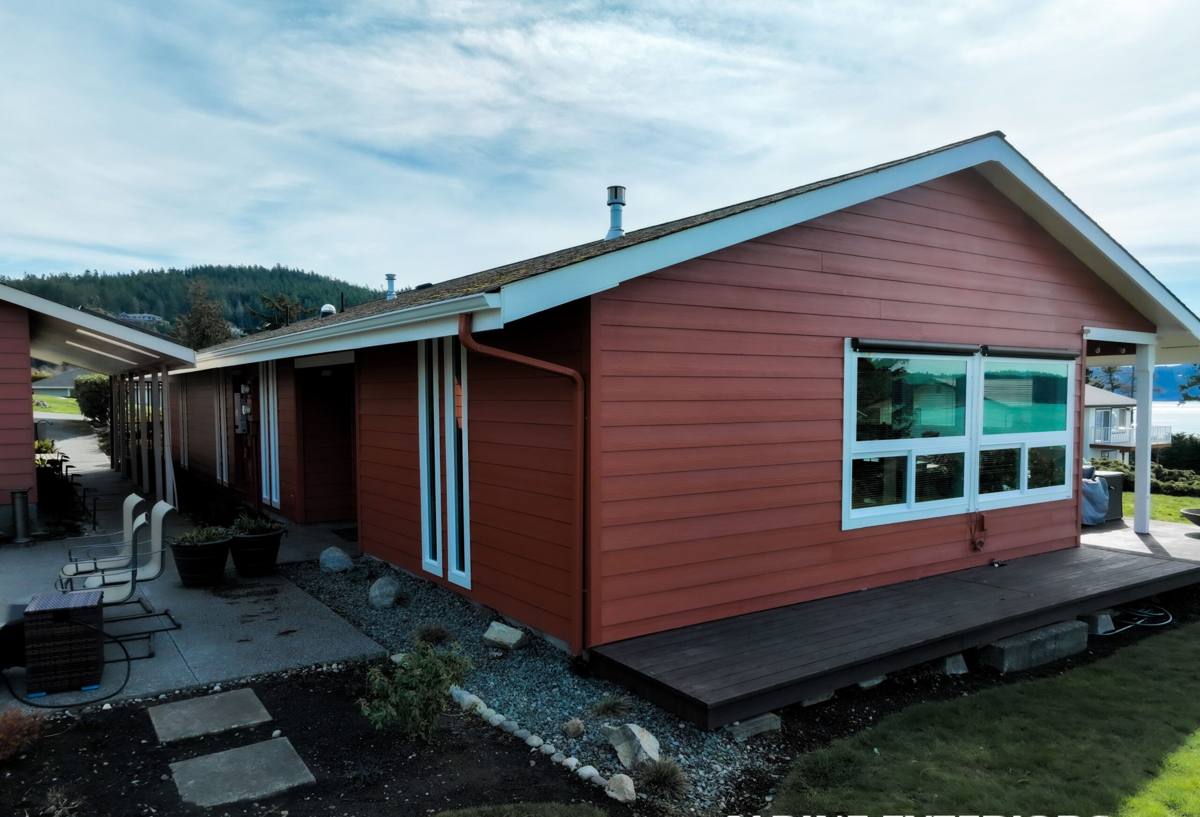
What Correct Siding Installation Actually Requires Here
The Weather Barrier Comes First
Before a single piece of siding goes up, the wall needs a continuous, properly lapped weather-resistive barrier with all penetrations — pipes, vents, outlets, hose bibs — flashed and sealed. In a marine climate with driving rain, this layer is doing more work than the siding itself. If it's installed sloppy, water gets behind the cladding regardless of what material is on the outside.
Flashing and Drainage Details
Window and door flashing, kick-out flashing at roof-to-wall intersections, and a drainage gap behind the siding (so bulk water has somewhere to go besides into your sheathing) matter more here than almost anywhere else in the state. We pay particular attention to these details because they're the ones that fail quietly — you won't see a problem until there's rot or mold inside the wall.
Fastening and Clearances
Fiber cement siding has to be fastened per the manufacturer's specifications — correct nail type, correct spacing, correct depth (not overdriven, not underdriven). It also needs proper clearance from grade, roof lines, decks, and horizontal surfaces so water and moss-friendly debris don't sit against the bottom edge of the boards. Skipping these details is the single biggest reason siding installed by a crew unfamiliar with coastal Washington fails early.
Why We Install James Hardie Fiber Cement — and Nothing Else
We made a deliberate decision years ago to install only James Hardie fiber cement siding, and we turn down jobs where a homeowner wants vinyl, LP SmartSide, primed spruce, cedar, or other fiber cement brands. That's not a marketing angle — it's a standard we hold because of what we've seen happen to other products in exactly this kind of climate.
Wood-based siding, even engineered products, relies on a wood strand core protected by a resin-treated surface. That protection is only as good as the installation, caulking, and paint maintenance behind it, and in an environment with this much sustained moisture and moss growth, the margin for error is thin. Cedar is a beautiful, legitimate material, but it demands ongoing refinishing and is genuinely combustible — a real consideration for a region that also deals with wildfire smoke and ember exposure in dry summer stretches. Vinyl is low-maintenance but it's a thin plastic product that can warp in heat, crack in cold, and fade unevenly under UV exposure, and it can't be painted to refresh its look. Cemplank and Allura are also fiber cement, and they're not bad products, but Hardie is the manufacturer that built specific product lines engineered for high-moisture climates, backs them with the strongest transferable warranty in the category, and has the deepest track record of correct installation guidance that we've verified over years of work in this exact region.
James Hardie fiber cement is non-combustible, dimensionally stable in wet-dry cycling, and finished with the ColorPlus factory-baked finish system, which resists fading and chipping far better than field-applied paint. For a marine climate with a long wet season, that combination — stability, a finish that doesn't rely on the installer's paint job, and a product line built for climates like ours — is why we standardized on it.
HZ5 and Climate-Engineered Product Lines
James Hardie makes region-specific formulations under its HardieZone system. Western Washington, including the Lummi Nation area, falls in a zone where moisture resistance and freeze-thaw stability matter more than extreme heat resistance. We spec the product lines engineered for this zone rather than a generic national blend, which is a detail a lot of out-of-area or big-box-affiliated crews don't account for.
Our Installation Process
- On-site assessment — we walk the exterior, check for existing moisture damage, moss buildup, and problem areas around windows, decks, and roof lines before quoting anything.
- Tear-off and sheathing inspection — old siding comes off and we inspect the sheathing underneath for rot or soft spots, which is common on homes that have had water intrusion for a while without visible signs.
- Weather barrier and flashing — a new, continuous weather-resistive barrier goes on with all penetrations and transitions properly flashed and lapped for this climate.
- Drainage plane installation — we install a rainscreen or drainage gap so water that does get behind the cladding can drain and dry rather than sit against the wall.
- Hardie board installation — boards are cut, fastened, and lapped to manufacturer spec, with attention to clearances from grade, roofs, and decks.
- Trim, caulking, and touch-up — factory-finished trim and touch-up paint matched to the ColorPlus system, not generic exterior paint.
- Final walkthrough — we go over the finished job with the homeowner and flag anything worth watching over the first year.
Comparing What's Actually on the Market
| Material | Moisture Performance in Coastal WA | Maintenance | Fire Rating | Typical Lifespan Here |
|---|---|---|---|---|
| James Hardie fiber cement | Strong — engineered for wet climates, stable in wet-dry cycling | Low; factory finish resists fade/chip | Non-combustible | 30+ years to first repaint need |
| Vinyl | Moderate; doesn't rot but can warp/crack with temperature swings | Low, but can't be refinished if faded | Combustible, can deform near heat | 15-25 years |
| LP SmartSide / engineered wood | Depends heavily on install quality and caulk maintenance | Moderate-high; needs ongoing sealant checks | Combustible | 15-25 years with diligent upkeep |
| Cedar | Good if maintained; struggles if neglected in moss-heavy shade | High; refinishing every few years | Combustible | 20-30 years with consistent upkeep |
None of these are "bad" products in the abstract. The differences show up over time, in a climate that punishes anything installed or maintained with margin for error.
Signs Your Current Siding Is Already Struggling
- Dark streaking or green/black growth that comes back within weeks of cleaning
- Soft or spongy spots when you press on the siding, especially near the bottom courses
- Paint or finish peeling in sheets rather than fading evenly
- Visible gaps or warping at seams and corners
- Rising utility bills that suggest the wall assembly isn't sealing the way it used to
- Musty smell or visible staining on interior walls that share an exterior wall
Any of these on a home near the water is worth a look sooner rather than later — moss season doesn't take a break, and small gaps become bigger repairs fast in this climate.
Living With the Finished Siding
Once James Hardie siding is installed correctly, upkeep is genuinely low, but "low" doesn't mean "none." A yearly rinse to knock down moss and algae before it establishes, keeping gutters clear so water isn't sheeting down the wall, and trimming back vegetation that shades the siding and keeps it damp all go a long way toward getting the full lifespan out of the material. Because the finish is factory-applied through the ColorPlus system, you're not looking at a repaint every five to seven years the way you would with field-painted wood siding — that's a real cost and time savings over the life of the home.
Why Local Experience in This Specific Area Matters
A crew that has worked homes in and around Lummi Nation knows which wall orientations take the worst of the wind-driven rain, which properties see the heaviest moss buildup because of tree cover and shade patterns, and how the salt exposure off the bay changes fastener and flashing choices compared to a job ten miles inland. That's not something you can fully substitute with general siding experience from a drier part of the state. It shows up in the small decisions — where extra flashing goes, how tight to set the drainage gap, which trim details get extra sealant — that determine whether a siding job holds up for thirty years or needs attention in eight.
If you're considering new siding, a repair, or just want an honest read on what condition your current siding is in, we're happy to come take a look. There's no pressure and no cost to get an estimate — just a straight assessment of what your home needs and what it would take to do it right.