 Ferndale
 Why Birch Bay Siding Takes More Punishment Than Most
Birch Bay sits right on the water, and that changes what siding has to survive day to day. Homes a few blocks inland in Ferndale deal with normal Pacific Northwest weather. Homes closer to the shoreline in Birch Bay deal with that same weather plus salt-laden air, more direct wind exposure off the water, and driving rain that hits siding sideways instead of just running down it. None of that is dramatic on any single day. It's the accumulation over years that separates siding that holds up from siding that doesn't.
Salt air is corrosive to metal fasteners, flashing, and trim over time, and it also accelerates the breakdown of paint films and cheaper cladding surfaces. Wind-driven rain finds every gap, seam, and undersized lap that a calmer climate would forgive. And Whatcom County's long wet season — especially in shaded, north-facing, or tree-covered lots common around Birch Bay — keeps siding damp longer than it would stay in a drier area, which is exactly the condition moss and algae need to take hold.
None of this means siding is doomed in Birch Bay. It means the material and the installation both have to be matched to the conditions, not just to a budget or a look.
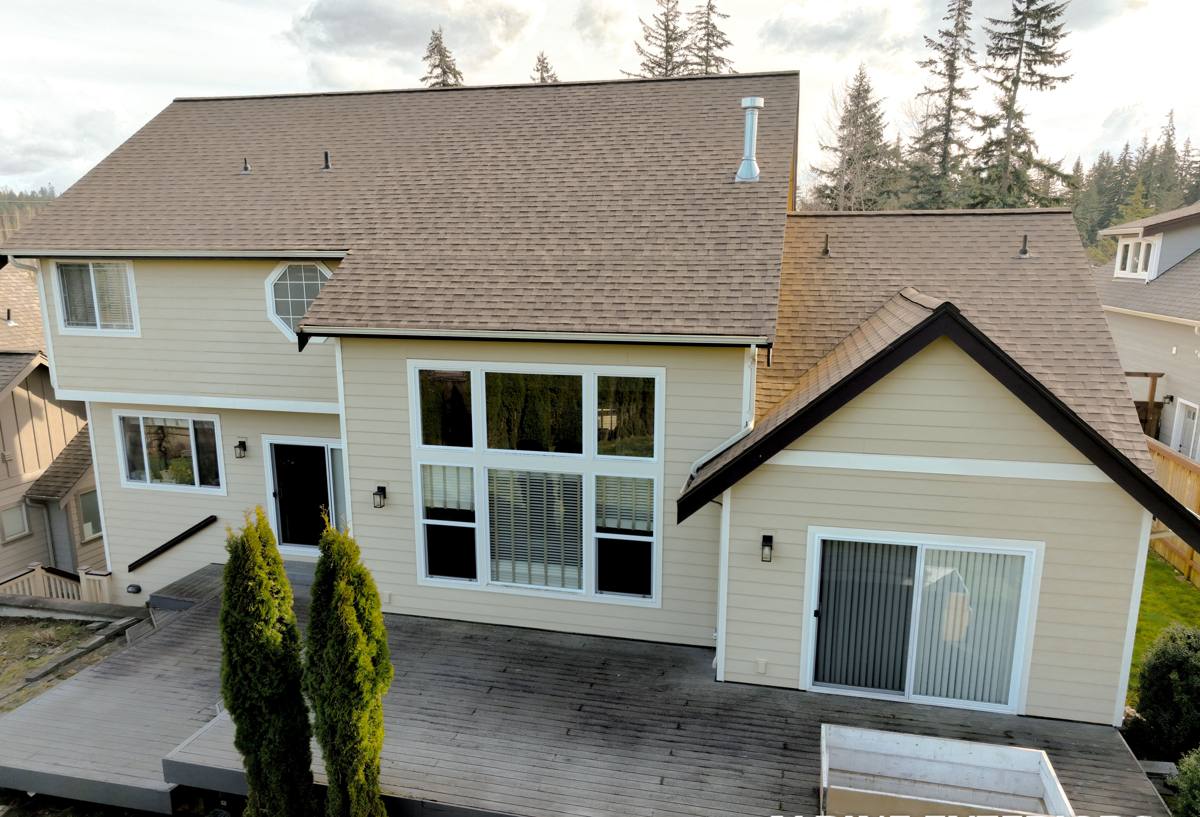
What Birch Bay Homes Actually Need From Their Siding
Resistance to Moisture, Not Just Water Shedding
Every siding product sheds bulk water reasonably well when it's new and installed correctly. The real test is what happens when moisture gets past the surface — through a nail hole, a caulk joint that's shrunk, or a lap seam that's opened slightly with age. Wood-based products swell, delaminate, or rot when that happens repeatedly. Fiber cement does not absorb and swell the way wood-based sidings do, which is a meaningful advantage in a climate where damp conditions aren't occasional, they're the default for months at a time.
A Surface That Doesn't Feed Moss and Mildew
Moss and algae need three things: moisture, shade, and a surface they can grip. Textured or porous siding surfaces give moss more to hold onto than a smooth, factory-cured finish. This doesn't make any siding immune to growth in a shaded, damp Birch Bay lot, but it does affect how fast it takes hold and how hard it is to clean off without damaging the surface underneath.
Fasteners and Flashing That Won't Corrode Prematurely
This is the part homeowners rarely think about but that matters most near the water. Salt air corrodes standard fasteners and flashing faster than it corrodes them a few miles inland. A siding job that looks identical on the surface can fail years earlier near Birch Bay's shoreline simply because the fasteners or flashing weren't rated for a marine-influenced environment.
Why We Only Install James Hardie Fiber Cement
We don't install vinyl, LP SmartSide, primed spruce, cedar, or other fiber cement brands. That's a deliberate standard, not a sales pitch. James Hardie's fiber cement is non-combustible, engineered specifically for different climate zones through its HZ5 product line, and finished with a factory-applied ColorPlus coating that's baked on and cured before it ever reaches a job site — rather than relying on field-applied paint to hold up against salt air and driving rain for the long haul. It also carries a strong, transferable limited warranty that covers both the material and the factory finish when the product is installed to Hardie's specifications.
We're not going to tell you every other product is unusable — plenty of homes around the country wear vinyl or engineered wood siding without incident. What we will say is that after years of installing exteriors in Whatcom County's salt air and rain, we decided we didn't want to put our name on installations using products we felt were a worse match for this specific climate. Fiber cement, installed correctly, is the product we're willing to warranty our workmanship on in a place like Birch Bay.
What a Correct Installation Requires Here
Fiber cement siding is only as good as the installation behind it. In a coastal, high-moisture environment, a handful of details make the difference between siding that lasts decades and siding that develops problems in five to seven years.
- Correct clearance between the bottom of the siding and grade, decking, or roof lines, so water and splash-back don't sit against the material
- Proper flashing at every window, door, and roof intersection, sized and lapped to shed water outward, not trap it behind the cladding
- A drainage plane and weather-resistant barrier installed behind the siding so any moisture that does get past the surface has somewhere to go
- Corrosion-resistant fasteners rated for the exposure, not general-purpose fasteners that will start rusting within a few seasons of salt exposure
- Correctly sized gaps at butt joints and panel ends, caulked with a sealant rated for exterior movement and UV exposure — not just packed tight
- Field-cut edges primed or sealed per manufacturer spec, since an unsealed cut edge is one of the more common points where moisture problems start
Every one of these is a small detail on its own. Skip two or three of them and you've built a siding system that will underperform no matter how good the material is.
How Materials Compare for a Location Like Birch Bay
Homeowners in Birch Bay often ask how fiber cement stacks up against other options they've seen on nearby homes or heard about from other contractors. Here's an honest comparison focused specifically on salt air, wind-driven rain, and moss exposure — not a generic siding comparison.
| Material | Salt Air / Corrosion Behavior | Moisture & Rot Resistance | Moss & Algae Resistance | Typical Maintenance |
|---|---|---|---|---|
| James Hardie Fiber Cement | Non-metallic surface, unaffected by salt corrosion; fasteners/flashing matched to exposure | Does not swell or rot; dimensionally stable when wet | Smooth factory finish resists buildup better than porous surfaces | Periodic rinsing; repaint only when the owner chooses a new color, typically well beyond a decade |
| Vinyl Siding | Panels don't corrode, but trim and fastener hardware can | Sheds water but seams and J-channels can trap moisture behind the panel | Prone to growth in shaded, damp conditions; textured styles hold it longer | Low, but can become brittle and crack over time in cold snaps |
| Wood or Cedar | Fasteners corrode faster near salt air; wood itself doesn't corrode but weathers hard | Absorbs moisture, prone to swelling, cupping, and rot without diligent upkeep | High — organic surface is a natural host for moss and mildew | Frequent: refinishing, caulking, and rot inspection on a recurring schedule |
| Engineered Wood (e.g. LP SmartSide) | Fasteners face the same corrosion risk; panel edges are moisture-sensitive | Wood-strand core can swell or fail if the factory edge seal is compromised | Moderate to high depending on finish and how well edges stay sealed | Moderate: edge sealing and paint upkeep matter more than with fiber cement |
Our Process for a Birch Bay Fiber Cement Project
Assessment
We start by walking the exterior and looking specifically at exposure — which walls take the most wind-driven rain, which sides stay shaded and damp longest, and where the current siding (or the sheathing behind it, if we're doing a full tear-off) is already showing moisture damage.
Product and Color Selection
We help homeowners choose the right Hardie panel or lap profile and ColorPlus finish for the home, factoring in how the color and texture will hold up under this area's UV exposure and salt-air conditions, not just how it looks on a sample board.
Installation to Spec
We install to James Hardie's published specifications for flashing, clearances, fastening, and joint treatment — the details covered above — because that's what the manufacturer's warranty is actually contingent on, and it's what determines how the siding performs in this climate over the next several decades.
Final Walkthrough
Before we call a job finished, we walk it with the homeowner, check clearances and caulk lines, and make sure everything matches what was scoped and quoted.
Keeping Fiber Cement Siding Performing in Birch Bay's Climate
Fiber cement installed correctly needs very little upkeep compared to wood or engineered wood siding, but "very little" isn't "none," especially this close to the water.
- Rinse siding periodically to clear salt residue and organic buildup, particularly on shaded or north-facing walls
- Check caulk joints around windows, doors, and trim every year or two, since sealant is the first thing that ages out
- Keep gutters clear so overflow isn't running down the siding face during heavy Whatcom County rain events
- Trim back vegetation and tree cover where practical to reduce the shade and moisture that feed moss
- Watch for any soft spots, staining, or visible fastener rust and have them checked before they become bigger repairs
Why Local Experience in Birch Bay Matters
A crew that already works in Birch Bay knows the difference between a job a mile from the shoreline and one further inland in Ferndale — how much more attention flashing and fastener selection need, which walls typically take the worst of the wind-driven rain, and how moss tends to establish on the shaded, tree-lined lots common in this area. That's not something you can fully substitute with a spec sheet. It's built from having done the work here, on homes with the same exposure your home has, and having gone back to see how those installations actually held up over time.
It also matters for permitting and code familiarity specific to Whatcom County, and for knowing realistic timelines given how weather windows work in a coastal community — scheduling around the wetter stretches of the year rather than fighting them.
What Affects the Cost of a Birch Bay Siding Project
Every home is different, so we won't quote a number without seeing the job, but a few factors consistently drive cost on projects in this area:
| Factor | Why It Affects Cost |
|---|---|
| Tear-off vs. new construction | Removing old siding, checking sheathing condition, and repairing any hidden moisture damage adds labor before new siding goes up |
| Wall exposure and detailing | Complex rooflines, dormers, and multiple corners take more flashing, cutting, and fitting time than a simple rectangular wall |
| Panel profile and finish choice | Lap width, panel style, and factory finish color affect material cost within the Hardie product line |
| Existing moisture or rot damage | Salt air and long wet seasons can mean hidden sheathing damage that has to be repaired before new siding is installed |
| Site access | Waterfront lots and tighter properties can affect staging, scaffolding, and material handling |
If you're weighing your options for a Birch Bay home, we're glad to walk the property, look at what your current siding is dealing with, and put together a straightforward, no-pressure estimate — no obligation, just a clear look at what correct fiber cement siding would involve for your specific home.