 Ferndale
 Siding Repair for Everson-Area Homes
Everson sits inland from Ferndale, but it shares the same weather system that soaks Whatcom County for most of the year. Marine air pushes in off the Strait and rides the lowland corridors east, and by the time it reaches this pocket of the county it's still carrying enough moisture to keep siding wet for days at a stretch. Add driving rain that hits gable ends and window trim at an angle, and a moss season that can run from fall through spring, and you get a specific, predictable set of siding repair problems — not random wear, but damage that follows the weather.
We're based out of Ferndale and already run crews through this part of Whatcom County regularly. This page is about one thing: siding repair on homes in and around Everson, what actually causes it to fail here, and what a repair has to get right to hold up through the next wet season instead of just looking fixed for a few months.
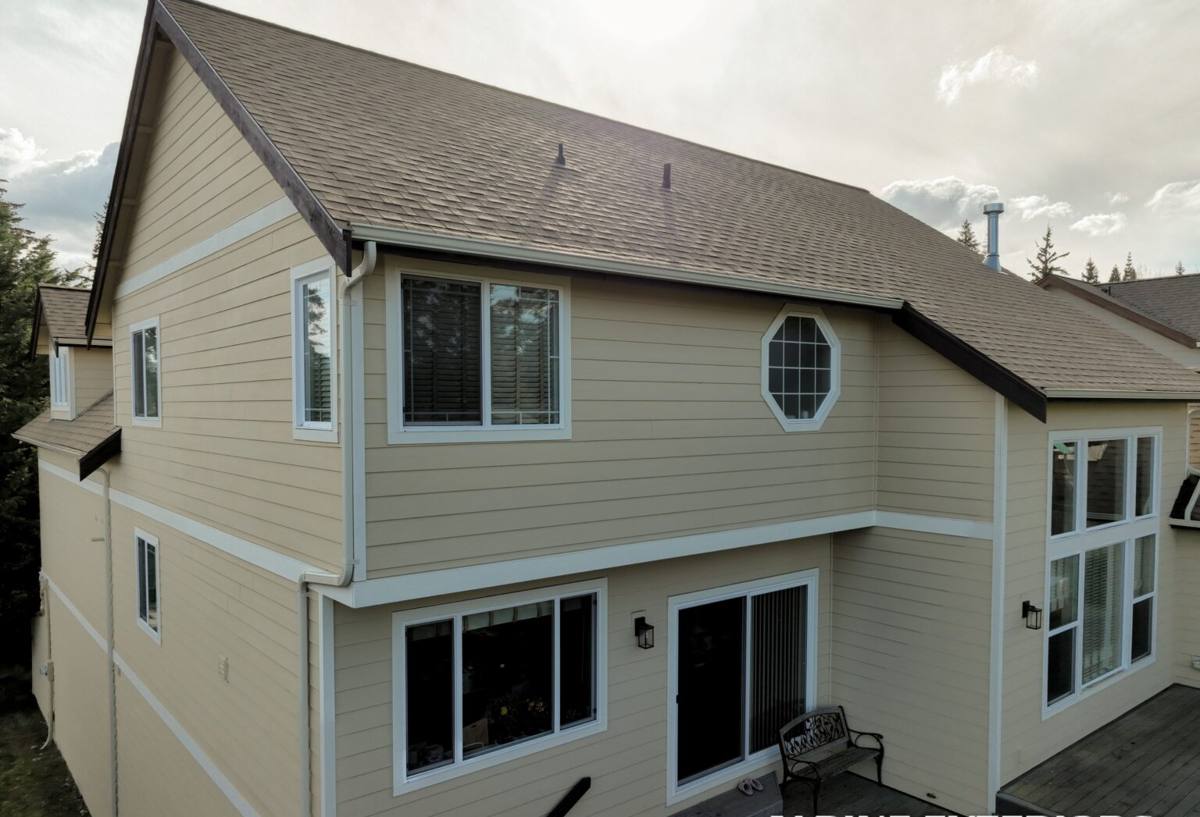
What This Climate Does to Siding Over Time
Moisture that doesn't dry out fast
Whatcom County doesn't get intense storms so much as long stretches of damp, overcast weather. Siding here rarely gets a hard, fast dry-out between rain events. Water that gets behind a board, into a seam, or under failed caulking has time to do real damage before conditions change. That's the core reason siding repair in this area is less about cosmetic patchwork and more about correcting how water is moving in the first place.
Moss, algae, and constant shade
Wooded lots and long tree lines around Everson keep a lot of siding shaded and slow to dry, which is exactly what moss and algae need to establish. Beyond the staining, moss holds moisture directly against the siding surface for extended periods, which accelerates rot in wood-based products and breaks down caulk and paint film faster than a home in full sun would experience.
Wind-driven rain at trim and penetrations
Rain in this region rarely falls straight down. Wind pushes it sideways into corner boards, window and door trim, and anywhere siding meets a penetration — hose bibs, vents, light fixtures. Those are the highest-failure points on almost every home we inspect in this area, and they're where a repair needs the most attention, not the least.
Common Siding Repair Issues We See Around Everson
- Failed or shrunken caulk joints at trim, corners, and penetrations, letting water track behind the siding
- Cracked or split boards from impact damage or, in older wood and engineered-wood products, moisture swelling followed by splitting
- Soft or delaminating material at the bottom courses, where splash-back and standing moisture do the most damage
- Persistent moss and algae staining on north- and shade-facing walls
- Paint or finish failure where the factory or field-applied coating has broken down and is no longer shedding water
- Warping or buckling where boards weren't fastened or gapped correctly for expansion and contraction
Most of these show up as a small, localized problem at first — a stained patch, a soft spot near a downspout, a gap that's opened up at a window. Left alone through another wet season, they tend to spread, because the underlying issue is a water path, not just the visible surface.
What a Correct Repair Actually Involves
A siding repair that only addresses what's visible is a temporary fix. We treat every repair call as a diagnostic job first and a materials job second.
Find the water path, not just the damage
Before we replace anything, we trace where water is actually getting in. A stained or soft board is often the exit point, not the entry point — the real gap might be a failed seal several inches away, or flashing that's directing water into the wall instead of away from it. Replacing the visible board without fixing the entry point means the same damage comes back.
Check what's behind the siding
Once a section is opened up, we look at the water-resistive barrier, flashing, and sheathing underneath. If moisture has gotten past the siding for any length of time, that layer matters as much as the siding itself. A repair that reinstalls new siding over compromised sheathing or house wrap is not a repair — it's a delay.
Match the material and the install method
Patch jobs that don't match board profile, reveal, or fastening pattern stand out visually and often perform worse than the surrounding siding because they weren't installed to the same spec. We match profile and, where the existing siding is James Hardie, we can typically match color and finish as well.
Repair vs. Section Replacement: How We Make the Call
| Situation | Typical Approach | Why |
|---|---|---|
| Isolated cracked board, sound material around it | Spot repair — remove and replace the damaged piece | Surrounding siding and water barrier are still doing their job |
| Caulk failure at trim or corners, no wood damage yet | Re-seal and inspect flashing | Catching it before moisture reaches the sheathing avoids a bigger job later |
| Soft, delaminating siding along a wall section | Section replacement, sheathing inspected | Damage has likely spread past what's visible on the surface |
| Widespread moss, staining, and finish failure across multiple elevations | Full re-side evaluation | Individual repairs won't outlast a siding system near the end of its service life |
| Repeated failures at the same wall despite past patch repairs | Investigate design or drainage issue, not just the siding | Recurring damage usually points to a water-management problem, not a material problem |
We'll tell you honestly which category your home falls into. Sometimes that means a modest repair. Sometimes it means recommending you plan for a fuller replacement of one elevation rather than keep patching a wall that's going to keep failing in the same spot.
Our Process for an Everson Siding Repair Call
- Inspection. We look at the reported problem area and the rest of the exterior — damage in one spot is often a sign of a shared cause elsewhere on the home.
- Diagnosis. We identify the actual water path or failure cause, not just the visible symptom, before recommending a fix.
- Written plan. You get a clear explanation of what's wrong, what we recommend, and why — repair, section replacement, or a heads-up that a larger issue needs addressing.
- The repair itself. Material removed, substrate checked, correct flashing and sealing details restored, matched siding installed to spec.
- Final check. We confirm the repaired area sheds water the way the rest of the wall does before we consider the job done.
Why We Only Work in James Hardie Fiber Cement
We don't install or repair-match vinyl, LP SmartSide, primed spruce, or cedar siding as a standard offering, and in a climate like this, that's a deliberate call, not a preference. Wood-based and engineered-wood products depend heavily on paint and caulk staying intact to keep moisture out; once that finish layer starts to fail — which it eventually does, faster in a wet, shaded climate — the underlying material is exposed to exactly the conditions that cause swelling, splitting, and rot. Vinyl doesn't rot, but it flexes with temperature, can crack on impact, and fades or chalks over time in ways that are difficult to repair invisibly.
James Hardie fiber cement is non-combustible, doesn't absorb and swell with moisture the way wood-based products do, and — critically for repair work — its ColorPlus factory finish is baked on and holds color far longer than field-applied paint. That means when we do need to replace a section, the color match holds up over time instead of drifting apart from the surrounding siding within a couple of seasons. It's also engineered in HZ product lines built specifically for wet, high-moisture climates like this one. When a repair calls for new material, this is what we put on the wall — and it's why homes we've already worked on tend to need fewer repeat repair calls down the road.
Signs an Everson Homeowner Should Get an Inspection
- Soft or spongy spots when you press on the siding, especially near the bottom courses
- Visible gaps, cracks, or shrinking caulk at trim boards and corners
- Paint that's peeling, bubbling, or flaking rather than just fading
- Persistent moss or algae growth that keeps coming back after cleaning
- Discoloration or staining that tracks downward from a specific point, like a window or fixture
- Any interior sign of a possible exterior leak — musty smell, staining, or soft drywall on an exterior wall
None of these guarantee a major problem, but each one is worth a look before another wet season adds to it. Catching a caulk failure or a small crack early is a much smaller job than dealing with damage that's had all winter to spread behind the wall.
Why It Matters That We Already Work This Area
Siding repair is easier to get right when the crew already understands how a specific area's weather behaves — which walls take the worst wind-driven rain, how much shade a given lot gets, how long moss takes to re-establish after a cleaning. We're a Ferndale-based crew that already runs jobs through Whatcom County, so an Everson repair call isn't a special trip or an unfamiliar climate zone for us. That local familiarity shows up in small ways that matter: knowing to check flashing at a specific detail because we've seen it fail on similar homes nearby, or recognizing a staining pattern as a symptom rather than just cosmetic buildup.
If you've got a siding problem on a home in the Everson area — whether it's one damaged board or a wall that's been giving you trouble for a while — we're happy to take a look. The estimate is free, there's no pressure to move forward with anything, and you'll get an honest answer about whether it's a simple repair or something bigger.