 Ferndale
 Decks Take a Different Kind of Beating Out Here
A deck in Everson doesn't fail the way a deck fails in a dry climate. Out here, the damage is almost always driven by water — combined with the salt-tinged air that rolls in off the Sound and a moss season that can run eight or nine months of the year. Boards don't just fade, they trap moisture underneath and start rotting from the bottom up, often well before the top surface shows any obvious problem. Fasteners corrode faster than the manufacturer's spec sheet ever accounts for. And any spot on a deck that stays shaded and damp — under railings, behind planters, along the house wall — becomes a moss and mildew farm that holds water against the wood around the clock.
We work decks all over the Ferndale area, and Everson-area properties tend to share the same pattern: the visible deck boards get replaced or resealed at some point, but the structure underneath — ledger board, joists, posts, hardware — gets ignored until something actually gives. That's the part of deck repair that actually matters for safety, and it's the part a lot of quick patch jobs skip.
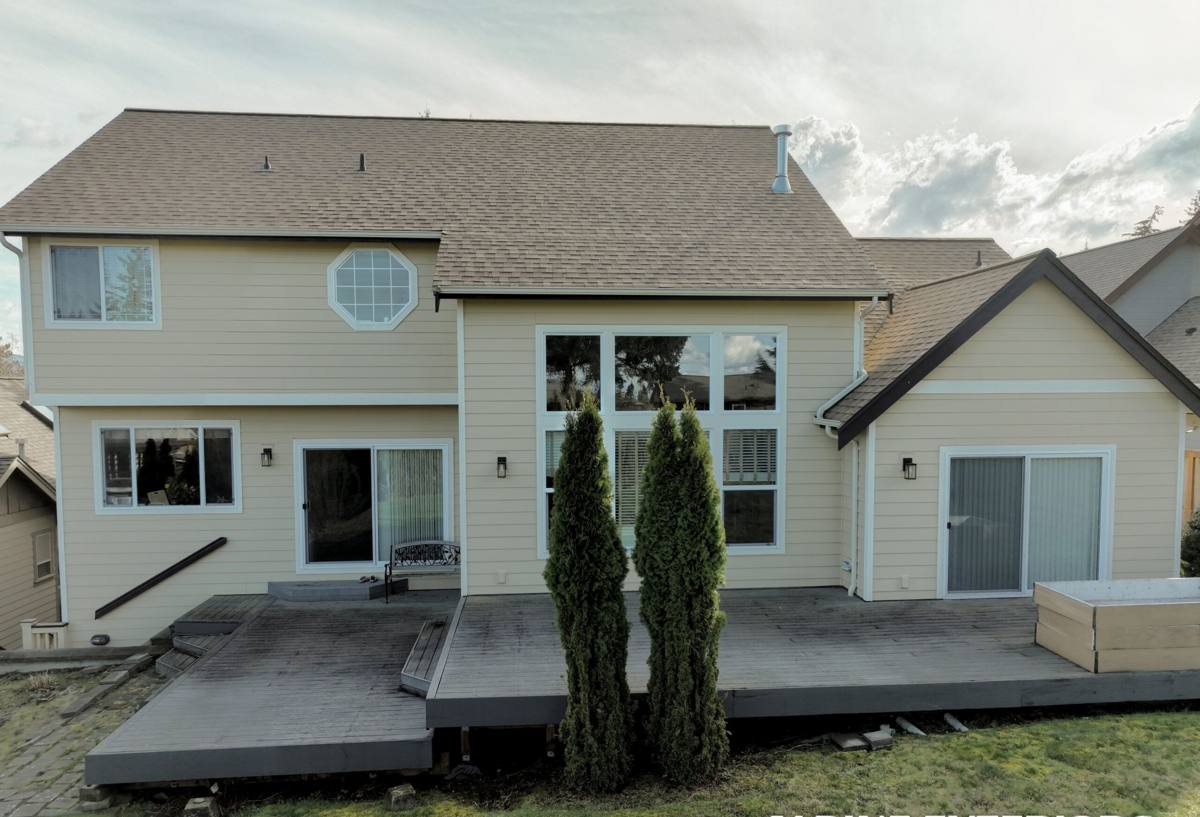
Warning Signs You Need Deck Repair, Not Just a Cleaning
Most homeowners call us for one of two reasons: the deck looks bad, or the deck feels wrong underfoot. Looking bad is usually the easy fix. Feeling wrong — bounce, sag, a railing that wiggles, a board that flexes more than its neighbors — means something structural is happening and needs a real inspection, not a pressure wash and a coat of stain.
- Soft or spongy spots when you walk across the deck
- A railing or post that moves when you push on it
- Visible gaps opening up where the deck meets the house
- Rust streaks bleeding out from screws, bolts, or joist hangers
- Wood that's gone gray and fuzzy, or that a screwdriver sinks into easily
- Persistent moss or dark staining that comes back within weeks of cleaning
- Standing water that doesn't drain off the surface within an hour or two after rain
Any one of these on its own might be minor. Two or three together, especially near the ledger board where the deck attaches to the house, is worth a proper look before it turns into a bigger repair or, worse, a safety issue.
Why the Ledger Board Gets Special Attention
The ledger board is the piece that bolts the deck to your house, and it carries a large share of the deck's total load. It's also the piece most exposed to water running off the siding and roofline above it, which is exactly why it's the most common failure point in older or poorly built decks. If the flashing behind it has failed or was never installed correctly, water gets trapped between the ledger and the house framing and rots both from the inside, invisibly, for years. We check this on every repair call regardless of what the homeowner asked us to look at, because it's the one spot where a small oversight turns into a real hazard.
What a Correct Deck Repair Actually Involves
A repair done right isn't just swapping out the boards that look worst. It starts with figuring out what's actually failing and why, then fixing the cause — not just the symptom.
- Structural check — ledger board attachment and flashing, joist condition, beam and post condition, footing stability
- Fastener condition — corroded or undersized screws, nails, and joist hanger hardware replaced with fasteners rated for exterior and treated-lumber contact
- Decking surface — individual board replacement where rot, splitting, or cupping has set in, rather than automatic full replacement
- Railings and stairs — checked for the same rot and fastener issues, since these take direct weather exposure and get more physical stress than the deck field
- Drainage and gaps — board spacing and any grading issues that keep water sitting on or under the deck
- Moss and mildew treatment — cleaned and treated before any new wood goes in, not just brushed off the surface
Skipping any of these isn't really a repair — it's a delay. A new top board over a rotted joist looks fine for a season and then fails again, usually at a worse point than before.
Repair or Replace? What Actually Drives That Decision
This is the question we get asked most, and the honest answer is that it depends on how much of the structure is still sound. A deck with isolated rot at the ledger or a handful of bad boards is almost always a repair candidate. A deck where the joists are failing in multiple spots, or where the whole thing was built without proper flashing to begin with, often costs more to keep patching than to rebuild correctly once.
| Factor | Leans Toward Repair | Leans Toward Replacement |
|---|---|---|
| Structural framing (joists, beams, posts) | Solid, with isolated soft spots | Widespread rot or sagging across multiple members |
| Ledger board & flashing | Intact, properly flashed | Missing/failed flashing, rot at the house connection |
| Age of the deck | Under 15–20 years, built to code | Older, built before current attachment standards |
| Decking surface | Scattered bad boards | Most boards cupped, split, or rotted |
| Railings and stairs | Sound, just weathered | Loose posts, rotted stringers |
We'll always give you a straight answer on which side of this your deck falls on, with the reasoning behind it — not a push toward the bigger job by default.
Decking Material Choices When We're Replacing Boards
When individual boards need replacing, the material decision matters more in this climate than in a lot of others, because everything on a deck spends months of the year wet.
| Material | Upfront Cost | Maintenance in Wet, Mossy Conditions | Notes for Repairs |
|---|---|---|---|
| Pressure-treated lumber | Lowest | Needs re-sealing every 1–2 years; prone to moss without upkeep | Easiest match to existing structure; widely available |
| Cedar | Moderate | Naturally rot-resistant but still needs sealing to hold color and shed moisture | Good match for cedar-sided homes; blends with existing cedar decking |
| Composite decking | Higher | Low maintenance; resists moss staining better but can trap moisture if airflow underneath is poor | Best where the whole deck surface is being redone, not single-board patches |
For a patch repair, we usually recommend matching the existing material so the fix blends in and behaves the same way as the rest of the deck under moisture. If you're already thinking about a bigger resurfacing job down the line, that's a separate conversation worth having honestly rather than folding into a repair estimate.
Our Repair Process
- Inspection — we check the ledger, framing, fasteners, and surface, including areas that aren't obvious from a casual look
- Written scope — you get a clear breakdown of what's structural, what's cosmetic, and what we recommend fixing now versus watching
- Repair plan — matched materials and fasteners rated for exterior, treated-lumber, and coastal-air exposure
- The work — structural fixes first, then surface boards, railings, and any drainage or flashing corrections
- Cleanup and moss treatment — the deck and surrounding area are cleaned, not just the repaired sections
- Maintenance guidance — a straightforward rundown of what to watch for and roughly when to reseal or recheck it
Living With a PNW Deck: Maintenance Between Repairs
A repair holds up a lot longer with a little seasonal upkeep. None of this requires special tools or products, just consistency.
- Sweep leaves and debris off the deck regularly, especially in fall — trapped organic matter holds moisture and feeds moss
- Clean moss and algae off the surface at least once a year, before it gets a foothold in the wood grain
- Check fasteners and railings for movement or rust once or twice a year
- Reseal or restain wood decking on the schedule the product calls for — usually every 1–3 years depending on sun and rain exposure
- Keep gutters and downspouts clear so runoff isn't dumping extra water directly onto or near the deck
- Make sure furniture, planters, and rugs get moved periodically so moisture doesn't sit under them in one spot
Permits and Code — Why It Matters for Structural Repairs
Repairs to a deck's structure — ledger reattachment, joist or beam replacement, railing rebuilds above a certain height — can fall under building code requirements, not just cosmetic work you can do without a second thought. This isn't red tape for its own sake; it's the same set of standards that keeps a deck from becoming a collapse risk down the line. When a repair crosses into structural territory, we'll tell you plainly whether it needs a permit and handle that conversation with you rather than quietly skipping it to save time.
Why a Crew That Already Works Everson Matters
Deck repair is one of those jobs where local experience shows up in small but real ways. A crew that already works the Ferndale and Whatcom County area knows how this specific climate treats wood and hardware over time — which corners get skipped on older builds, which fastener grades hold up and which don't, how fast moss comes back if the drainage underneath isn't addressed. That's the difference between a repair that's cosmetic and one that actually holds.
It also means a faster, more honest estimate. We're not guessing at how coastal moisture and a long wet season affect a deck's framing — we see it on repair calls throughout the year, and we bring that directly into how we scope and price the work for your property.
If you've got a deck in the Everson area that's showing any of the warning signs above, or you just want an honest read on its condition before it becomes a bigger problem, we're happy to take a look. Reach out for a free, no-pressure estimate using the form below.