 Ferndale
 Deck Building for Kendall Homes Isn't a One-Size-Fits-All Job
A deck built for a dry inland climate and a deck built for Whatcom County are not the same project, even if they look identical on paper. The framing lumber, the fasteners, the flashing details, and even the decking material itself all need to account for what this region actually does to outdoor structures over a few wet winters. For homeowners in the Kendall area, that means thinking past the initial build and asking a simple question: how will this deck hold up ten or fifteen years from now, after a decade of driving rain, salt-laden air, and the long moss season that defines this part of Washington?
We build decks for homes throughout the Ferndale area, and Kendall projects come with their own set of considerations shaped by local terrain, tree cover, and exposure. This page walks through what actually matters for a deck built to last here — not generic deck-building advice, but the specifics that come from working this ground.
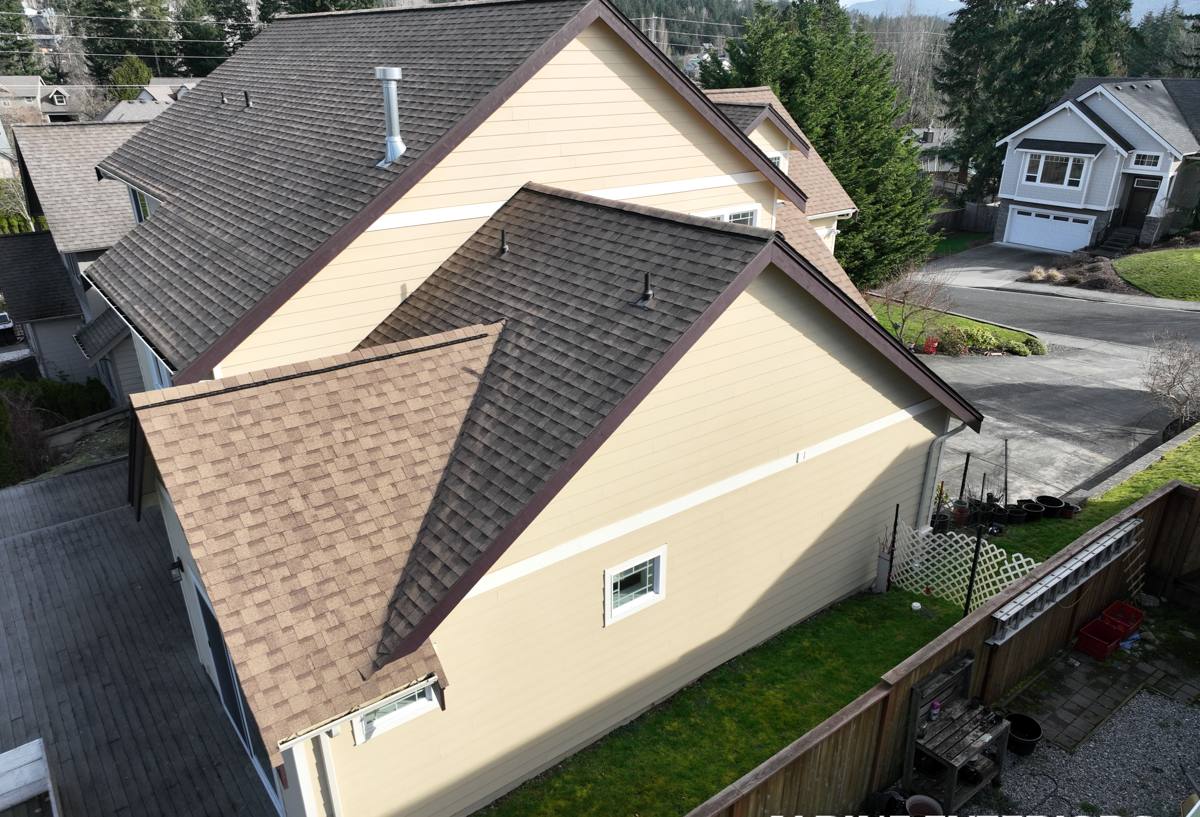
What This Climate Actually Does to a Deck
Whatcom County's marine climate is mild compared to the rest of the country, but "mild" doesn't mean easy on wood and metal. The combination of moisture, salt-influenced air, and shade from mature trees creates conditions that shorten the life of a poorly built deck faster than most homeowners expect.
Moss and Standing Moisture
Long, wet stretches with limited direct sun give moss and algae plenty of time to establish themselves on decking boards, especially in shaded corners or under tree cover common to Kendall-area lots. Moss holds moisture against the wood surface, and that trapped moisture is what actually causes rot — not rain that runs off and dries. A deck built without attention to drainage, board spacing, and airflow underneath will grow moss faster and rot sooner, regardless of what the decking is made of.
Driving Rain and Ledger Connections
Wind-driven rain doesn't fall straight down — it gets pushed sideways into wall connections, ledger boards, and any point where the deck meets the house. This is the single most common failure point we see on older decks in this region: water working its way behind poorly flashed ledger boards and rotting the rim joist or sheathing from the inside, often for years before anyone notices from the outside.
Salt Air and Metal Corrosion
Proximity to Puget Sound and Georgia Strait means the air here carries more salt than an inland climate, and that accelerates corrosion on any fastener, bracket, or hanger that isn't rated for it. A deck held together with standard galvanized hardware in a coastal-influenced climate can show rust streaking and weakened connections well before the wood itself is a problem. This is a detail that's invisible on install day and expensive to ignore later.
What a Correctly Built Deck Actually Includes
A deck that's going to hold up here needs the fundamentals done right before anyone talks about railing styles or decking colors. These are the pieces that don't show up in a photo but determine whether the structure is still sound in fifteen years.
Footings and Framing
Footings need to be sized and set to the depth required by local code for frost protection and soil bearing, not guessed at. Beam and joist sizing has to match the actual span and load — not just "what's always been done" — and joist spacing should account for the decking material being used, since composite and PVC products often call for tighter spacing than solid wood.
Ledger Attachment and Flashing
Where the deck attaches to the house, the ledger board needs mechanical fasteners rated for the load (not just nails), proper flashing that directs water out and away from the house structure, and a gap or drainage plane between the ledger and the siding so water can't wick behind it. This one detail prevents the majority of structural rot we see on deck-to-house connections in this climate.
Fasteners and Hardware
Every joist hanger, structural screw, and bolt should be rated for contact with modern treated lumber and rated for the exposure this area sees. That means hot-dip galvanized or stainless steel — not a lighter coating that looks fine in the box but wasn't built for years of damp, salt-influenced air.
Choosing a Decking Material for This Climate
There's no single "best" decking material — there's a best fit for your budget, your maintenance appetite, and how much shade and moisture your specific lot deals with. Here's how the common options actually compare once you factor in a Whatcom County winter.
| Material | Upfront Cost | Maintenance in This Climate | How It Handles Moss & Moisture |
|---|---|---|---|
| Pressure-treated wood | Lowest | Annual cleaning and periodic sealing/staining | Needs regular upkeep to resist moss staining and moisture absorption |
| Cedar | Moderate | Sealing every 1-2 years to maintain appearance and resist graying | Naturally more rot-resistant than treated pine, but still needs sealed end grain and drainage below |
| Composite decking | Higher | Occasional washing, no staining or sealing | Resists rot and moisture absorption well; still needs airflow underneath to limit surface algae/moss growth |
| PVC/cellular decking | Highest | Lowest — occasional washing only | Doesn't absorb moisture, so rot isn't a concern; surface can still grow moss/algae film if never cleaned |
The honest trade-off: wood costs less to install but costs more in ongoing labor and attention. Composite and PVC cost more upfront but shift that cost away from yearly maintenance. Neither choice eliminates the need for good drainage and airflow in the framing below — that part of the job matters no matter what decking you put on top.
Railings, Stairs, and Code Basics
Guardrails, stair rails, and baluster spacing aren't style choices — they're governed by building code, and Whatcom County permitting follows the state building code requirements for residential decks. In general terms, guardrails are required once a deck surface sits a certain height above grade, guardrail height has a required minimum, and the gaps between balusters are limited so a small child can't pass through them. Stair handrails have their own height and graspability requirements.
We don't treat these as boxes to check — a rail system that's technically inspected but wobbles under real weight isn't a job we consider finished. Post attachment to the framing (not just to a fascia board) is one of the most common shortcuts that leads to a rail system that looks fine and isn't actually safe.
Hardware and Fasteners: The Detail Most Decks Get Wrong
This is worth its own section because it's the most common place we see corners cut on decks built by out-of-area crews unfamiliar with this climate. The lumber can be correctly rated and the framing correctly sized, and the deck will still fail early if the hardware holding it together isn't matched to the exposure.
| Hardware Type | Where It's Used | Why the Rating Matters Here |
|---|---|---|
| Joist hangers & structural screws | Every joist-to-beam and ledger connection | Standard coatings can corrode faster in salt-influenced, high-moisture air, weakening connections from the inside |
| Structural bolts & lag screws | Post-to-beam and ledger-to-house connections | These carry direct structural load; corrosion here is a safety issue, not just cosmetic |
| Deck screws (surface) | Decking boards to joists | Visible corrosion streaking is often the first sign hardware wasn't rated correctly |
We spec hot-dip galvanized or stainless hardware as our standard on deck framing, not as an upsell. It costs more than the minimum-code option, and it's the difference between a deck that's still tight in fifteen years and one that starts showing loose connections in five.
Our Deck-Building Process, Start to Finish
Every deck we build in the Kendall area follows the same sequence, whether it's a straightforward ground-level platform or a multi-level deck off the back of the house.
- On-site visit to assess the lot, grade, sun/shade exposure, and how the deck will tie into the existing structure.
- Design and material discussion — decking type, railing style, stairs, and any structural considerations specific to the site.
- Permit application and submission to the appropriate jurisdiction, since most decks above a certain height or attached to the house require one.
- Footings and framing, built to span and load requirements with corrosion-rated hardware throughout.
- Ledger flashing and attachment, done to prevent water intrusion at the house connection.
- Decking, railing, and stair installation.
- Final walkthrough and inspection sign-off before we consider the job complete.
Nothing on that list is optional or skipped to save time. The steps that don't show up in the finished look — flashing, hardware grade, footing depth — are the ones that determine whether the deck is still solid a decade from now.
Why a Ferndale-Based Crew Matters for a Kendall Project
A crew that already works this part of Whatcom County knows which details actually matter here versus a generic checklist. We know how driving rain behaves against a ledger connection in this climate, why moss shows up faster on certain exposures than others, and which fastener grade holds up against salt-influenced air over time. That's the difference between a deck built to pass inspection and a deck built to actually last through what this region's weather does year after year.
There's also a practical side to working local: we're not driving a crew in from out of the area, we know the permitting process for this jurisdiction, and if something needs a follow-up visit after the first winter, we're not far away. For a structure that's outside year-round and exposed to everything the weather brings, that local familiarity isn't a nice-to-have — it shows up in how the deck holds up.
Checklist: What to Ask Before You Hire a Deck Contractor
- Are you licensed and insured to work in Washington, and can you provide proof?
- Will you pull the required permit, or is that left to me?
- What fastener and hardware grade do you use on framing connections?
- How do you flash and attach the ledger board where the deck meets the house?
- What footing depth and spacing will you use, and how did you determine it?
- What's your plan for drainage and airflow underneath the decking?
- Do you offer a written warranty on workmanship, separate from the material manufacturer's warranty?
If a contractor can't answer the hardware and flashing questions specifically, that's worth noting — those are the details that separate a deck that looks good on day one from one that's still sound after several wet Whatcom County winters.
Let's Talk About Your Kendall Deck Project
Whether you're planning a new deck or replacing one that's showing its age, we're happy to walk the site, talk through material options, and give you a straightforward estimate — no pressure, no hard sell. Use the form below to get started.