 Ferndale
 Siding Repair in Custer: A Different Climate Than Most Repair Manuals Assume
Custer sits close enough to the water that homes here take on a combination most siding repair guides never account for: salt-laden air rolling in off the Strait of Georgia and Puget Sound, driving rain that hits walls sideways instead of falling straight down, and a long stretch of the year — roughly October through April in Whatcom County — where surfaces barely dry out between storms. That combination is hard on every exterior material, but it is especially hard on siding that was never engineered for it. A repair job that looks fine on paper can fail again in eighteen months if it doesn't account for how water and salt actually move through a wall assembly out here.
We do siding repair work throughout Ferndale and the surrounding communities, and Custer jobs tend to follow a recognizable pattern: damage clusters on the windward and ground-facing sides of the house, fasteners show corrosion before the siding itself fails, and moss or algae growth is usually part of the story even when it isn't the primary complaint. Understanding that pattern is the difference between a repair that lasts and one that's a temporary patch.
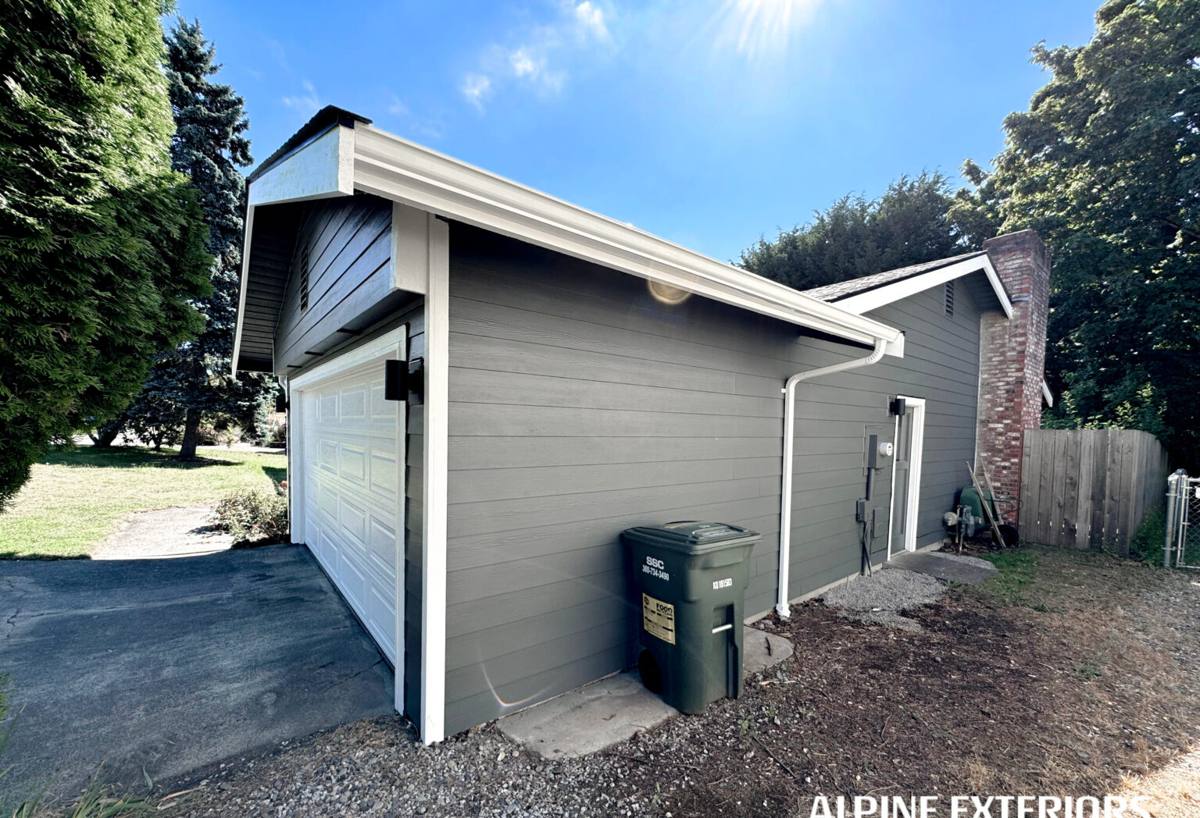
Signs a Custer Home Needs Siding Repair
Some damage is obvious. A lot of it isn't — it shows up as a soft spot, a slightly different paint sheen, or a smell in a closet on an exterior wall long before anyone sees a visible crack. Walk your exterior and look for:
- Soft, spongy, or crumbling siding when pressed — a strong sign of moisture intrusion behind the surface
- Peeling, bubbling, or chalky paint that keeps coming back after repainting
- Visible gaps, cracks, or warping, especially near corners, window trim, and the bottom courses close to grade
- Rust streaks below nail heads or staples — a sign fasteners are corroding, often from salt exposure
- Dark green or black staining that keeps returning within a season of cleaning
- Musty odors indoors along an exterior wall, or visible mold on interior drywall near a window
- Siding that has pulled away slightly from the wall, leaving a gap you can see light through
Any one of these on its own might be minor. Two or three together, especially on the same wall, usually means water has been getting behind the siding for a while and the visible damage is only the part you can see.
Why Salt Air and Driving Rain Change the Repair Calculus
Salt Air and Fasteners
Salt-laden air accelerates corrosion on anything metal — nail heads, staples, flashing, and hidden fasteners all corrode faster near the water than they would ten or fifteen miles inland. When we open up a section of damaged siding in Custer, corroded fasteners are one of the most common root causes we find, even when the siding material itself still looks reasonable. A repair that reuses corroded fasteners or replaces them with standard-grade hardware is a repair that's going to need doing again.
Driving Rain and Wind-Driven Moisture
Straight-down rain is relatively easy for siding to shed. Wind-driven rain — common on exposed Custer lots — pushes water sideways and upward into laps, seams, and trim joints that were never designed to handle water moving in that direction. Over years, that's how water finds its way behind siding through gaps that would be harmless in a calmer climate.
Moss and the Long Wet Season
Whatcom County's long damp season means north-facing walls, shaded lots, and areas under tree canopy stay wet for extended stretches. Moss and algae don't just look bad — they hold moisture against the siding surface, which speeds up rot in any material that isn't fully moisture-resistant, and it keeps caulked joints and seams wet longer than they'd otherwise be.
Repair or Replace? How We Actually Decide
Not every damaged section needs full replacement, and we don't default to "replace everything" just because it's a bigger job. But repair only makes sense when the damage is contained and the material underneath is sound. Here's the general framework we use on a Custer inspection:
| Situation | Usually Repairable | Usually Needs Replacement |
|---|---|---|
| Damage extent | Isolated to one or two boards or a single wall section | Spread across multiple walls or the whole exterior |
| Underlying sheathing | Dry, solid, no rot when probed | Soft, spongy, or visibly rotted |
| Cause of damage | Impact damage, a single failed flashing detail, isolated fastener failure | Systemic moisture intrusion, chronic wrong-material-for-climate issues |
| Age and material of existing siding | Sound material still within its useful life | Original material near or past end of service life, or a product not suited to this climate |
| Cosmetic match | Replacement boards can be color- and profile-matched acceptably | Match is impossible or would look visibly patched forever |
When the framing and sheathing behind the siding are dry and sound, a targeted repair is the honest recommendation — there's no reason to sell a full re-side when a section repair solves the problem. When we find rot in the sheathing, chronic moisture staining across multiple walls, or siding that's simply reached the end of what it can handle in this climate, we'll say so plainly and explain why patching it would just be delaying the same failure.
What a Correct Repair Actually Involves
A siding repair that holds up in Custer's climate is not just "cut out the bad piece and nail in a new one." Done right, it involves several steps most homeowners never see:
- Removing enough surrounding material to expose the full extent of the damage, not just the visible part — hidden rot almost always extends past what's obvious from outside
- Inspecting the sheathing and framing underneath for soft spots, staining, or active moisture before anything new goes back on
- Repairing or replacing the water-resistive barrier (the house wrap or building paper) in the damaged area — a repair that skips this step is just as vulnerable as before
- Correcting the flashing detail that likely allowed water in, whether that's window flashing, a butt joint, or a penetration for a vent or fixture
- Installing corrosion-resistant fasteners rated for coastal exposure, not standard hardware
- Matching the replacement material as closely as possible in profile, reveal, and finish
- Sealing and painting or finishing to blend with the surrounding surface
Skip step three or four and you haven't fixed the problem — you've just covered it back up until the same spot fails again, usually within a year or two.
Why We Repair and Rebuild With James Hardie, Not a Mixed Bag of Materials
We install James Hardie fiber cement siding exclusively — we don't install vinyl, LP SmartSide, cedar, primed spruce, or other fiber cement brands. That standard applies to repair work too, and it shapes how we approach Custer jobs specifically.
When we're patching an existing Hardie installation, matching is straightforward: Hardie's ColorPlus factory-finished boards are produced to consistent profiles and colors, so a well-matched repair section blends in rather than reading as an obvious patch, and it carries the same non-combustible, moisture-resistant material properties as the rest of the wall.
When the existing siding is a different material — cedar, vinyl, an older fiber cement product, or engineered wood — and the damage is isolated, we can often make a sound, honest repair using compatible material or a close match, and we'll tell you clearly when that's the right call versus when it's a stopgap. But if the damage is a symptom of that material reaching the end of what it can handle in this climate — chronic moisture behind vinyl, rot returning to the same wood section year after year — we'll say so directly rather than keep patching a problem that keeps coming back. In that conversation, Hardie's climate-engineered HZ product lines, factory-cured ColorPlus finish, and strong transferable warranty are why it's what we recommend and what we put on the wall ourselves.
Moss, Algae, and Ongoing Maintenance
Repair fixes the damage that's already happened. Maintenance is what keeps it from coming back, and in a climate with this much sustained moisture, that matters more than in most parts of the country.
| Maintenance Task | Recommended Frequency in Custer's Climate |
|---|---|
| Visual inspection of siding, caulk joints, and trim | Twice a year, spring and fall |
| Soft wash to remove moss and algae buildup | Annually, more often on shaded or north-facing walls |
| Re-caulking gaps at trim, windows, and butt joints | As needed when caulk cracks or separates, typically every few years |
| Clearing vegetation and debris away from siding contact | Ongoing — keep plants trimmed back from direct contact |
| Checking and clearing gutters that discharge near siding | Twice a year, before and after the wet season |
Keeping vegetation trimmed back and gutters clear does more to prevent future repair calls than almost anything else, because most of the damage we see traces back to water sitting against the siding longer than it should.
Our Repair Process, Start to Finish
For a Custer repair, the process is straightforward and we walk you through each step before work starts:
- On-site inspection where we identify the full extent of damage, not just what's visible from the ground
- A clear explanation of what we found, whether it's a repair or a case for replacement, and why
- A written estimate with the scope spelled out — what's being removed, what's being replaced, and how it'll be finished
- Scheduled work that accounts for our wet season — we plan around weather rather than rushing a repair into a rain window
- A final walkthrough so you can see the completed work and ask questions before we consider the job done
Why a Crew That Already Works Custer Matters
Siding repair is a trade where local experience shows up in the details. A crew that's worked houses along this stretch of Whatcom County already knows which walls tend to take the worst of the wind-driven rain, how fast moss reestablishes on shaded siding here, and which fastener and flashing shortcuts fail first in salt air. That's not something you can fully substitute with a general contractor working from a national manual — it comes from having actually opened up walls in this specific climate and seen what does and doesn't hold up.
It also means straightforward logistics: someone who can get to your property without a long drive, who understands the seasonal weather window for exterior work here, and who isn't guessing at what "coastal exposure" means in practice.
If you're seeing soft spots, peeling paint that won't stay fixed, or moss that keeps coming back no matter how often you clean it, it's worth having someone look before the damage spreads further. We offer a free, no-pressure estimate — we'll tell you plainly whether it's a repair or something bigger, and why.