 Ferndale
 Blaine's Coastal Climate Is Hard on Siding
Blaine sits close enough to the water that homes here deal with a version of weather most of the country never sees: salt-laden air off the Strait of Georgia and Semiahmoo Bay, wind-driven rain that hits walls sideways instead of falling straight down, and a gray, wet stretch from late fall through spring where surfaces rarely get a chance to fully dry. Add in the shade from mature evergreens on a lot of Whatcom County properties, and you've got the exact conditions that grow moss and algae on siding faster than almost anywhere else in the state.
None of that is exotic information to anyone who's lived here a while. But it matters a lot when you're choosing what material goes on the outside of your house, because siding that performs fine in a dry inland climate can struggle in this one. Salt air accelerates corrosion on fasteners and trim. Driving rain finds every gap in flashing and caulk that a calmer climate would forgive. And moss doesn't just look bad — trapped moisture underneath it is what actually damages siding over time.
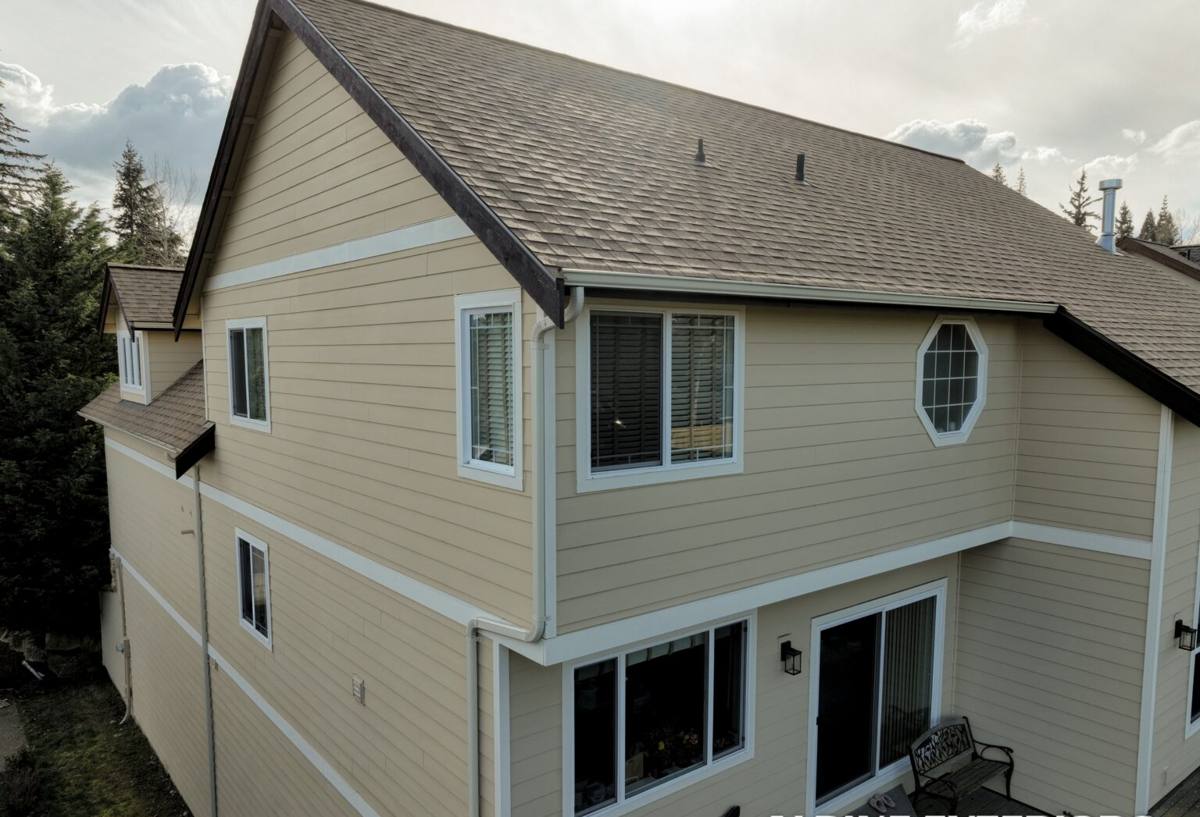
Why We Only Install James Hardie
We don't install vinyl, LP SmartSide, cedar, or other fiber cement brands. That's not a marketing line — it's a standard we hold because we've seen what a wet coastal climate does to materials that aren't built for it, and we don't want to be back at a Blaine home in five years explaining why the siding we installed is failing.
James Hardie's fiber cement is cement, sand, and cellulose fibers, engineered and cured to be dimensionally stable and non-combustible. It doesn't absorb water the way wood-based products can, it doesn't swell or delaminate at cut edges the way some engineered wood products can when moisture gets in, and it holds its factory finish for a long time instead of needing to be repainted every several years. For a home taking on salt air and near-constant winter dampness, that stability is the whole point.
The HZ5 Product Line
James Hardie makes climate-specific versions of its siding, and the HZ5 line is engineered for the Pacific Northwest's wet, moderate climate — the moisture and freeze-thaw exposure common in Whatcom County. It's the line we specify for Blaine and Ferndale homes rather than a generic product designed for a drier region. That distinction matters more here than in most parts of the country, because the difference between siding rated for your actual weather and siding that just happens to be sold nearby shows up in how long it lasts.
What a Correct Installation Actually Involves
Good siding material installed poorly will still fail in this climate, usually faster than people expect. Most siding problems we get called out to inspect in this area aren't material failures — they're installation shortcuts that let water in behind the siding, where it does its damage out of sight. A correct James Hardie install in a coastal wind-and-rain environment includes:
- A properly lapped weather-resistive barrier behind the siding, with all penetrations (pipes, vents, hose bibs) flashed and sealed before a single board goes up
- Correct fastener type and spacing — Hardie specifies this precisely, and it's not the same as framing nailer defaults
- Proper clearance at the bottom of the siding from grade, decks, and roof lines, so water has somewhere to go instead of wicking up into the board
- Butt joints and corners sealed and flashed to shed wind-driven rain rather than just relying on caulk alone
- Factory-cut and factory-primed edges kept intact wherever possible, with any field cuts properly sealed with Hardie-approved products
- Corrosion-resistant fasteners and trim hardware, given the salt air this close to the water
Skip any one of these and you can end up with siding that looks fine from the street for a couple of years while moisture is already working on the sheathing behind it. That's the failure mode we're most careful to prevent.
Moss, Algae, and Long-Term Appearance
Blaine's tree cover and damp season create ideal conditions for moss and algae growth on north-facing and shaded walls. James Hardie's ColorPlus factory finish is baked on under controlled conditions and holds color and sheen better than field-applied paint, which helps growth show up less and makes cleaning easier when it does appear. But finish quality doesn't eliminate the need for basic maintenance — siding in a moss-prone spot still benefits from an occasional gentle rinse and keeping nearby vegetation trimmed back so walls get some air and light.
What correct installation and a factory finish do prevent is the deeper problem: moisture trapped against the substrate under moss or algae growth. On materials prone to swelling or rot, that's where real damage starts. On properly installed Hardie siding, the surface growth stays a cosmetic issue instead of a structural one.
Comparing Materials for a Coastal Whatcom County Home
| Factor | James Hardie Fiber Cement | Vinyl | Wood / Engineered Wood |
|---|---|---|---|
| Moisture resistance in driving rain | Strong when correctly installed | Moderate — seams and gaps are vulnerable points | Variable — dependent on maintenance and coatings |
| Salt air / corrosion exposure | Non-combustible cement board; needs corrosion-resistant fasteners | Plastic doesn't corrode but can become brittle over time | Fasteners and hardware corrode; wood weathers unevenly |
| Finish longevity | Factory ColorPlus finish, long-lasting | Color molded in, can fade | Needs repainting or restaining on a recurring cycle |
| Moss/algae resistance | Good; growth stays surface-level | Similar surface growth possible | Growth can trap moisture against substrate |
| Fire resistance | Non-combustible | Combustible, can melt/deform | Combustible |
This isn't a knock on every home that has vinyl or wood siding today — plenty of it is still doing fine. It's an explanation of why, when a Blaine homeowner asks us to replace failing siding, we recommend fiber cement engineered for this climate rather than defaulting to whatever's cheapest to install.
Our Process for Blaine Projects
The work starts with an in-person look at the home, not a phone estimate. We check the current siding and sheathing condition, look at drainage around the foundation, note shaded or moss-prone walls, and identify anything unusual about the home's exposure — corner lots facing the water, tree cover, deck or roofline intersections that need extra flashing attention.
From there we put together a detailed scope: which HZ product and profile fits the home, what trim and flashing work is needed, and a realistic timeline that accounts for Whatcom County's wet-season scheduling realities. We don't start tearing off existing siding without a plan for keeping the wall assembly dry if weather turns during the job — that's a real risk in this climate and it needs to be managed, not ignored.
During installation, the weather barrier and flashing details get done first and checked before siding goes up over them, because that's the layer that actually keeps water out — the siding itself is the visible piece, but the barrier behind it is what does the protecting.
What to Check Before You Hire Any Siding Contractor
- Do they specify the correct James Hardie climate line (HZ5) for this region, or a generic product?
- Will they show you the weather-resistive barrier and flashing plan before siding goes up, not just after?
- Do they use manufacturer-specified fasteners and corrosion-resistant hardware given the salt air here?
- Can they explain how they'll handle clearance at grade, decks, and rooflines on your specific house?
- Do they have a plan for protecting the wall assembly if it rains mid-project?
- Is the estimate written, itemized, and clear about what's included — trim, flashing, disposal, permits?
Why Local Experience in Blaine Matters
A crew that's worked on homes in this specific area already knows which walls tend to stay damp longest, how far wind-driven rain travels up a wall on an exposed lot, and where moss tends to establish first. That's not something you learn from a spec sheet — it's learned by doing the work here, season after season. It shows up in small decisions: extra attention to a north wall that never sees direct sun, a slightly more conservative clearance at grade on a lot with poor drainage, choosing trim details that shed water instead of just looking clean on install day.
It also means the crew understands the practical side of working in Whatcom County's wet season — how to sequence a tear-off and re-side so the home isn't sitting exposed longer than necessary, and how to read a forecast that changes fast this close to the water.
What This Costs
Every Blaine home is different — square footage, number of stories, existing siding condition, trim complexity, and access all affect the number. In general terms, fiber cement siding costs more upfront than vinyl and is comparable to or somewhat more than mid-grade wood siding options, but it's priced for a service life measured in decades rather than years, with far less repainting and repair along the way. We'll give you a specific, itemized number for your home rather than a rough range that doesn't mean much until we've actually looked at the project.
If you're planning a siding replacement or new construction project in Blaine and want it done with a product and a process built for this climate, we're happy to come take a look and put together a straightforward, no-pressure estimate — just fill out the form below.