 Ferndale
 Why Blaine Homes Wear Out Siding Faster Than Homes Inland
Blaine sits right up against the water, and that proximity changes what siding has to survive. Salt-laden air corrodes fasteners and trim hardware that would last decades a few miles inland. Wind-driven rain off the water doesn't fall straight down — it drives sideways into wall assemblies, finding every gap in flashing, caulk, and butt joints that a calmer climate would never test. And the long, wet, low-sun stretch of fall through spring gives moss and algae months to colonize any siding surface that holds moisture or shade. None of this is unique to one street or one subdivision — it's the baseline condition for anything built close to Whatcom County's shoreline, and it's the reason siding choices that work fine in a dry inland climate can fail early here.
We work Blaine regularly out of our Ferndale base, and the siding failures we get called out to fix follow a pattern: swollen seams where water got behind the panel, moss lines at the bottom courses where splash-back never dries, corroded nail heads bleeding rust streaks down the face of the wall, and paint that's chalked or peeled years ahead of schedule. A correctly chosen and correctly installed siding system avoids nearly all of it.
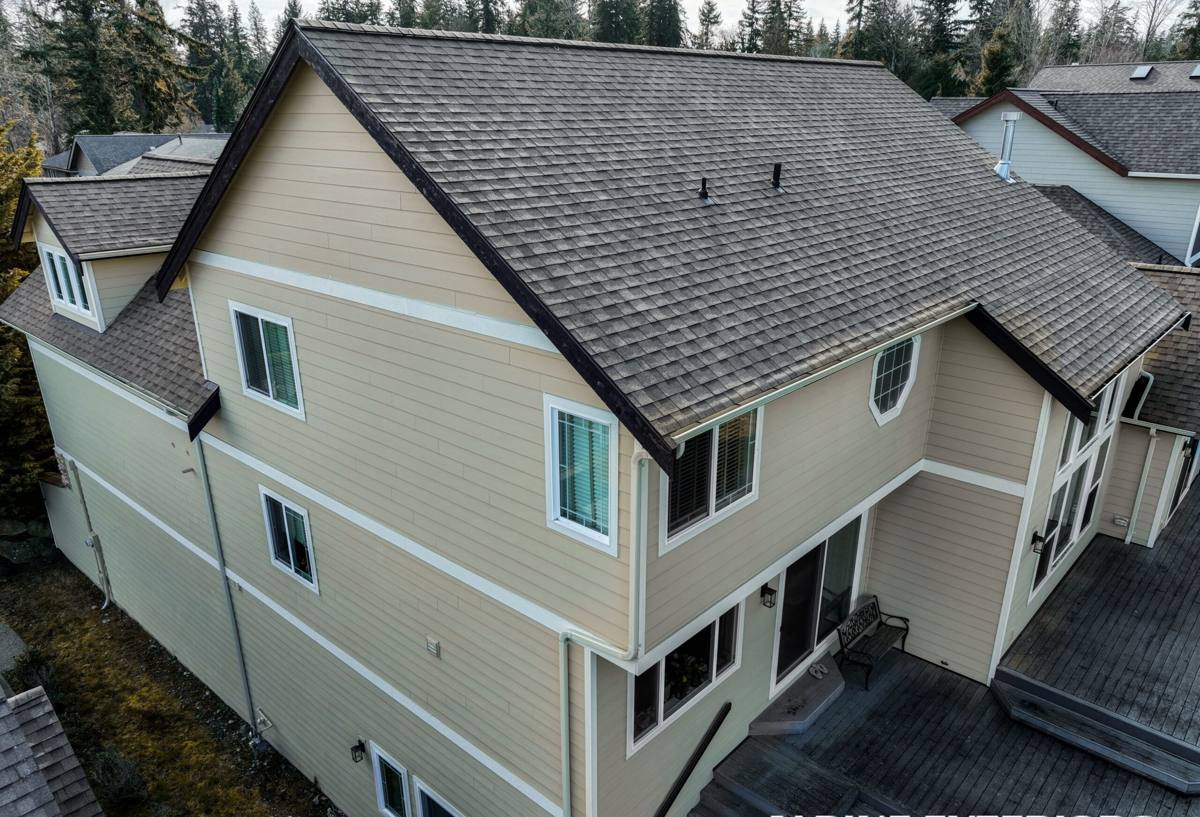
What Blaine's Climate Actually Demands From a Siding Product
Three conditions define the job here, and any siding material or installation plan has to answer all three:
- Salt air exposure — fasteners, flashing, and trim need to resist corrosion, not just today but for the 30+ year life of the siding.
- Driving rain — the water management behind the siding (weather-resistive barrier, flashing, drainage plane) matters as much as the siding itself. Wind-driven rain will find any weak point.
- Extended moss season — surfaces need to shed water fast and resist organic growth, or they need factory-applied finishes that don't feed moss and algae the way bare, absorbent materials do.
This is why we install James Hardie fiber cement exclusively, and specifically their HZ5 product line engineered for the Pacific Northwest's wet climate zone. It's not the only siding material on the market, but it's the one we're willing to put our name behind on homes exposed to this kind of weather.
Why We Standardized on James Hardie — and Not the Alternatives
We get asked why we don't offer vinyl, LP SmartSide, or other fiber cement brands like Cemplank or Allura. Each of those products has legitimate uses somewhere. Here's the honest trade-off calculation that led us to Hardie-only:
Vinyl
Vinyl is inexpensive and low-maintenance in mild climates, but it's a thin plastic product that expands and contracts with temperature swings, and its seams and J-channels give wind-driven rain more entry points than a properly lapped fiber cement installation. In a driving-rain environment, that's a real liability, not a theoretical one.
LP SmartSide
LP SmartSide is engineered wood — strand board with a resin coating. It performs reasonably well when maintained, but it's still wood at its core, and wood-based siding is more vulnerable to prolonged moisture exposure than cement-based siding. In a climate with a long wet season and salt air working on every seam and cut edge, that's the wrong bet for a 30-year investment.
Other Fiber Cement Brands (Cemplank, Allura, etc.)
These are legitimate fiber cement products, and the base material science is similar to Hardie's. What we standardized on with Hardie is the factory-applied ColorPlus finish system, the depth of their climate-specific engineering (the HZ5 line specifically), and a warranty structure we've found to be the most straightforward to support. Consistency also matters operationally — our crew installs one system, to one spec, every time, which reduces the chance of a detail getting missed.
Primed Spruce or Cedar
Wood siding can look great, and some homeowners want that look specifically. But raw or primed wood siding demands a maintenance schedule — recaulking, repainting, spot-treating moss and rot — that most homeowners underestimate, and in a climate this wet, the maintenance interval only gets shorter.
What a Correct Fiber Cement Installation Involves
The siding material is only part of the job. Most of the failures we see trace back to installation shortcuts, not the product itself. A correct install on a Blaine home includes:
- A continuous, properly lapped weather-resistive barrier behind the siding — this is the actual waterproofing layer; the siding sheds most water but the barrier handles what gets through.
- Corrosion-resistant fasteners driven to the manufacturer's specified pattern and depth — overdriven or underdriven nails are one of the most common causes of early siding failure.
- Correct flashing at every window, door, and roofline intersection, integrated with the weather barrier rather than just caulked over it.
- Proper clearance between the bottom siding course and grade, decks, or roofing — too little clearance traps moisture and accelerates moss growth right where you'll see it first.
- Factory-primed or ColorPlus-finished cut edges sealed in the field, since a raw cut edge is the fastest way for a fiber cement board to absorb water.
- Caulking only where Hardie's install specs call for it — over-caulking traps moisture just as often as under-caulking lets it in.
Fiber Cement vs. the Alternatives, for Blaine's Climate
| Factor | James Hardie Fiber Cement (HZ5) | Vinyl | LP SmartSide | Primed Cedar/Spruce |
|---|---|---|---|---|
| Moisture resistance | High — cement-based, engineered for wet climates | Moderate — seams are vulnerable to driving rain | Moderate — wood core, resin-treated | Low without diligent upkeep |
| Salt air / corrosion resistance | High with correct fasteners | High for the panel, low for exposed hardware | Moderate | Moderate; hardware still corrodes |
| Moss/algae resistance | Good, especially with ColorPlus finish | Good on the surface, poor at seams/trim | Fair | Poor without regular treatment |
| Maintenance burden | Low — occasional wash, repaint on a long cycle | Low | Moderate — periodic recoating | High — recurring paint, caulk, moss treatment |
| Fire resistance | Non-combustible | Melts/deforms under heat | Combustible (wood core) | Combustible |
| Typical lifespan when correctly installed | 30+ years | 20-30 years | 20-30 years | 15-25 years with upkeep |
Our Process on a Blaine Fiber Cement Job
1. On-Site Assessment
We look at the existing siding, wall assembly, and problem areas specific to the house — moss patterns, water staining, soft spots — before quoting anything. Coastal exposure varies even within Blaine depending on how sheltered or exposed a given lot is, so we assess each house rather than quoting off a template.
2. Tear-Off and Sheathing Check
We remove the old siding down to the sheathing and check for hidden water damage. This is often where we find the real story behind moss and staining on the old siding — trapped moisture that's been working on the wall for years unseen.
3. Weather Barrier and Flashing
We install a continuous weather-resistive barrier and properly integrated flashing at every penetration before a single piece of siding goes up. This step is invisible once the job is done, and it's the step that determines whether the house stays dry for the next 30 years.
4. Hardie Installation to Spec
HardiePlank, HardiePanel, or HardieTrim — depending on the home's design — installed to manufacturer fastening, clearance, and joint specifications, with ColorPlus finished pieces field-cut and sealed correctly.
5. Final Walkthrough
We walk the finished job with the homeowner, checking trim lines, caulk joints, and clearances before calling it done.
Why a Crew That Already Works Blaine Matters
Siding installation isn't just about following a spec sheet — it's about knowing which details matter most for the specific conditions a house faces. A crew that regularly works Blaine and the surrounding Ferndale area already knows which fastener grades hold up against salt air, which wall orientations take the worst of the driving rain, and where moss tends to establish first on a coastal wall. That's knowledge you build by doing the work here repeatedly, not by reading a general installation manual. It also means fewer surprises during permitting and inspection, since we're familiar with how Whatcom County jurisdictions handle exterior work.
Maintenance Checklist for Blaine Homeowners
Even the right siding, correctly installed, benefits from basic upkeep in this climate. A short annual routine goes a long way:
- Rinse siding surfaces annually, focusing on north-facing and shaded walls where moss establishes first.
- Inspect caulk joints around windows, doors, and trim each spring for cracking or separation.
- Check the bottom courses near grade, decks, and roof-to-wall intersections for splash-back staining or trapped debris.
- Look for rust streaking below fastener heads or trim hardware — an early sign of corrosion worth addressing before it spreads.
- Keep gutters clear so overflow isn't running down the siding face during heavy rain events.
- Repaint on the manufacturer's recommended cycle rather than waiting for visible failure.
When to Repair vs. When to Replace
Not every siding problem in Blaine means a full replacement. Isolated moisture damage, a few failed boards, or trim rot can often be repaired if the underlying wall assembly is sound. Full replacement makes more sense when the weather barrier itself has failed, when moisture damage is widespread rather than isolated, or when the existing siding material — vinyl, older wood, or a non-Hardie composite — has reached the point where repair costs start approaching replacement costs. We'll tell you honestly which situation you're in rather than defaulting to the bigger job.
If you're dealing with moss buildup, water staining, or aging siding on a Blaine home, we're happy to take a look and walk you through what we'd recommend and why. Reach out for a free, no-pressure estimate — the form below gets you started.