 Ferndale
 Nooksack's Climate Is Hard on Siding — Here's Why
Homes in and around Nooksack sit inland from the Salish Sea but still catch the marine-influenced weather that defines this corner of Whatcom County: long stretches of driving rain, damp air that lingers in the river valley, and a moss season that can run from early fall well into spring. Add the humidity that settles under tree cover near the Nooksack River and you get a climate that punishes siding materials that can't handle sustained moisture exposure.
This isn't a place where siding just needs to look good for a few dry summer months. It needs to shed water without trapping it, resist the organic growth that thrives in shaded, damp conditions, and hold its finish through repeated wet-dry cycles year after year. A lot of siding failures we see on older homes in this area aren't dramatic — they're slow. Swelling at the bottom edge of lap boards, soft spots around window trim, dark streaking and moss creeping up from the foundation line. By the time it's visible, the damage has usually been building for years.
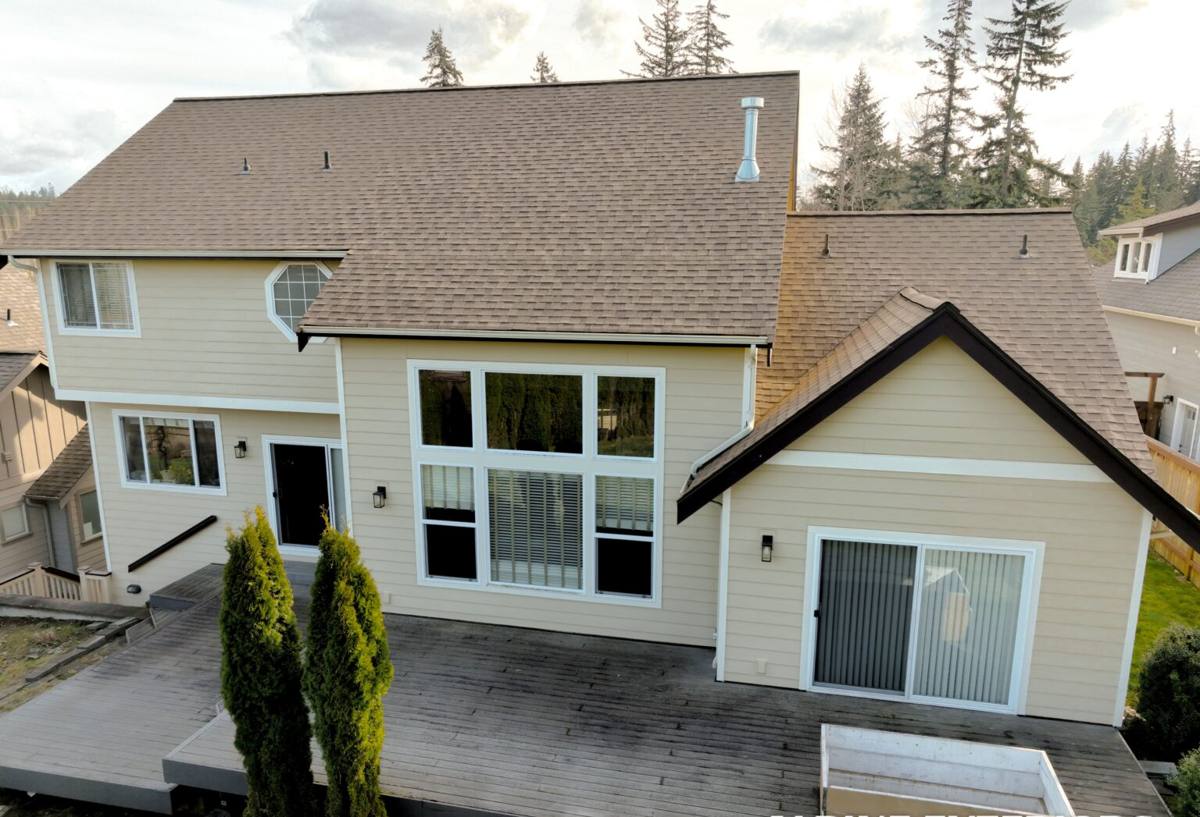
Why James Hardie Fiber Cement Fits This Environment
We install James Hardie exclusively, and in a climate like Nooksack's, the reasoning is straightforward. Fiber cement is engineered from cement, sand, and cellulose fiber — it doesn't absorb water the way wood-based products do, and it doesn't warp, rot, or become a food source for the moss and mildew that thrive in this region's shade and moisture. That matters more here than it would in a drier climate, because the growing season for moss and algae on north-facing walls and shaded siding runs most of the year.
James Hardie also builds region-specific product engineering into its lines. For the Pacific Northwest, that means the HZ5 formulation, designed for climates with sustained moisture and freeze-thaw cycling. It's not a marketing label — it's a different manufacturing specification meant for exactly the conditions Nooksack sees: wet falls, cold snaps, and long gray stretches where siding rarely gets a chance to fully dry out between rain events.
ColorPlus Factory Finish
Most Hardie siding we install carries the ColorPlus finish — a baked-on, factory-applied color coat that's more consistent and more resistant to fading and moisture intrusion than field-applied paint. In a climate where repainting siding every few years isn't realistic for most homeowners, a finish that's engineered to hold up outperforms one that depends on getting perfect paint conditions during a narrow dry-weather window.
Why We Don't Install Anything Else
We get asked from time to time about vinyl, LP SmartSide, or cedar. Each of those products has a legitimate place in the market, and we're not going to pretend otherwise. But we made a decision to standardize on one product system because it lets us guarantee the installation quality, warranty coverage, and long-term performance we're willing to put our name behind — especially in a climate this demanding. Vinyl can warp and doesn't hold up structurally the way fiber cement does. Engineered wood products need meticulous edge-sealing to prevent moisture wicking, which is a hard standard to hold on every job. Cedar is beautiful but requires ongoing maintenance that most homeowners don't want to keep up with in a climate this wet. James Hardie, installed correctly, removes most of that risk.
What a Correct Installation Actually Involves
The siding itself is only part of the equation. Most siding failures we see — on any brand — trace back to installation mistakes, not product defects. In a high-moisture climate like Nooksack's, the details matter even more than usual.
- Weather-resistive barrier and flashing installed first — the siding is the last line of defense, not the only one. Proper house wrap and flashing at every penetration keep water out even if it gets behind the cladding.
- Correct clearance from grade and hard surfaces — Hardie's own specifications call for a minimum clearance from soil, decks, and roofing to prevent wicking. This is one of the most commonly skipped details on rushed jobs.
- Kick-out flashing at roof-wall intersections — a small detail that prevents a large amount of water from being diverted directly into the wall assembly, which is a common cause of hidden rot.
- Proper fastener type, spacing, and placement — Hardie specifies fastener patterns by product line and exposure; over-driven or improperly placed fasteners crack boards or create entry points for moisture.
- Correctly caulked and sealed joints — using sealants rated for the product and climate, not general-purpose caulk that dries out and cracks within a few seasons.
- Proper board gaps at butt joints — fiber cement needs room to expand and contract; tight joints lead to buckling over time.
Skip any one of these and you can end up with siding that looks fine at close inspection but fails early where it counts — behind the surface, where you can't see it until there's a real problem.
Our Process on Nooksack Projects
1. On-Site Assessment
We walk the exterior, check the current siding and water management (flashing, gutters, grading), and look for existing moisture damage before it's covered up by new siding. Covering rot with new material doesn't fix anything — it hides it.
2. Product and Line Selection
We talk through Hardie's plank, shingle, and panel options and help match the profile and color to the home and to what actually performs well in this climate, not just what looks good in a photo.
3. Prep and Removal
Old siding comes off, the sheathing underneath gets inspected, and any damaged material is repaired before anything new goes up. This step gets skipped by crews trying to move fast — we don't skip it.
4. Installation to Manufacturer Spec
We install to James Hardie's published specifications for clearance, fastening, flashing, and joint treatment — the details covered above — because that's what keeps the manufacturer's warranty valid and keeps the siding performing for decades.
5. Final Walkthrough and Warranty Registration
We review the finished work with the homeowner and make sure the installation is registered so the full manufacturer warranty is active and documented.
Cost Factors for a Nooksack Home
Every project is different, and we won't quote a number without seeing the house, but these are the variables that actually move the price up or down:
| Factor | Why It Matters |
|---|---|
| Home size and wall complexity | More corners, dormers, and trim details mean more cutting, fitting, and labor time |
| Current siding removal | Tear-off and disposal of old material adds cost versus a bare-sheathing new build |
| Hidden sheathing or framing damage | Moisture damage found during removal has to be repaired before new siding goes on |
| Product line and profile | Lap, shingle, and panel styles carry different material and labor costs |
| Trim and accessory work | Fascia, soffit, and trim replacement alongside siding affects overall scope |
| Access and site conditions | Slopes, tree cover, and tight lot lines around some Nooksack properties can affect staging and labor time |
Signs a Nooksack Home May Need Siding Attention
- Persistent moss or dark streaking on siding, especially on shaded or north-facing walls
- Soft or spongy spots when you press on the siding, particularly near the bottom courses
- Visible warping, cupping, or separation at seams and joints
- Paint that's peeling, bubbling, or failing faster than it should between repaints
- Water stains or discoloration on interior walls near exterior corners
- Siding that feels consistently damp or takes unusually long to dry after rain
Why Local Experience on This Product Matters
Installing James Hardie correctly isn't the same everywhere. A crew that's spent time working on homes in and around Ferndale and Nooksack knows how the local moisture patterns, tree cover, and building stock behave — which walls take the most weather, where moss builds up fastest, and which older homes tend to have hidden water damage under their existing siding. That familiarity shows up in the details: where we pay extra attention to flashing, how we sequence a job around this area's weather windows, and what we look for during tear-off that a crew unfamiliar with this climate might miss. It also means we're not guessing at permitting or local expectations — we've done this work here before.
If your Nooksack home's siding is showing its age, or you're planning ahead rather than reacting to a problem, we're happy to take a look. Reach out for a free, no-pressure estimate — we'll walk the property with you, answer questions honestly, and give you a straightforward assessment of what your home actually needs.