 Ferndale
 Siding Installation in Everson: A Ferndale Crew That Already Works This Ground
Everson sits inland from Ferndale along the Nooksack River, far enough from the coastline that homeowners sometimes assume their siding gets an easier ride than houses closer to the water. In practice, the difference is smaller than it looks. Everson still sits inside the same Whatcom County weather pattern: salt-tinged marine air that pushes inland on a regular basis, driving rain that comes in sideways more often than straight down, and a moss season that runs long on shaded roofs and north-facing walls near the river bottom. A siding installation that isn't planned around those conditions tends to show it within a few wet seasons, regardless of how it looked on the day it went up.
We're based out of Ferndale and run crews across Whatcom County, including Everson, on a regular basis. We install James Hardie fiber cement siding exclusively — no LP SmartSide, no vinyl, no Cemplank, no Allura, no primed spruce, no cedar. That's not a marketing angle. It's a standard we settled on after seeing which materials actually hold up in this specific climate and which ones quietly become a maintenance problem a few years in.
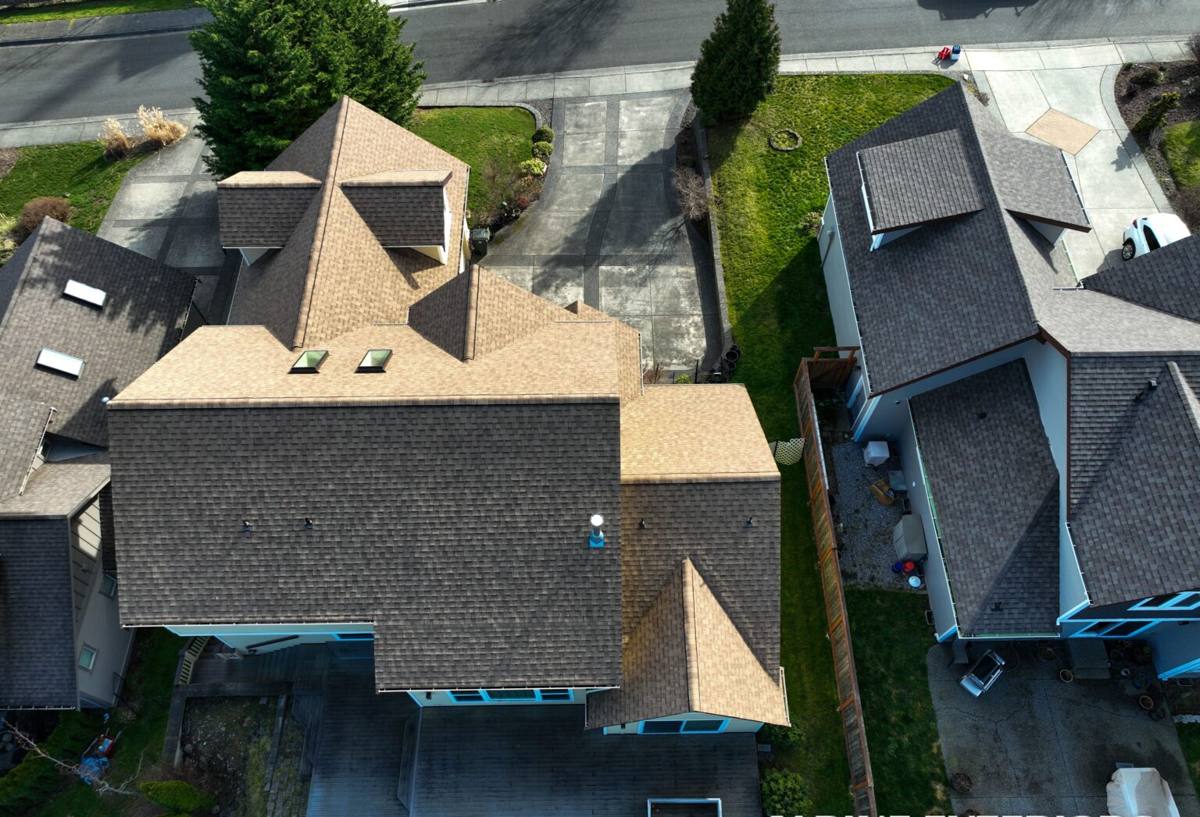
What Everson's Climate Asks of a Siding Job
Inland Doesn't Mean Dry
Everson's distance from the immediate shoreline doesn't take it out of the marine weather system that defines this part of Washington. Moist air still moves through the river valley, and the same wind-driven rain that soaks Ferndale and Bellingham reaches Everson too. Any siding installation planned as if the town were in a drier, more sheltered climate is starting from the wrong assumptions.
River-Bottom Moisture and Shade
Homes along the Nooksack corridor often sit lower and closer to tree cover than homes on more open ground, which means slower drying after a storm and longer stretches of shade on at least one side of the house. That combination is exactly what moss, mildew, and organic growth need to establish themselves on siding, trim, and roof edges. A porous or moisture-absorbing siding material in that setting stays damp longer than it would on a more exposed lot, and that extra dwell time is where a lot of early siding failure starts.
Freeze-Thaw Swings
Whatcom County's winters aren't severe by national standards, but Everson does see more frost and cold snaps than the immediate coastline, since it sits farther from the moderating effect of the water. Siding that absorbs moisture and then goes through repeated freeze-thaw cycling is more prone to cracking, spalling, or losing its bond with paint and finish over time. That's a real factor in material selection here, not a theoretical one.
Why We Only Install James Hardie Siding
We used to install a broader range of siding products. We narrowed it to one system, and the reasoning was practical rather than promotional.
- Non-combustible fiber cement core: It doesn't feed a fire the way wood-based or wood-fiber siding products can, which matters for household safety and often for insurance considerations.
- Factory-applied ColorPlus finish: The color is baked on in a controlled factory process rather than applied on site, so it resists fading, chalking, and moisture damage far longer than field-applied paint on a humid, shaded lot.
- Climate-engineered HZ formulations: Hardie's HZ5 product line is built for regions with sustained moisture exposure and freeze-thaw cycling, which describes inland Whatcom County as much as it does the coast.
- Dimensional stability: Fiber cement doesn't swell, cup, or warp the way engineered wood siding can after repeated wet-dry cycles along a river corridor.
- A strong transferable warranty: Hardie's warranty coverage is among the more robust in the industry, provided the installation is done to spec.
LP SmartSide, vinyl, Cemplank, Allura, primed spruce, and cedar all have a legitimate place in the market, and plenty of homeowners are happy with them elsewhere. We made a professional call that in a climate that stays damp this long, on lots that stay shaded this much, one system we can fully stand behind is worth more than a cheaper option that shifts maintenance risk onto the homeowner a few years down the line.
What a Correct Installation Actually Involves
The material is only half the equation. A James Hardie installation performs the way it's designed to only when the fastening pattern, clearances from grade and roofline, joint lapping and sealing, and the house wrap and flashing details behind the siding are all done correctly. Skipping or rushing any one of those steps is one of the most common ways a good product ends up with a bad reputation on a specific house, which is why we treat installation detail with the same seriousness as the material choice itself.
Our Process on an Everson Job
- Walk the property and assess the existing siding, substrate condition, and any moisture history around windows, trim, and low-wall areas.
- Confirm scope: full tear-off versus a case where localized repair genuinely makes sense.
- Remove old siding where required and inspect sheathing and framing for hidden rot or moisture damage before anything new goes up.
- Install or verify house wrap and flashing at every penetration, window, and roofline transition.
- Install James Hardie siding to manufacturer fastening and clearance specifications, with attention to the wall orientations that stay wettest longest.
- Final walkthrough with the homeowner before we consider the job finished.
Repair vs. Full Replacement
Not every siding issue in Everson needs a full tear-off. A storm-damaged section, a failed piece of trim around a window, or a small area of impact damage can often be repaired and matched into existing Hardie siding without redoing the whole wall. But once moisture has been tracking behind the siding for a while, or the existing material is an older product near the end of its service life, a repair usually just delays a larger job. We'll tell you which situation you're actually in.
Cost Factors for an Everson Siding Installation
| Factor | What It Affects | Why It Matters in Everson |
|---|---|---|
| Home size and wall complexity | Total material and labor | More trim, gables, and corners mean more joints where wind-driven rain can work its way in |
| Tear-off vs. overlay | Labor scope and substrate access | Tear-off exposes hidden moisture damage that's common under older siding near shaded, low-lying lots |
| Substrate condition | Repair costs before new siding goes on | Trapped moisture behind failing siding can rot sheathing, especially on shaded or river-adjacent properties |
| Site access and tree cover | Labor time and equipment staging | Wooded lots common around Everson can add setup time and affect drying conditions during install |
| Trim and color selection | Material cost and long-term finish life | ColorPlus factory finish holds up better against UV and moisture than field-applied paint |
These are the variables that move a price, not a quote. We walk each property in person before giving a real number, because a generic per-square-foot figure doesn't account for what we actually find on the wall.
Signs Your Everson Home's Siding Needs Attention
- Moss or dark staining that comes back quickly after cleaning, especially on shaded or north-facing walls
- Soft or spongy siding, particularly near grade level or around window and door trim
- Peeling paint, bubbling, or visible cupping and warping on siding boards
- Cracked, chipped, or missing sections after wind or storm events
- Visible gaps at seams, corners, or trim joints where water can track behind the wall
- A musty smell near exterior walls, which can point to moisture trapped behind siding rather than a roof issue
Roofing, Windows, and Decks Alongside Your Siding
Siding damage often has a cause that isn't the siding itself. A poorly flashed window, a roof valley shedding water in the wrong direction, or a deck ledger board trapping moisture against the house can all surface as siding problems even though the wall covering is only where the damage becomes visible. Because we also handle roofing, windows, and decks, we can look at an Everson home as one connected exterior system rather than treating a wet wall as an isolated siding question and missing where the water is actually getting in.
Why Hiring a Crew That Already Works Everson Matters
Everson is a smaller community than Ferndale or Bellingham, and it doesn't always get the same attention from crews based farther away. A crew that's out in Whatcom County regularly, including on the inland side of the county near the Nooksack River, has a working sense of how salt-tinged air, wind-driven rain, and a long moss season actually behave on real houses here — not just how a product performs on a spec sheet. That shows up in small decisions on install day: which wall gets extra flashing attention, which orientation stays wet longest after a storm, and which details are worth the extra time so you're not dealing with a callback two winters from now. We treat an Everson job with the same standard we hold in Ferndale, because it's the same climate doing the same things to a house.
If your Everson home needs new siding, or you want a second opinion on a quote you've already received, we're happy to walk the property and give you a straightforward, no-pressure estimate.