 Ferndale
 Everson's Climate Is Harder on Siding Than It Looks
Everson sits inland from Bellingham Bay along the Nooksack River, but the weather that reaches it is still shaped by the same marine air that moves through the rest of Whatcom County. That means damp, mild winters, rain that comes in sideways during fall and winter storms, and long stretches of the year when siding, fascia, and trim never fully dry out between soakings. Add in the shaded lots and tree cover common along the river corridor and you get one of the longer moss seasons in the Pacific Northwest — often eight or nine months out of twelve on the north and east sides of a house.
That combination of salt-tinged marine humidity, wind-driven rain, and near-constant shade doesn't just make siding look dirty. Over years, it's what drives paint failure, swollen trim, and rot at the joints and edges where water collects and sits. It's a problem you solve with a siding system engineered for this exact climate, installed the way the manufacturer specifies, by a crew that already understands how Everson's moisture and shade patterns behave on a real house.
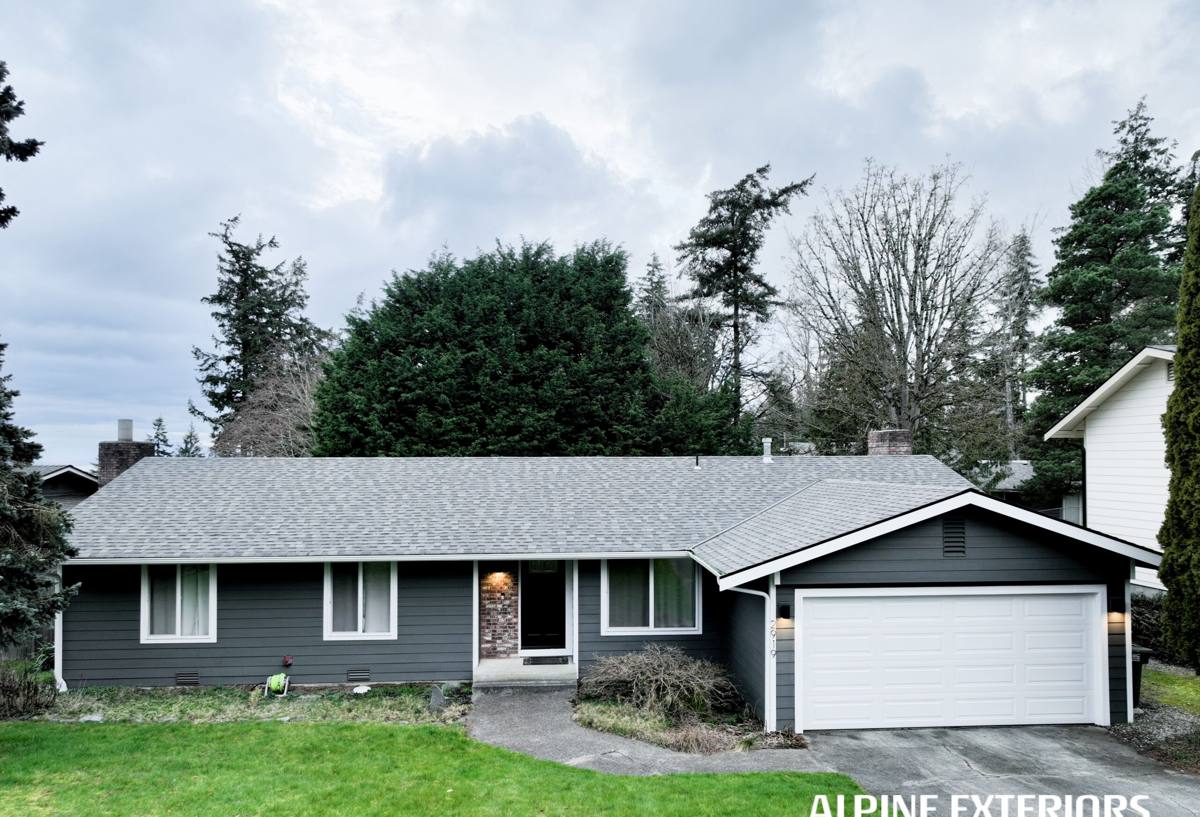
What Damp, Moss-Prone Weather Does to the Wrong Siding
Moss Holds Moisture Against the Wall
Moss doesn't just grow on roofs. On shaded siding, especially anywhere caulking has cracked or a butt joint has opened up, moss and algae hold water against the surface far longer than open sun-exposed walls ever see. On wood-based products, that constant dampness is exactly what starts rot at the substrate. On fiber cement that's been correctly primed and finished, it's a cosmetic issue you can rinse off — not a structural one.
Wind-Driven Rain Finds the Weak Points
Storms in this part of Whatcom County rarely fall straight down. Rain driven sideways by wind gets pushed up under laps, into unflashed penetrations, and behind trim that wasn't gapped and caulked correctly. A siding material can be rated for decades of service and still fail in five years if the installation didn't account for wind-driven rain at every seam, corner, and fixture penetration.
Repeated Wet-Dry Cycling
Everson's climate doesn't give siding long dry stretches to fully recover between rain events. Materials that swell, warp, or absorb moisture at cut edges are put through more wet-dry cycles here than they would see in a drier climate, and that cycling is what shortens their real-world service life compared to their rated one.
What Correct Fiber Cement Installation Involves
Fiber cement siding is only as good as the installation behind it. The material itself resists moisture, fire, and pests, but a poorly installed job on a good product will still fail at the seams — which is exactly where Everson's climate does the most damage. A correct installation includes:
- A weather-resistive barrier installed and lapped correctly behind the siding, with no gaps at seams or penetrations
- Flashing at every window, door, deck ledger, and roof-to-wall intersection — not just caulk
- Proper clearance from grade, roofing, decks, and walkways so siding isn't sitting in standing water or splash-back
- Correct nail or screw type, spacing, and depth — over-driven fasteners crack the board and create entry points for water
- Factory-cut or field-cut edges primed or sealed before installation, since raw cut edges absorb moisture fastest
- Gapped joints caulked with a high-quality, paintable sealant rated for the manufacturer's specifications, not just whatever caulk was on the truck
Site Prep Matters as Much as the Siding
Before any new siding goes up, the sheathing underneath needs to be sound. On older Everson homes, that means checking for water damage from the old siding system, correcting any grading or drainage issues at the foundation, and confirming that vents, hose bibs, and other penetrations will be flashed properly under the new system — not just caulked over.
Why We Only Install James Hardie Fiber Cement
We standardized on James Hardie fiber cement because it's engineered specifically for climates like this one. Hardie's HardieZone system rates products by region, and the versions specified for the Pacific Northwest are built to handle sustained moisture exposure rather than the drier, warmer conditions other fiber cement products are optimized for. It's non-combustible, which matters given the wildfire smoke and drought stretches Western Washington has seen in recent summers, and it holds its factory-applied ColorPlus finish far longer than field-applied paint holds up against Whatcom County's damp winters.
We're not going to tell you every other siding product on the market is bad — vinyl, LP SmartSide, and cedar all have legitimate uses and real advantages in the right application. But for the moisture load, moss exposure, and wind-driven rain that Everson homes deal with year after year, we've made a professional decision to install one system, install it correctly, and stand behind it — rather than offer several products and hope the cheaper option holds up as well as the one we know does.
How Fiber Cement Compares for This Climate
| Material | Moisture & Moss Resistance | Maintenance | Typical Lifespan |
|---|---|---|---|
| James Hardie Fiber Cement | Engineered for damp climates; factory finish resists moss staining | Occasional rinse; no repainting for years with ColorPlus | Multiple decades with correct installation |
| Vinyl Siding | Sheds water but seams and laps can trap moisture behind panels | Low, but panels can warp or crack over time | Variable; shorter in high-moisture, high-UV cycling climates |
| LP SmartSide | Engineered wood product; performs well but relies heavily on sealed edges and caulk maintenance | Moderate; edge sealing and caulk need regular inspection | Shorter than fiber cement if maintenance lapses |
| Cedar | Natural material; absorbs moisture and is a food source for moss and mildew | High; regular staining, sealing, and moss treatment required | Shortest of the group without consistent upkeep |
This isn't a knock on any single product — it's why we chose the one that needs the least babysitting in exactly the conditions Everson deals with every winter.
Our Process for Everson Siding Projects
- On-site inspection of the existing siding, trim, and any visible moisture damage or moss buildup
- Diagnosis of the sheathing and framing condition once old siding is removed, with any needed repairs addressed before new siding goes on
- Installation of the weather-resistive barrier and flashing package at every window, door, and penetration
- Fiber cement installation to manufacturer spec — correct fasteners, clearances, and gapped, caulked joints
- Trim, corners, and touch-up work using matched ColorPlus product where possible
- Final walk-through to confirm flashing, caulking, and clearances before we consider the job finished
Maintenance Everson Homeowners Should Expect
Fiber cement is low-maintenance, not no-maintenance. In a climate with this much shade and moisture, a little attention goes a long way:
- Rinse siding annually, paying extra attention to shaded north- and east-facing walls where moss takes hold first
- Keep gutters and downspouts clear so runoff isn't sheeting down the siding face
- Trim back landscaping and tree cover that keeps a wall shaded and damp longer than it needs to be
- Inspect caulk joints every couple of years — caulk is the first thing to fail, long before the siding itself does
- Address any soft trim or bubbling paint promptly rather than waiting for it to spread
What Affects the Cost of a Fiber Cement Job in Everson
| Cost Factor | Why It Matters |
|---|---|
| Home size and siding profile | More square footage and more complex trim details mean more labor and material |
| Condition of existing sheathing | Rot or moisture damage found during tear-off adds repair time before new siding can go up |
| Site access and lot conditions | Tree cover, slope, and tight lot lines around Everson properties can slow staging and installation |
| Trim and detail complexity | Additional flashing, corner boards, and custom trim work add labor beyond flat wall panels |
| Color and finish choice | Factory ColorPlus finishes reduce future repainting costs even if upfront pricing differs by color |
We don't quote a job until we've actually looked at it — every Everson property has a different mix of sun exposure, tree cover, and existing siding condition, and those differences change the scope more than most homeowners expect.
Why a Crew That Already Works in Everson Matters
A crew that only shows up in this area once in a while doesn't know which walls hold moss the longest, which older homes tend to have hidden moisture damage behind their original siding, or how a given lot's shade and drainage will affect a new installation. A crew that already works Whatcom County day to day has seen the failure points before — the caulk joints that always go first, the flashing details that get skipped on rushed jobs, the trim that always seems to rot first on a shaded wall. That familiarity shows up in fewer callbacks and a job that's built to actually hold up through another wet Everson winter, not just look good on installation day.
If you're weighing your siding options for a home in Everson, we're happy to take a look and walk you through what we'd actually recommend for your specific house — no pressure, no obligation. Fill out the form below to schedule a free estimate.