 Ferndale
 Why Sudden Valley's Climate Is Hard on Siding
Sudden Valley sits in a stretch of Whatcom County where the weather doesn't do anything in half measures. Homes here take on salt-laden air moving in off the water, driving rain that comes in sideways during winter storms, and long stretches of shade under mature evergreen canopy that never quite lets a wall dry out. Individually, none of those is unusual for western Washington. Together, over years, they're what separates a siding job that looks fine at installation from one that actually holds up.
Salt Air and Wind-Driven Rain
Salt in the air accelerates corrosion on fasteners, trim, and any exposed metal, and it works its way into seams and laps that aren't detailed correctly. Add wind-driven rain — the kind that hits a wall at an angle instead of running straight down it — and you get moisture pushed into places a fair-weather installation never accounts for: butt joints, window and door flashing, inside corners, and anywhere caulking was asked to do a job that flashing should have done instead. A siding system and an install method both have to be built for that combination, not just for an average rainy day.
Shade, Tree Cover, and a Long Moss Season
The same tree cover that makes this part of Whatcom County attractive also keeps walls damp longer than homes out in the open. Less direct sun means slower drying after every rain, and slower drying means more time for moss, algae, and mildew to get a foothold on north-facing and heavily shaded elevations. Moss doesn't just look bad — it holds moisture against the surface underneath it, which is exactly the kind of sustained dampness that breaks down materials not built to shrug it off. On a home in this kind of setting, moss season isn't a once-a-year nuisance; it's close to a year-round condition on the shaded sides of the house.
What Fiber Cement Brings to This Kind of Exposure
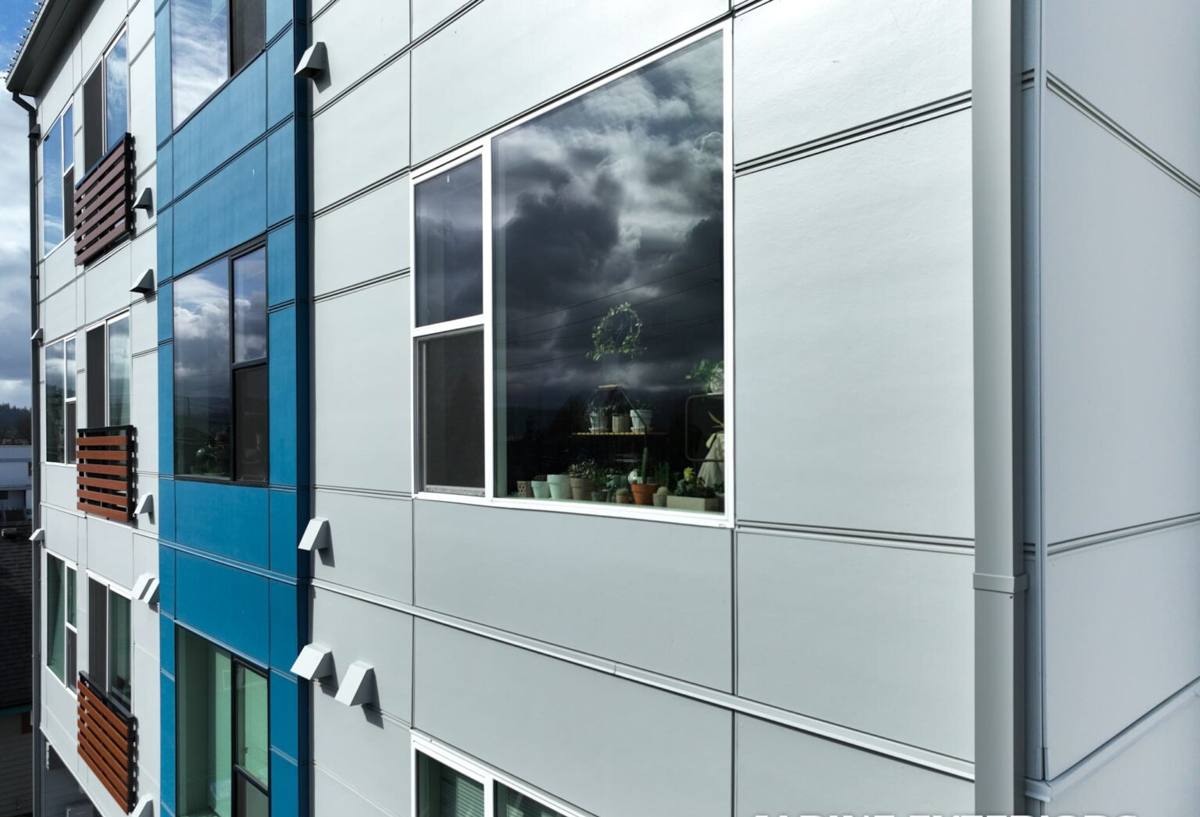
James Hardie fiber cement is cement, sand, and cellulose fiber, factory-cured into planks and panels. It doesn't rot, it isn't a food source for moss or mildew the way untreated wood fiber is, and it doesn't absorb and swell with moisture the way wood-based composite products can. It's also non-combustible, which matters in a region where wildfire smoke and defensible-space concerns have become a normal part of homeownership conversations, even west of the mountains. None of that makes a home immune to the effects of salt air, rain, and shade — but it gives the siding material itself a much longer runway before those conditions start to matter.
The factory-applied ColorPlus finish is part of that equation too. It's baked on under controlled conditions rather than field-applied, which means better adhesion and a finish that's built to handle repeated wet-dry cycling without chalking or peeling the way some field-painted surfaces do over time.
Fiber Cement vs. the Alternatives in Whatcom County Conditions
Homeowners in Sudden Valley usually end up comparing three broad categories when it's time to re-side: fiber cement, vinyl, and wood or wood-composite products. Here's how they typically hold up against the specific conditions in this area.
| Material | Moisture & Moss Resistance | Behavior in Wind-Driven Rain | Long-Term Maintenance |
|---|---|---|---|
| Fiber Cement (James Hardie) | Doesn't rot or feed mold/moss growth; holds up under sustained shade dampness | Rigid, dimensionally stable; performs well when laps and flashing are detailed correctly | Occasional wash; factory finish reduces repainting cycles |
| Vinyl | Won't rot, but can trap moisture behind it if house wrap and flashing aren't done right | Can flex, warp, or be driven off track by sustained wind and pressure | Low upkeep, but color fades and it's hard to patch invisibly after damage |
| Wood / Wood-Composite | Most vulnerable to rot and moss in shaded, damp settings without diligent upkeep | Absorbs moisture at joints and cut ends if not sealed and maintained | Requires regular painting, caulking, and moisture inspection |
This isn't a knock on every product on that list — vinyl and wood both have legitimate uses. It's why, as a company, we standardized on one material and install it correctly rather than trying to be everything to everyone.
What a Correct Fiber Cement Installation Actually Involves
Fiber cement's reputation is only as good as the install underneath it. Most of the siding failures we get called out to inspect on older homes trace back to installation shortcuts, not the material itself. On a climate like this one, the details matter even more than usual.
- Correct gapping at butt joints and around penetrations, sized for expansion and contraction rather than caulked tight
- Proper flashing — not caulk — above windows, doors, and any horizontal trim where water can collect
- Fastener placement and type matched to the substrate, to avoid the corrosion and pull-through issues salt air can accelerate
- Minimum clearance from grade, decks, and roof lines so the bottom course isn't sitting in a moisture trap
- Field-cut edges sealed per manufacturer spec, since a raw cut edge is the one place factory protection doesn't reach
- House wrap and weather-resistive barrier installed and lapped correctly underneath, not just relied on as an afterthought
Skip any one of these and the wall can look right for a year or two before the shortcuts start showing up as staining, buckling, or soft trim.
Our Process for Sudden Valley Projects
Because we already work in this part of Whatcom County, our process for a Sudden Valley home starts with a look at how that specific lot sits — sun exposure, tree cover, and which elevations take the worst of the weather.
- On-site assessment — we walk the exterior, check for existing moisture damage or rot behind the current siding, and note which sides of the house need the most attention to shade and drainage.
- Scope and product selection — we go over the right Hardie product line and profile for the home, plus color and finish options, based on exposure and the look you're after.
- Tear-off and substrate check — old siding comes off and we inspect sheathing underneath before anything new goes up; damaged sheathing gets addressed, not covered over.
- Weather barrier and flashing — house wrap, flashing at every penetration, and drainage details go in before a single piece of siding is hung.
- Installation to spec — correct gapping, fastening, and sealed cut edges throughout, not just on the visible elevations.
- Final walkthrough — we go over the finished work with you before calling the job done.
Why We Install Only James Hardie
We made a decision as a company to install one siding system and install it right, rather than carrying multiple product lines and letting price alone decide what goes on a house. That means we don't install LP SmartSide, vinyl, Cemplank, Allura, primed spruce, or cedar. Each of those has situations where it's a reasonable choice, and homeowners are free to go that route with another contractor. What led us to standardize on James Hardie specifically is the combination of non-combustible fiber cement construction, a factory-applied finish built for repeated wet-dry cycling, climate-engineered HZ product lines suited to the Pacific Northwest, and a warranty structure that transfers with the home. In a climate that includes salt air, driving rain, and a moss season that runs most of the year, that combination is what we're willing to put our name behind.
What Drives the Cost of a Sudden Valley Siding Project
Every home is different, so we don't quote off square footage alone. These are the factors that most often move the number for homes in this area.
| Factor | Why It Matters Here |
|---|---|
| Home size and wall complexity | More corners, dormers, and trim details mean more cut edges and flashing points to detail correctly |
| Condition of existing sheathing | Shaded, rain-exposed walls are more likely to need sheathing repair once old siding comes off |
| Product line and profile | Lap width, panel style, and trim selections affect material cost and labor time |
| Site access and tree cover | Tight lots and heavy landscaping around the house can add setup and protection time |
| Color and finish selection | ColorPlus factory finishes vs. field-painted options carry different upfront and long-term costs |
We'll walk through all of this on-site and give you real numbers for your home rather than a broad estimate that doesn't account for your specific conditions.
Why Hiring a Crew That Already Works This Neighborhood Matters
A crew that regularly works Sudden Valley and the surrounding parts of Whatcom County already knows what the shade and moisture patterns in this kind of setting do to a wall over time, without having to learn it on your house. That shows up in small decisions — where extra flashing attention goes, which elevations get prioritized, how tight the gapping needs to be given how long walls here stay damp after a storm. It also means a crew that's used to coordinating around narrower lots, established landscaping, and tree cover that has to be worked around rather than cleared, which keeps the job efficient without cutting corners.
Keeping Moss and Growth Off Your New Siding
Fiber cement resists moss far better than wood, but "resists" isn't "immune," especially on shaded elevations. A little routine care keeps a Sudden Valley home's siding looking like new for years longer.
- Rinse shaded and north-facing walls once or twice a year with a garden hose — pressure washing isn't necessary and can damage caulking if used too aggressively
- Keep landscaping and tree limbs trimmed back from the walls so more air and light reach the siding
- Clear gutters and downspouts regularly so overflow isn't running down the wall face
- Check caulking at trim and penetrations annually and have any cracked or shrunk sections redone
- Address any moss or algae growth early with a gentle wash rather than letting it establish and hold moisture against the surface
If you're weighing a siding replacement for a home in Sudden Valley, we're happy to take a look and talk through what your specific house needs — no pressure, no obligation. Use the form below to request a free estimate.