 Ferndale
 Why Blaine Homes Wear Out Siding Faster
Blaine sits right up against Semiahmoo Bay and Drayton Harbor, which means homes here deal with a combination of stresses that inland Whatcom County properties simply don't face to the same degree. Salt-laden air moves in off the water and settles on exterior surfaces daily, accelerating corrosion of fasteners, trim, and any siding material that isn't built to resist it. Add in driving rain that comes sideways off Georgia Strait during winter storms, and you've got wind-driven moisture finding its way into every gap, seam, and poorly flashed joint. Then there's the long moss season — our mild, wet Pacific Northwest winters give moss and algae months to establish themselves on north-facing walls and shaded siding, holding moisture against the surface long after the rain has stopped.
None of this is unique to any one house in Blaine — it's the baseline condition every exterior on this stretch of coastline has to survive, year after year. Siding that isn't matched to that reality doesn't fail because it was installed badly; it fails because it was never designed for salt air, sustained wind-driven rain, and moss in the first place.
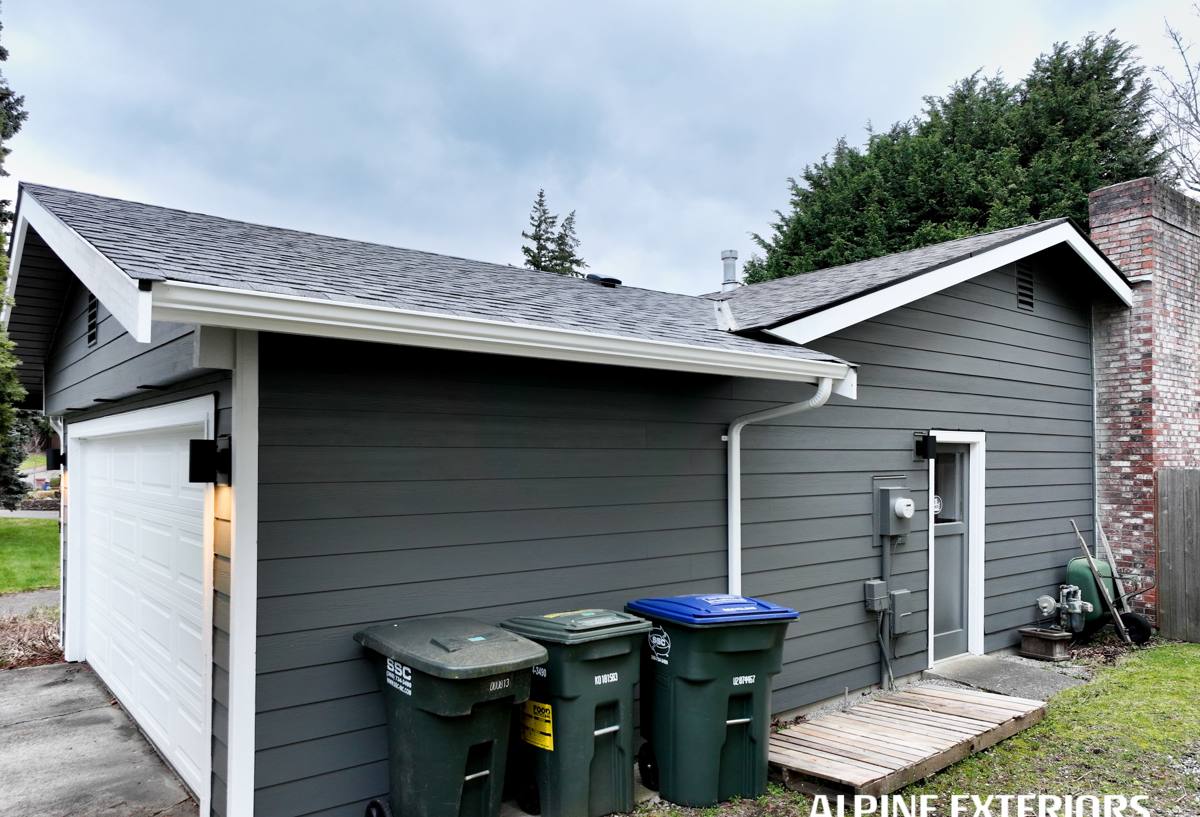
Signs Your Blaine Siding Has Reached the End of Its Life
Because coastal exposure works slowly, a lot of Blaine homeowners live with failing siding for years before the damage becomes obvious. Watch for:
- Soft or spongy spots when you press on the siding, especially near the bottom courses and around window and door trim
- Paint that keeps failing within a year or two of repainting, no matter how good the prep work was
- Persistent moss or algae staining on north- and west-facing walls that returns within months of cleaning
- Visible corrosion streaks below nail heads or metal trim — a telltale sign of salt-air exposure on the wrong fastener or material
- Warping, cupping, or delamination at panel edges and seams
- Rising interior humidity, musty smells near exterior walls, or unexplained drywall staining, which often point to moisture already inside the wall assembly
Any one of these on its own might be a minor repair. Several together usually mean the siding system as a whole — not just the visible surface — has been compromised.
Why We Standardized on James Hardie Fiber Cement
We install James Hardie fiber cement siding exclusively. We don't install vinyl, LP SmartSide, Cemplank, Allura, primed spruce, or cedar, and in a place like Blaine that's not a marketing preference — it's a decision made against the specific climate this town sits in.
Fiber cement is non-combustible and dimensionally stable, meaning it doesn't expand and contract with moisture the way wood-based products do, and it doesn't soften or degrade when it stays damp for extended periods the way some engineered wood products can. James Hardie's ColorPlus factory finish is baked on under controlled conditions rather than field-painted, which matters enormously in a moss-and-salt environment where field-applied paint has to fight algae growth and salt residue from day one. Hardie also builds climate-specific HZ product lines engineered for exactly the kind of wet, coastal exposure Blaine gets — that's a level of product-to-climate matching that generic siding options don't offer.
We're not going to tell you every other product on the market is junk — vinyl, LP, and cedar all have legitimate uses and loyal customers elsewhere. But for homes that sit this close to salt water and get this much sustained wet weather, we've made the call that fiber cement is the only material we're willing to put our name behind, and it's the only one we install.
What a Correct Siding Replacement Actually Involves
Replacing siding on a Blaine home isn't just pulling off old panels and nailing up new ones. Done right, it's a full building-envelope job:
Tear-off and inspection
Once the old siding is off, we inspect the sheathing underneath for rot, soft spots, or prior water damage — this is often the first time anyone has actually seen the condition of the wall behind the siding. Any compromised sheathing gets replaced before anything new goes up.
Weather-resistive barrier and flashing
A new, continuous weather-resistive barrier goes over the sheathing, with special attention to window and door flashing, kick-out flashing at roof-wall intersections, and any penetrations for vents or fixtures. In a driving-rain climate like Blaine's, flashing detail is usually the difference between siding that lasts decades and siding that leaks within a few years — it's also the step that's easiest to rush and hardest to inspect once the siding is on.
Rainscreen or drainage plane
Where appropriate, we build in a drainage gap behind the siding so any moisture that does get past the outer surface can drain and dry rather than sitting against the wall — important given how long Blaine's wet season runs.
Installation to manufacturer spec
James Hardie siding has specific fastening patterns, clearances, and caulking requirements. Installing it correctly is what preserves the warranty and what actually delivers the performance the product is engineered for — installed wrong, even the best material won't perform the way it's supposed to.
Our Process, Start to Finish
We keep the process straightforward and predictable, because a siding replacement disrupts your home enough without added surprises:
- On-site assessment — we walk the exterior with you, check for moisture damage, and talk through what we're seeing before any work is scheduled
- Written estimate — a clear scope and price, with the product lines and colors specified
- Prep and protection — landscaping, walkways, and windows get protected before tear-off begins
- Tear-off and sheathing repair — old siding comes off, and any damaged sheathing is addressed and documented
- Weather barrier and flashing — the envelope gets rebuilt correctly before anything new goes up
- Hardie installation — installed to manufacturer spec, with attention to fastening, clearances, and joint sealing
- Final walkthrough and cleanup — we review the finished work with you and clear the site fully
Comparing Siding Options for a Coastal Blaine Property
| Factor | James Hardie Fiber Cement | Vinyl | Wood (Cedar) or Primed Spruce |
|---|---|---|---|
| Salt air resistance | Non-combustible, dimensionally stable, factory finish holds up well | Can become brittle and discolor with prolonged UV and salt exposure | Absorbs moisture and salt residue; finish needs frequent renewal |
| Moisture behavior | Resists moisture-driven warping when installed with proper drainage | Doesn't rot, but seams and fasteners are vulnerable to wind-driven rain | Prone to swelling, cupping, and rot in sustained wet conditions |
| Moss and algae | Factory finish resists staining better than field-applied paint | Can host algae in shaded, damp areas | Porous surface is highly susceptible to moss and mildew growth |
| Maintenance | Occasional washing; repainting intervals are long | Low, but cracks and fades over time; hard to patch invisibly | Regular repainting or resealing required, especially on wet-side walls |
| Fire resistance | Non-combustible | Melts/deforms under heat | Combustible |
This isn't a knock on any of these alternatives in the right setting — it's simply why, for a coastal Blaine exterior, we've settled on fiber cement as the only product we're willing to stand behind.
What Drives the Cost of a Blaine Siding Replacement
Every home is different, but the same handful of factors drive most of the price variation we see on Blaine projects:
| Factor | Why It Matters |
|---|---|
| Sheathing condition | Hidden rot found during tear-off adds repair scope that can't be priced sight-unseen |
| Home size and wall complexity | Dormers, multiple gables, and cut-up wall planes take more labor and material than simple rectangular walls |
| Siding profile and trim detail | Lap width, board-and-batten accents, and trim complexity all affect material and labor cost |
| Existing siding removal | Multiple layers of old siding or asbestos-era materials add disposal and labor time |
| Flashing and drainage upgrades | Bringing an older wall assembly up to a proper drainage standard is worth the investment on a coastal property |
We give you a firm written number after the on-site assessment, not a ballpark over the phone — too much of the real cost depends on what's actually behind your existing siding.
Why It Matters That We Already Work in Blaine
A crew that only occasionally works this far north in Whatcom County has to relearn the local conditions on your dime. A crew that regularly works Blaine already knows how much more aggressively salt air and moss build up here compared to homes even a few miles inland, already accounts for the wind-driven rain patterns off the strait when planning flashing and sequencing, and has seen firsthand how different siding products actually hold up on this stretch of coastline over time — not in a brochure, but on real houses. That local pattern recognition shows up in small decisions throughout the job: how tight the flashing laps need to be, where extra sealant attention pays off, which walls need the most moss-resistant detailing. None of it replaces a proper installation, but it means fewer surprises and fewer callbacks.
If your Blaine home's siding is showing its age, we'll walk the exterior with you, give you a straight assessment of what's actually going on, and put together a clear, no-pressure estimate for a James Hardie replacement built for this coastline. Fill out the form below to schedule a free estimate.