 Ferndale
 Why Birch Bay Roofs Wear Differently Than Roofs Inland
Birch Bay sits right on the water, and that location changes what a roof has to deal with year after year. A roof on a shaded, tree-lined lot a few miles inland ages differently than one facing open water in a bay-front community exposed to salt air, wind, and near-constant winter moisture. When we install a new roof in Birch Bay, we're not just putting shingles on a house — we're building an assembly that has to hold up against conditions that are genuinely harder on roofing materials than what most of Whatcom County sees.
Salt Air and Exposed Metal
Salt-laden air off the bay speeds up corrosion on anything metal that isn't rated for it — nail heads, flashing, vent caps, and gutter hardware all take more abuse here than they would a few miles inland. A roof that looks fine on the outside can have fasteners or flashing quietly corroding underneath, and once flashing fails, water finds its way in. This is one of the biggest reasons material selection and fastener choice matter more in Birch Bay than in a lot of other Whatcom County neighborhoods.
Wind-Driven Rain, Not Just Rain
Open water means open wind. Rain in Birch Bay doesn't always fall straight down — it gets pushed sideways and can drive up under shingle laps and around penetrations that would stay dry in a calmer setting. That kind of wind-driven rain is exactly what proper underlayment, ice-and-water barrier placement, and flashing detail are designed to stop, and it's exactly where a rushed or generic installation tends to fail first.
A Long Moss Season
Whatcom County's mild, wet winters and heavy tree cover on many residential lots add up to a moss season that can stretch for the better part of the year. Moss isn't just cosmetic — it holds moisture directly against the roofing material, works its way under shingle edges, and can lift tabs enough to let water underneath. A new roof installed without moss-resistant details or products is starting its clock already behind.
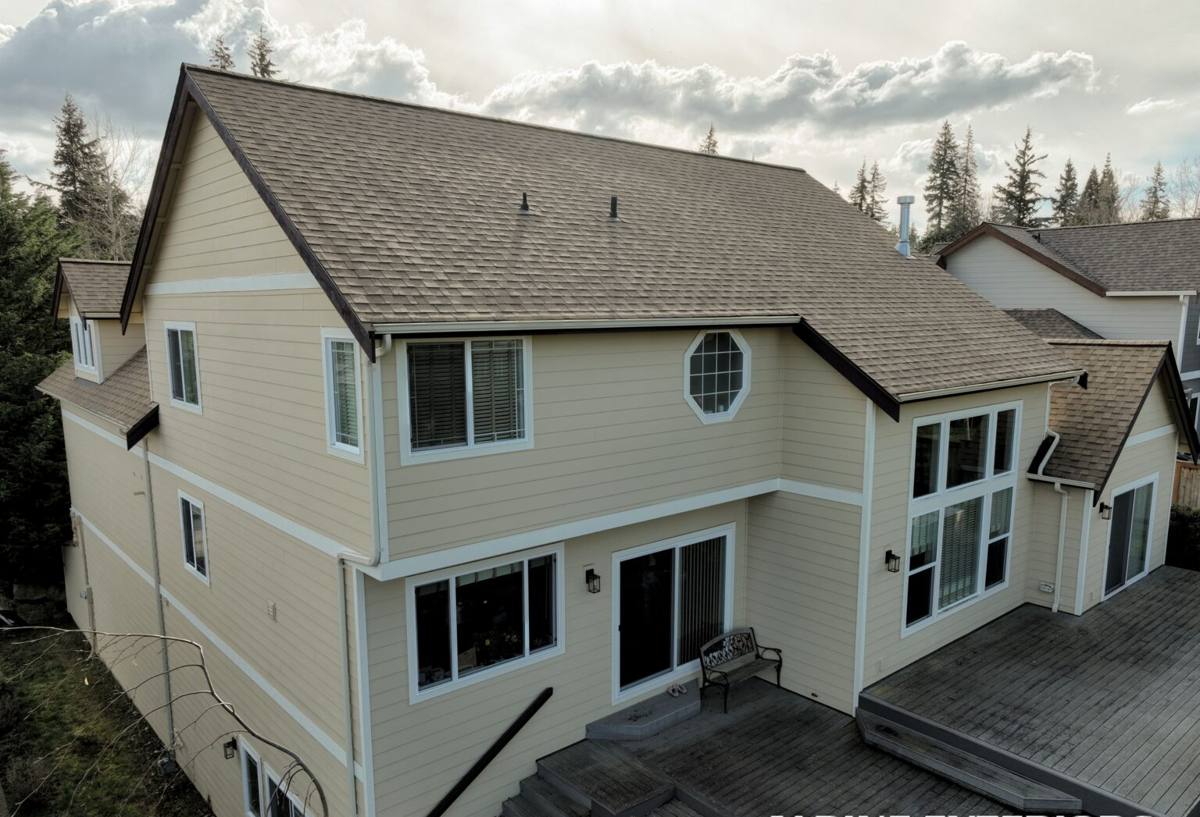
What a Correctly Installed New Roof Actually Includes
"New roof" covers a lot of ground, and the difference between a roof that lasts and one that causes problems in five years usually comes down to what's happening underneath the visible shingles, not the shingles themselves.
Full Tear-Off and Deck Inspection
We remove the old roofing down to the deck rather than layering over it. That lets us actually see the plywood or OSB sheathing underneath — check for soft spots, delamination, or water staining from old leaks — and replace only what's damaged. Skipping this step is how new roofs end up installed over rotten decking that was never visible from the top.
Underlayment and Ice-and-Water Barrier
A synthetic underlayment goes down across the whole deck as the roof's real waterproofing layer, with self-adhering ice-and-water shield reinforcing the spots that take the most abuse — eaves, valleys, and around chimneys or skylights. Given how much wind-driven rain Birch Bay sees, we don't treat this as optional extra protection; it's a standard part of a correct installation here.
Flashing at Every Penetration and Transition
Vent pipes, chimneys, skylights, wall transitions, and valleys are where roofs actually leak — flat shingle field rarely fails on its own. Correctly formed and properly lapped metal flashing at every one of these points, installed so water sheds over each layer instead of into it, is non-negotiable in a climate that pushes rain sideways.
Balanced Attic Ventilation
Intake at the eaves and exhaust at the ridge keep air moving through the attic, which controls moisture buildup, helps prevent ice damming in cold snaps, and extends the life of the roofing material from underneath. In a humid marine climate, poor ventilation shows up as trapped moisture, mold on sheathing, and premature shingle aging — problems that are cheap to prevent and expensive to fix later.
Choosing a Roofing Material for a Marine Environment
There's no single "best" roofing material — the right choice depends on budget, how long you plan to stay in the home, and how much maintenance you're willing to do. For Birch Bay specifically, corrosion resistance and moss performance carry more weight than they would inland.
| Material | Salt Air / Corrosion Resistance | Moss Resistance | Typical Lifespan | Relative Upfront Cost |
|---|---|---|---|---|
| Architectural asphalt shingle | Good, with corrosion-resistant fasteners and flashing | Fair to good with algae/moss-resistant granules | 25-35 years | Lowest |
| Standing seam metal | Excellent with coastal-rated coatings and fasteners | Excellent — sheds moss, little to grip onto | 40-60+ years | Highest |
| Synthetic/composite shingle | Very good | Good to very good | 30-50 years | Mid to high |
We don't push one material on every homeowner. Our job is to lay out how each option actually performs under Birch Bay's conditions — including the maintenance each one asks of you over time — so you can weigh cost against how much upkeep you want to sign up for.
Signs Your Roof Needs Replacement, Not Another Repair
Not every roof problem calls for a full replacement, and we'll tell you honestly when a repair is the right call. But certain signs point to a roof that's past the point where patching makes sense — especially on a home taking the kind of weather Birch Bay gets.
- Granule loss heavy enough that shingles look bare or patchy in spots, especially on slopes facing the water
- Shingles that are curling, cupping, or cracking across multiple areas of the roof, not just one isolated section
- Moss or algae growth that keeps coming back within a season or two of cleaning
- Soft or spongy spots underfoot when walking the roof, which usually means deck damage underneath
- Daylight visible through the roof deck from inside the attic, or staining on attic sheathing
- Flashing that's visibly rusted, lifted, or separating from chimneys, vents, or wall transitions
- A roof that's approaching or past the expected lifespan of its material, especially if it was never fully torn off and replaced
- Repeated leaks in different spots after previous patch repairs
How Our New Roof Installation Process Works
We keep the process straightforward and try to remove the guesswork for homeowners who haven't been through a full roof replacement before.
- On-site inspection and estimate. We walk the roof, check the attic where accessible, and give you an honest read on condition and options — not just a number.
- Material and detail selection. We go over material choice, color, and any climate-specific upgrades like enhanced ice-and-water coverage or corrosion-resistant hardware, based on your home's exposure.
- Scheduling and site protection. Landscaping, siding, and outdoor living spaces get covered or protected before tear-off starts.
- Tear-off and deck inspection. Old roofing comes off, the deck gets inspected, and any damaged sheathing is replaced before anything new goes down.
- Installation. Underlayment, ice-and-water barrier, flashing, and the roofing material go on in that order, with attention to every penetration and transition.
- Cleanup and magnetic nail sweep. The property gets cleared of debris and swept for stray fasteners before we consider the job finished.
- Final walkthrough and paperwork. We walk the finished roof with you, answer questions, and hand over warranty documentation.
Permits and Building Requirements in Whatcom County
A full re-roof typically requires a permit through the applicable local building department, and inspections are part of a properly completed job — that's true whether you're in Ferndale proper, unincorporated Whatcom County, or a bay-front community like Birch Bay. Permitted work also means the installation gets checked against current code, which matters for things like ventilation requirements and ice-and-water barrier coverage in coastal, wind-exposed areas. We handle the permitting process as part of the job rather than leaving it for the homeowner to sort out.
Protecting Your New Roof After Installation
A correctly installed roof still benefits from basic upkeep, and in Birch Bay that upkeep looks a little different than it would inland.
Staying Ahead of Moss
Given how long the moss season runs here, periodic gentle moss treatment and removal — done in a way that doesn't damage granules or shingle edges — goes a long way toward protecting the investment you just made. Trimming back overhanging branches also helps by letting more sun and airflow reach shaded roof sections.
Gutter and Drainage Maintenance
Wind-driven rain moves a lot of water fast, and gutters clogged with needles or debris can send that water where it shouldn't go, including up under roof edges. Keeping gutters clear, especially heading into fall and winter storms, protects both the roof and the fascia behind it.
Periodic Inspections
An occasional check of flashing, seals, and fastener condition — particularly after a hard storm off the water — catches small problems while they're still small. This matters more in a salt-air environment where corrosion can progress quietly on metal components that look fine from the ground.
Why Local Experience in Birch Bay Matters
A roofing crew that works Birch Bay regularly already knows which slopes take the worst of the wind off the water, which lots hold onto moss longest because of tree cover, and which fastener and flashing choices actually hold up here versus in a drier, calmer part of the county. That's not something you get from a crew that mostly works inland and treats every job the same way. We're a Ferndale-based crew that works this stretch of Whatcom County regularly, and we bring that knowledge into every estimate and every installation.
If you're weighing a repair against a full replacement, or you just want an honest read on where your roof stands, we're happy to take a look. Fill out the form below for a free, no-pressure estimate.